
Cost & Estimation
13 min read•Ajay Chaudhary
AI Development Cost in 2026: A Practical Pricing Guide
Read Analysis
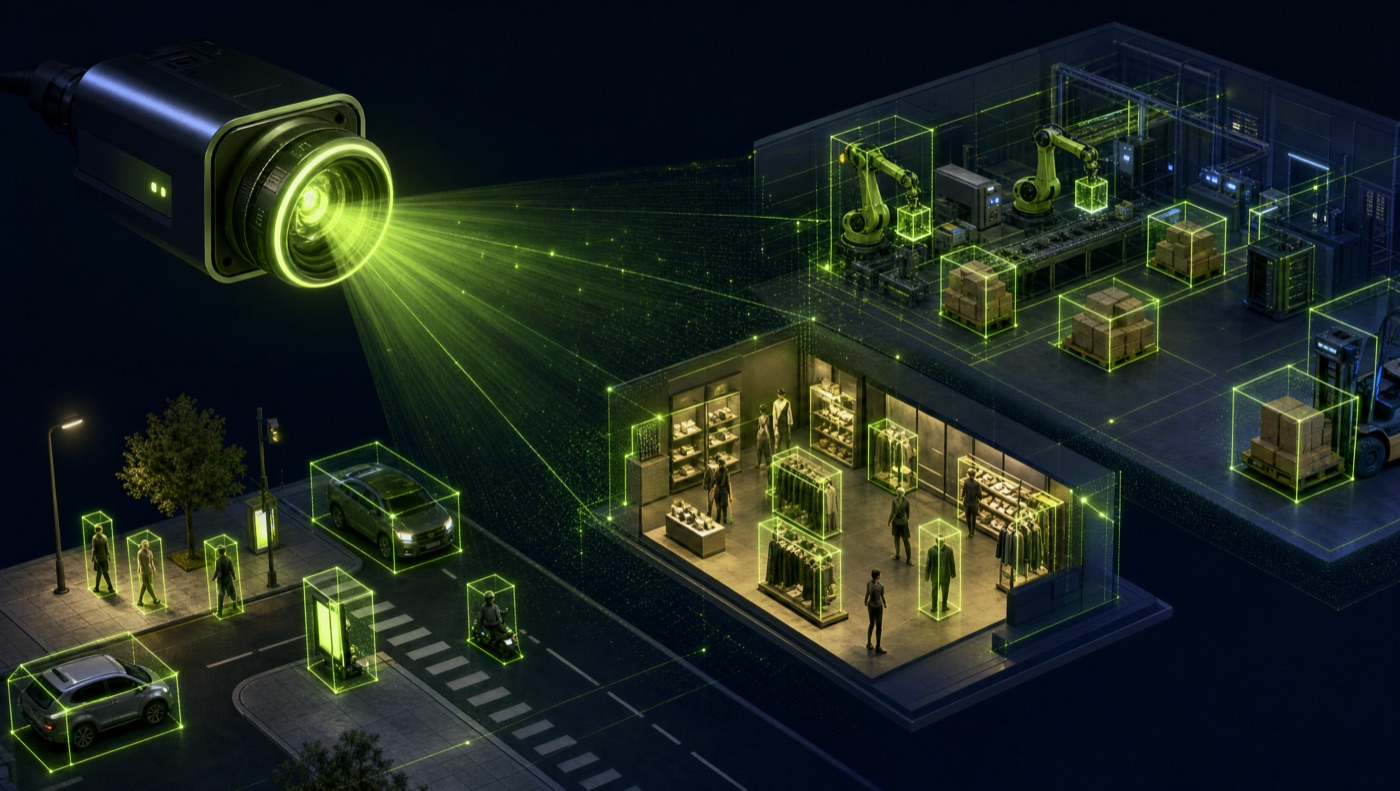
We design, train, and deploy custom computer vision systems, from object detection and OCR to facial recognition and quality inspection, engineered for real-world accuracy at production scale.
Our Clients
From ambitious startups to global enterprises, we build technology that moves businesses forward.


Computer Vision Expertise
Quick answer: computer vision means training a model to read a photo or video feed the way a person would, spotting a defect, reading a document, or recognising a face, without a human reviewing every frame. Our engineers work with clients across United States, United Kingdom, Australia, United Arab Emirates, Canada, and India, including AI development services in California and AI development company in Melbourne.
Deep understanding of visual content at scale: classification, scene understanding, and content moderation.
Real-time detection and tracking of objects, vehicles, and assets across live camera feeds, wired into your systems through our AI integration services team.
Privacy-conscious facial recognition and verification systems built with consent and compliance in mind, reviewed against your industry's specific requirements.
Optical and intelligent character recognition for automating document and form processing.
Depth estimation, spatial mapping, and 3D scene reconstruction for robotics and industrial automation.
Enhancement, restoration, and generative editing pipelines built on modern vision-AI architectures, the same approach behind our generative AI development services.
Explore real products where a trained vision model, not a manual review step, does the recognising.
Generative Portrait & Avatar Vision Pipeline
Built the image-generation pipeline behind an app that turns a handful of selfies into professional-quality portraits and avatars across thousands of styles.
Species Identification & Image Classification
Built the image-classification model behind an AI-assisted hunting and fishing companion app that helps outdoor enthusiasts identify species from a photo.
Every vision system is engineered with encrypted data handling and audit-ready compliance from day one.
Our vision engineers hold hands-on production deployment experience, not just academic research credentials.
No off-the-shelf templates: every model is trained and tuned for your specific visual recognition problem.
Systems architected to scale from a single pilot camera to thousands of concurrent video streams.
Client Video Stories & Reviews
"The AI-powered fitness platform Apptechies developed integrates personalized workout plans, nutrition tracking, and real-time progress monitoring in one beautiful app. Their technical execution has been exceptional."
"Apptechies has been a reliable engineering partner on our link-management platform, working across web, iOS, and Android with a level of scalability and reliability that’s simply phenomenal. They are world-class engineers."
“Apptechies has been a reliable engineering partner on our link-management platform, working across web, iOS, and Android with a level of scalability and reliability that’s simply phenomenal. They are world-class engineers.”
“The MSK performance platform Apptechies built has changed how our clinicians track patient outcomes. The data-driven insights have significantly improved rehabilitation decisions, and the team understood our clinical domain deeply from day one.”
“Movesy has completely transformed the moving and delivery industry thanks to Apptechies. The GPS tracking, dynamic pricing, and route optimisation they built has made our operations incredibly efficient.”




Tools & Platforms We Work With
Technology Ecosystem


We assess your visual data sources, business goals, and technical constraints to scope the right vision solution.
Detailed technical planning covering model architecture, data requirements, and deployment infrastructure.
Curating and annotating training datasets with rigorous quality control before any model training begins.
Designing the interfaces and dashboards through which your team will interact with vision system outputs.
Building and training the vision model alongside the surrounding application and integration layer.
Rigorous accuracy, edge-case, and adversarial testing before any model reaches production traffic.
Phased production deployment with monitoring in place from the very first live camera feed or image upload.
Ongoing retraining and drift monitoring that keeps vision accuracy high as real-world conditions change.
Technical write-ups, model benchmarks, and production lessons learned from deploying computer vision models at scale.
Discover our full spectrum of specialized AI service lines — from foundational strategy and custom model training to intelligent autonomous agents.
Common questions about working with our computer vision engineering team. Can't find yours? Ask us directly.
It covers image or video data assessment, model selection and training, integration into your existing cameras or systems, accuracy and bias testing, and production deployment with monitoring. Most clients start with whichever visual recognition problem is costing them the most manual review time.
Computer vision automates visual inspection, quality control, and monitoring tasks that would otherwise require manual review, cutting inspection time and catching issues human reviewers miss due to fatigue.
The main cost drivers are how much labelled image or video data you already have, whether the model needs to run on-device or in the cloud, and how many systems it needs to integrate with. A focused proof-of-concept typically takes 6-10 weeks; enterprise-scale deployment with edge infrastructure and full integration usually takes 14-20 weeks. We scope cost after a discovery assessment rather than quoting blind.
We start with strategic discovery, then project planning, then data analysis and preprocessing, then interface design, then end-to-end model and application development, then testing and validation, then production rollout, and finally continuous maintenance. Each stage is a real deliverable you review before the next one starts.
Yes. We train models on your specific visual data, whether that's manufacturing defects, medical images, retail shelf photos, or logistics documentation, rather than relying on generic pretrained models.
A cloud vision API is usually faster and cheaper when your recognition task is generic, like reading standard text or detecting common objects. Custom model development earns its cost once you need accuracy on your own visual data, a specific defect type, a proprietary product catalogue, that a generic API was never trained to recognise.
It depends on latency and connectivity requirements. Edge deployment (on-device or on-site hardware) fits use cases needing real-time results without a network round trip, like a factory floor camera. Cloud processing fits use cases where volume and model complexity matter more than millisecond latency. We size this decision against your actual infrastructure, not a default answer.
We validate every model against held-out test data and real-world edge cases, run adversarial robustness testing, and build continuous monitoring so accuracy is tracked, not assumed, once the system is live.
Yes. Our AI integration services team builds connections to ERP, CRM, IoT camera networks, mobile apps, and cloud platforms, so vision model outputs flow directly into the workflows your team already uses.
Yes. We regularly conduct vision system audits and take over in-flight projects, providing an architecture review and remediation plan before continuing development.
We design every vision system against GDPR, HIPAA, and sector-specific requirements from the architecture phase, including data retention policies, consent handling for facial recognition, and full audit trails.
Yes. If you would rather embed engineers into your own team than commission a fixed-scope build, you can hire dedicated AI developers who work under your direction on your existing roadmap and stack.
Absolutely. Full IP assignment is standard on every engagement. You own the code, trained models, datasets, and all associated documentation outright once the engagement is complete.
Real-world conditions like lighting, camera angles, and product changes shift over time, so we build drift detection and retraining pipelines into every production system, and offer ongoing monitoring retainers to keep accuracy high after launch.
We work with clients across United States, United Kingdom, Australia, United Arab Emirates, Canada, and India, from early-stage startups through enterprise teams. Engagement scope is shaped by the project itself, not by where you are based.
Book a free consultation with our senior computer vision engineers.