Category: Tech Stack | Apptechies

  • Best Programming Languages for Web Development in 2026

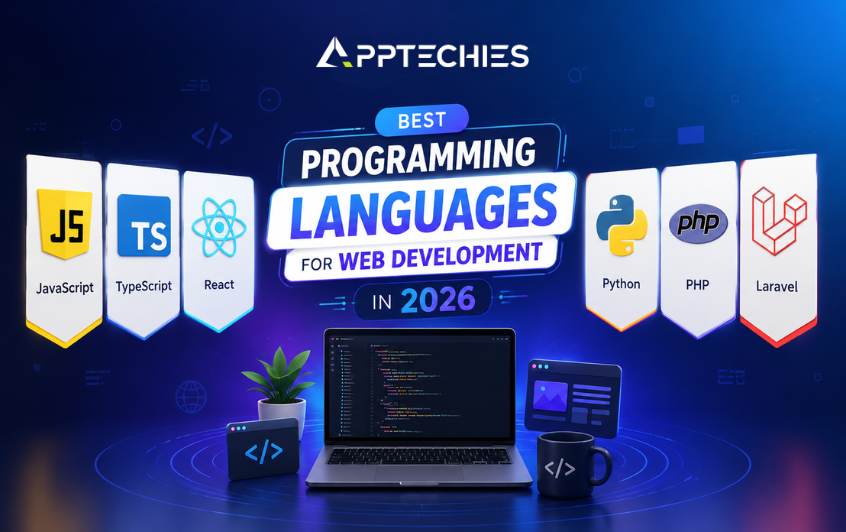
    Best Programming Languages for Web Development in 2026

    Picking the wrong programming language for a web project is one of the most expensive mistakes a business can make. It slows development. It raises hiring costs. It creates technical debt that can take years to untangle.

    The global web development market is expected to exceed $89 billion by 2027. Every business, from a two-person startup to a Fortune 500 company, needs a web presence. And behind every great website is a language choice that either helps or hurts the team building it.

    Here is the reality: there is no single best language for every project. JavaScript powers the world’s most visited sites. Python runs the backend of some of the smartest applications. PHP still serves over 77% of all websites. Java handles millions of daily banking transactions without breaking a sweat.

    What matters is matching the language to your goals. That means thinking about:

    • Development Speed: How fast can your team ship features?
    • Scalability: Can the codebase handle 10x growth?
    • Security: How well does the language protect user data?
    • Hiring: How easy is it to find skilled developers?
    • Cost: What does long-term maintenance actually look like?
    • AI Compatibility: Does the language support modern AI tooling?

    This guide covers all of it. Whether you are a business owner evaluating a technology partner, a startup founder scoping your MVP, or a developer wanting to sharpen your stack knowledge, this is built for you.

    At Apptechies, we have built web applications across dozens of industries using multiple languages and frameworks. This guide reflects what we have seen work and what we have seen fail.

    What is a Web Development Programming Language?

    A programming language is a formal set of instructions that tells computers what to do. In web development, these languages control everything you see on a website: the layout, the buttons, the data, the logic behind login systems, checkout flows, and search results.

    There are two environments where web languages operate:

    Client-side (frontend): Code that runs inside the user’s browser. It determines what you see and engage with.. HTML structures the content. CSS styles it. JavaScript makes it move and respond.

    Server-Side (backend): Code that runs on a server. It handles databases, user authentication, business logic, and data processing before sending results to the browser.

    Real World Examples

    Netflix uses Node.js on the backend for its streaming engine and React on the frontend for the user interface.

    Amazon uses Java and C++ for its core infrastructure and React for the customer-facing web experience.

    Facebook (Meta) built its own PHP framework (Hack) and React, a JavaScript library now used by millions of developers worldwide.

    Airbnb relies on Ruby on Rails for its backend and React for the frontend, handling millions of bookings daily.

    Understanding this distinction helps you make better decisions when choosing your tech stack.

    Frontend vs Backend vs Full-Stack Development

    Before choosing a language, you need to understand where it fits in the development ecosystem.

    Frontend development focuses on user experience. Every pixel, animation, and button click is driven by frontend code. Backend development is the engine underneath, invisible to users but critical to everything working correctly.
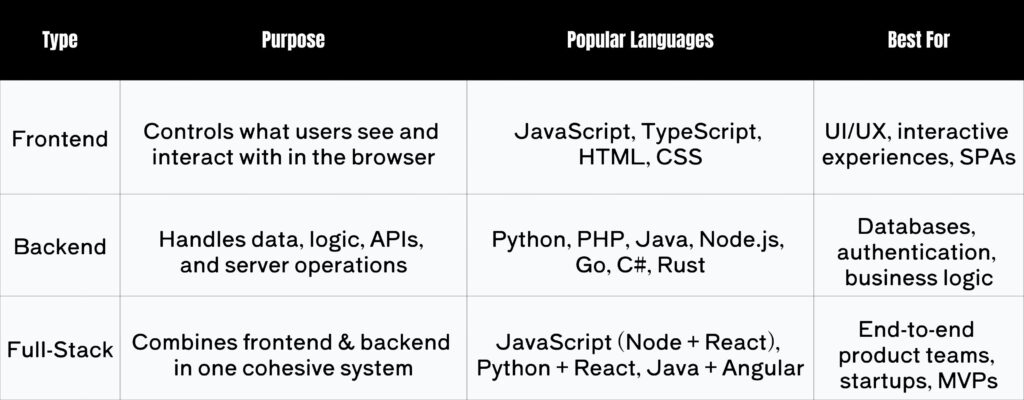
    Frontend vs Backend vs Full-Stack Development

    Businesses building complete digital solutions often partner with teams that handle both layers. Our web development services cover the full stack, from pixel-perfect interfaces to robust backend architecture.

    How to Choose the Best Programming Language for Web Development

    No language wins every category. The best option depends on your specific circumstances. Here is the decision-making framework we use at Apptechies when advising clients.

    Business Goals

    • Startups: Speed matters. Choose JavaScript (MERN stack) or Python. Both have large talent pools and fast development cycles.
    • Enterprise: Stability and security matter most. Java, C#, and Python have scaled successfully.
    • SaaS Platforms: Scalability is the priority. Node.js, Go, or Python with React on the frontend handle rapid user growth well.
    • Marketplaces: Complex logic and real-time features need proven stacks like MERN or Python + Django.

    Scalability

    Some languages handle 1,000 concurrent users easily. Others handle 10 million. Go and Java are built for extreme scale. PHP and Ruby work well at medium scale with proper architecture. Node.js scales horizontally with minimal cost.

    Budget

    PHP and Python developers are generally more affordable to hire. Java and .NET specialists command higher salaries. Open-source frameworks (Django, Laravel, React) reduce licensing costs significantly compared to proprietary solutions.

    Security

    All major languages offer strong security when used correctly. Java and .NET have mature enterprise-grade security features. Python has extensive libraries for encryption and secure coding. Rust is gaining traction for security-critical systems due to its memory-safe design.

    Hiring Availability

    JavaScript developers are the most available globally. Python is close behind. Java has a large talent pool concentrated in enterprise sectors. Go and Rust are newer — fewer developers, but growing fast.

    AI Compatibility

    If your product roadmap includes AI features, Python is the dominant choice. Its ecosystem — TensorFlow, PyTorch, scikit-learn — is unmatched. JavaScript also has AI libraries, but they are less mature for production AI workloads.

    Top Frontend Programming Languages

    JavaScript

    The only programming language that is compatible with all web browsers is JavaScript. It is the foundation of frontend web development. Nothing else comes close in terms of ecosystem size and adoption.

    Advantages

    • Runs in every browser — no installation required for end users
    • More than two million npm packages make up this vast ecosystem.
    • Huge developer community — easiest language to hire for
    • Handles both frontend and backend (via Node.js)
    • Real-time features like live chat and notifications are straightforward

    Disadvantages

    • Dynamic typing can lead to bugs in large codebases
    • Inconsistent browser behavior requires testing across environments
    • Security vulnerabilities if developers are not careful (XSS, injection attacks)

    Top Frameworks

    • React: Component-based UI library by Meta. Used by Facebook, Instagram, Airbnb, Netflix.
    • Vue.js: Lightweight and beginner-friendly. Popular for smaller teams.
    • Angular: Full-featured framework by Google. Preferred for large enterprise applications.

    Best Use Cases

    • Single-page applications (SPAs)
    • Real-time dashboards and web apps
    • Progressive Web Apps (PWAs)
    • Full-stack development with Node.js

    TypeScript

    TypeScript is JavaScript with types. It adds static type-checking to catch errors before they reach production. Microsoft built it, and it has become the default choice for serious JavaScript projects.

    Why Enterprises Prefer TypeScript:

    • Catches errors at compile time, not at runtime — fewer bugs in production
    • Better tooling and code editor support (autocomplete, refactoring)
    • Scales better in large teams where multiple developers touch the same codebase
    • Seamlessly integrates with React — most new React projects are TypeScript-first

    Stack Overflow’s 2024 developer survey ranked TypeScript as one of the most loved and most used languages for the fourth consecutive year. Its adoption is only accelerating in 2026.

    HTML & CSS

    HTML and CSS are not traditional programming languages but they are the foundation of every website on the internet. HTML provides structure. CSS provides style.

    No matter which JavaScript framework or backend language you use, the output eventually becomes HTML and CSS that browsers render. Understanding both is non-negotiable for any frontend developer.

    CSS has evolved significantly. Modern CSS features like Grid, Flexbox, and Custom Properties allow developers to build complex layouts without heavy JavaScript. CSS frameworks like Tailwind CSS have changed how teams approach styling at scale.

    Responsive web design, built with HTML, CSS, and JavaScript, is the foundation for consistent experiences across devices. A specialized mobile app is another way that many companies expand this. Our mobile app development services help teams build cohesive digital experiences across web and mobile.

    Top Backend Programming Languages

    Python

    Python is the most versatile backend language available today. It reads almost like plain English, which makes it fast to write and easy to maintain. But its real superpower is its ecosystem.

    Key Frameworks

    • Django: A full-featured framework that handles authentication, ORM, admin panels, and more out of the box. Used by Instagram, Pinterest, and Disqus.
    • Flask: A lightweight micro-framework for teams that want more control and less abstraction. Popular for APIs and microservices.
    • FastAPI: A contemporary, quick framework for creating APIs is called FastAPI. Growing rapidly in 2025-2026 for its performance and automatic documentation.

    Advantages

    • Fastest development speed for most web applications
    • Dominant in data science, machine learning, and AI integration
    • Large library of third-party packages (PyPI has over 500,000 packages)
    • Clean syntax reduces bugs and improves code readability

    Disadvantages

    • Slower raw performance compared to Go, Java, or C++
    • Not ideal for CPU-intensive tasks without optimization
    • The Global Interpreter Lock (GIL) may be a multi-threading bottleneck.

    Python is the language of choice for teams building AI-powered web applications. Its integration with machine learning frameworks is unmatched. If your product roadmap includes intelligent features, explore our AI development services to see how we help businesses build smarter systems.

    PHP

    PHP powers over 77% of all websites on the internet — including WordPress, which alone runs about 43% of the web. It is mature, widely supported, and extremely cost-effective to deploy and maintain.

    Key Frameworks & Platforms

    • Laravel: Modern PHP framework with elegant syntax, built-in authentication, and a rich ecosystem. A top choice for custom web applications in 2026.
    • WordPress: The world’s most popular CMS. Ideal for blogs, business sites, and content-heavy platforms.
    • Symfony: Enterprise-grade PHP framework used by large organizations needing robust, modular architecture.

    Best For

    • Content-heavy websites and blogs
    • e-commerce platforms (WooCommerce, Magento)
    • Cost-effective custom web applications
    • Teams with existing PHP expertise

    Java

    Java is one of the oldest and most reliable programming languages in existence. It has been the backbone of enterprise software for over 25 years. Although it is not the most preferred option in 2026, nothing compares to it for the proper projects.

    Key Frameworks

    • Spring Boot: The dominant Java web framework for building enterprise-grade APIs and microservices.
    • Hibernate: ORM framework for database operations, widely used in Java enterprise apps.

    Best For

    • Banking and fintech applications requiring high reliability
    • Large enterprise systems with long maintenance cycles
    • Android mobile backends
    • High-traffic applications needing horizontal scalability

    C# and .NET

    C# is Microsoft’s flagship programming language. Combined with the .NET ecosystem, it is a top choice for businesses already invested in Microsoft infrastructure — Azure, Windows Server, and Office 365.

    • Excellent performance — comparable to Java for most enterprise workloads
    • Strong typing and mature tooling with Visual Studio
    • Azure cloud integration is seamless
    • ASP.NET Core is a fast, modern web framework for APIs and web apps
    • Popular in gaming (Unity), desktop software, and enterprise web development

    Go (Golang)

    Go was built by Google to solve real-world problems: fast compilation, efficient execution, and simple concurrency. It has become the language of choice for teams building high-performance microservices and APIs.

    • Compiles to a single binary — simple to deploy anywhere
    • Built-in concurrency makes handling thousands of simultaneous requests straightforward
    • Fast execution speed — significantly faster than Python and PHP
    • Used by Google, Uber, Dropbox, Docker, and Kubernetes
    • Best for microservices, API gateways, and real-time systems

    Rust

    Rust is the most exciting systems language of the decade. It offers C++-level performance with a memory safety model that eliminates entire categories of bugs — null pointer errors, buffer overflows, and data races.

    • Ranked the most loved language in Stack Overflow’s survey for 9 consecutive years
    • Growing adoption in WebAssembly, embedded systems, and security-critical infrastructure
    • Mozilla, Microsoft, Amazon, and the Linux kernel have all adopted Rust
    • Steeper learning curve than most languages — not ideal for rapid MVP development
    • Best for security-critical systems, performance-intensive backends, and WebAssembly apps

    Best Full-Stack Languages and Frameworks

    Using comparable front-end and back-end technologies is known as a full-stack approach. The right combination reduces context-switching for developers and simplifies communication across the team.

    MERN Stack (MongoDB + Express + React + Node.js)

    JavaScript runs everything in MERN — frontend, backend, and database queries. This is the most popular full-stack choice for startups and modern web applications.

    Advantages

    Single language across the entire stack, massive community, fast development speed, great for real-time apps.

    Disadvantages

    JavaScript’s flexibility can become a liability in very large teams without strict TypeScript enforcement.

    Best For

    Startups, MVPs, SaaS platforms, social apps, real-time dashboards.

    MEAN Stack (MongoDB + Express + Angular + Node.js)

    Like MERN, except using Angular in place of React. Angular’s opinionated structure makes it a better fit for teams that prefer clear conventions over flexibility.

    Advantages

    TypeScript by default with Angular, strong structure for large teams.

    Disadvantages

    Compared to React, Angular has a more difficult learning curve.

    Best For

    Enterprise web applications, teams coming from Java or .NET backgrounds.

    Python + React

    Python on the backend (Django or FastAPI) paired with React on the frontend. A powerful combination for data-heavy applications, dashboards, and platforms requiring AI integration.

    Advantages

    Python’s data science ecosystem + React’s UI flexibility = a strong product stack.

    Disadvantages

    Requires separate frontend and backend expertise.

    Best For

    Data platforms, analytics dashboards, and AI-powered web apps.

    Java + Angular

    A proven enterprise combination. Java Spring Boot on the backend with Angular on the frontend. Highly structured, type-safe across the full stack, and trusted by large organizations.

    Best For

    Banking, insurance, government, and enterprise software.

    .NET + React

    C# with ASP.NET Core on the backend and React on the frontend. A top choice for businesses in the Microsoft ecosystem wanting modern, performant web applications.

    Best For

    Microsoft-centric enterprises, Azure-hosted applications, internal business tools.

    Comprehensive Language Comparison Table
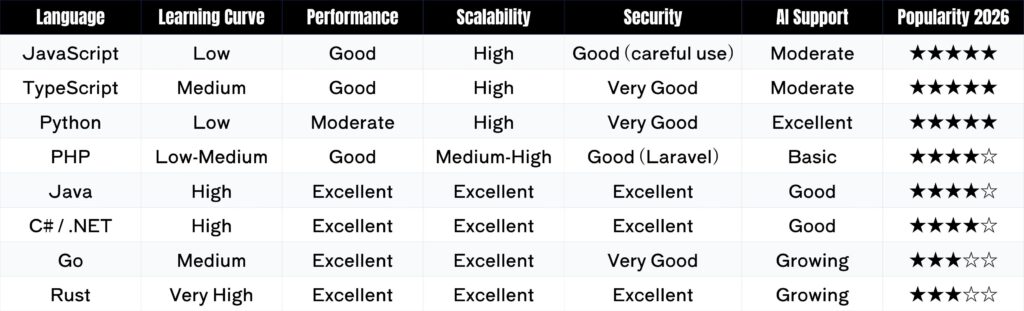
    Comprehensive Language Comparison Table

    Best Programming Languages by Project Type

    Startup Websites

    Speed to market is the priority. You need a stack your small team can move fast with, and that investors and early users will find reliable.

    Recommended Stack

    MERN (MongoDB + Express + React + Node.js) or Python + React with FastAPI

    Why

    Large talent pools, rapid development, strong open-source ecosystems, and easy to scale when traction comes.

    SaaS Platforms

    SaaS products need to handle growing user bases, recurring billing, multi-tenancy, and complex business logic.

    Recommended Stack

    Python (Django/FastAPI) + React, or Node.js + React with PostgreSQL

    Why

    Both handle complex logic and scale horizontally. Django offers built-in admin tools that accelerate internal operations management.

    eCommerce Websites

    eCommerce demands performance, security, and reliability. One second of load delay costs conversion rates.

    Recommended Stack

    PHP (Laravel/WooCommerce) for mid-market, Node.js or Java for high-traffic stores

    Why

    PHP powers the majority of e-commerce platforms. Laravel offers excellent security features for handling payments and user data.

    Enterprise Solutions

    Enterprise software requires long-term maintainability, security audits, and integration with existing infrastructure.

    Recommended Stack

    Java (Spring Boot) + Angular, or C# (.NET) + React

    Why

    Strong type systems, mature tooling, enterprise support contracts, and decades of proven stability.

    AI-Powered Applications

    Products that include machine learning models, intelligent recommendations, or natural language processing need a backend built for it.

    Recommended Stack

    Python (FastAPI or Django) + React, with TensorFlow or PyTorch for model serving

    Why

    Python’s machine learning ecosystem has no equal. Deploying models as API endpoints with FastAPI is fast and production-ready. We build AI-integrated web applications for businesses across industries. See how our AI development services can make your product smarter.

    How AI Is Transforming Web Development

    Two years ago, AI in web development meant adding a chatbot. Today, it means fundamentally changing how applications are built, tested, and personalized.

    AI Coding Assistants

    Tools like GitHub Copilot and Cursor have changed daily development workflows. Developers now write code faster, catch bugs earlier, and spend more time on architecture decisions than repetitive syntax. Studies show developers using AI coding tools complete tasks up to 55% faster in certain scenarios.

    AI-Generated and AI-Reviewed Code

    AI can now generate boilerplate code, write unit tests, review pull requests for security issues, and suggest performance improvements. This is not replacing developers — it is amplifying their output.

    AI-Powered Testing

    Manual QA is time-consuming. AI testing tools automatically generate test cases, identify regression issues, and simulate user behavior at scale. Products ship with fewer bugs and faster release cycles.

    AI Chatbots and Virtual Assistants

    Embedding large language model-powered chatbots into web applications has become standard for customer support, onboarding flows, and lead qualification. Businesses that deploy conversational experiences report measurable improvements in user engagement.

    AI Personalization Engines

    From eCommerce product recommendations to news feed curation, personalization algorithms are now accessible to mid-market companies, not just tech giants. Python-backed recommendation engines can be deployed as APIs and integrated into any web application.

    AI-Enhanced Search

    Semantic search powered by vector databases and embedding models is replacing keyword-only search. Users find what they are looking for faster. This lowers bounce rates and increases retention.
    Our AI development services help businesses integrate intelligent features into existing web applications and build new products with AI at the core.

    Development Cost Comparison by Language

    Language choice directly affects your development budget — both upfront and over time.
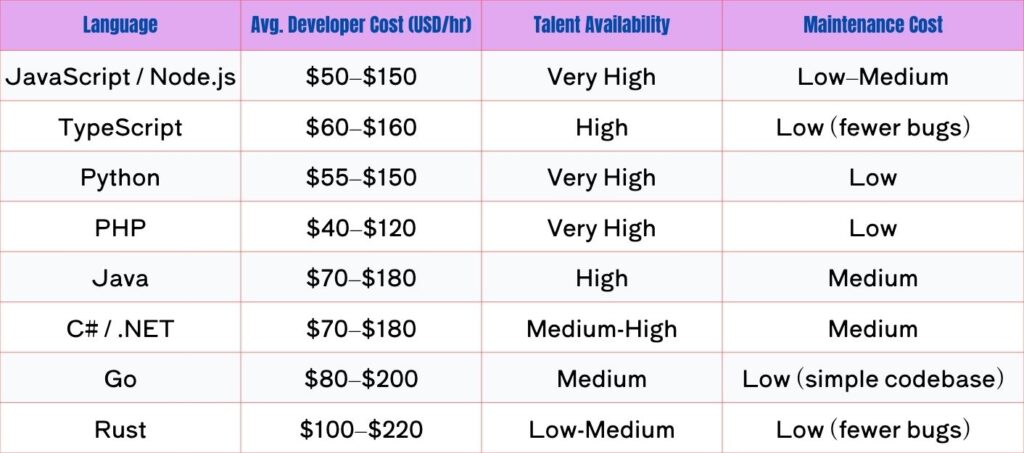
    Development Cost Comparison by Language

    Why Some Languages Cost More

    • Talent scarcity: Go and Rust developers are rarer. Scarcity drives rates higher regardless of project complexity.
    • Framework complexity: Java and .NET enterprise projects often require senior developers with deep domain knowledge.
    • Long-term maintenance: Because bugs are discovered early, strongly typed languages (such as TypeScript, Java, C#, and Rust) often have lower maintenance costs.
    • PHP and JavaScript: The largest talent pools in the world. Easier and faster to hire, which reduces project risk.

    It’s not always the case that the lowest hourly rate equals the lowest overall cost. A PHP project built by experienced developers with clean architecture can cost far less over 5 years than a Go project built by a team learning the language as they go.

    Emerging Languages and Technologies to Watch in 2026

    Rust — Security-First Performance

    Rust is moving from systems programming into web backends. Whole types of vulnerabilities are eliminated by its memory safety paradigm. The US government’s CISA has formally recommended Rust (and similar memory-safe languages) for new software projects. Expect enterprise adoption to accelerate.

    TypeScript — The Default JavaScript

    TypeScript is no longer an alternative to JavaScript, it is becoming the default. New React projects, Next.js apps, and Node.js backends are TypeScript-first. Any team still writing plain JavaScript in a large codebase will migrate.

    WebAssembly (Wasm) — Native Performance in Browsers

    WebAssembly allows languages like Rust, C++, and Go to run inside browsers at near-native speed. Video editors, CAD tools, and gaming engines are among the applications that are migrating to the browser from desktop software. Figma, Google Earth, and Autodesk CAD web tools all use WebAssembly.

    Edge Computing and Serverless

    Running backend code at the network edge, closer to users — reduces latency dramatically. Cloudflare Workers, Vercel Edge Functions, and AWS Lambda at Edge support JavaScript, TypeScript, and WebAssembly. Teams building low-latency applications are moving logic closer to users rather than centralized servers.

    Bun — JavaScript Runtime Challenger

    Bun is a new JavaScript runtime that claims to be significantly faster than Node.js in benchmarks. It is still maturing, but its performance characteristics are attracting serious attention from the JavaScript community.

    Common Mistakes Businesses Make When Choosing a Language

    Following Trends Blindly

    Rust is impressive. Go is fast. But if your team knows Python and your project is a standard web application, rewriting in Rust because it is trendy adds risk and cost with minimal benefit.

    Ignoring Scalability Until It Is Too Late

    A language that works perfectly at 1,000 users may struggle at 100,000. Plan for scale upfront, it is far cheaper to architect correctly from the beginning than to refactor under user pressure.

    Underestimating Hiring Challenges

    Choosing a niche language because one senior developer loves it is a risk. If that developer leaves, you may struggle to find replacement talent. Prioritize languages with large, active communities.

    Accumulating Technical Debt Through Poor Framework Choices

    The language matters, but the framework matters just as much. Choosing an outdated or abandoned framework creates long-term maintenance costs that dwarf the original development budget.

    Choosing Unfamiliar Frameworks Under Time Pressure

    When deadlines are tight, teams sometimes pick frameworks they have seen in job postings rather than ones they actually know. This slows development exactly when speed is most critical. Work with what your team knows deeply, then expand.

    Not Thinking About Security From the Start

    Security is not a post-launch addition. The language, framework, and architectural choices you make at the start determine how easy it is to secure your application later. Languages with strong typing and secure default configurations reduce exposure significantly.

    Why Businesses Choose Apptechies for Web Development

    We have helped startups validate ideas in weeks, enterprise teams modernize legacy systems, and growing businesses scale their digital infrastructure without technical disruption.

    We contribute the following to each project:

    Multi-Language Expertise

    JavaScript, TypeScript, Python, PHP, Java, C#, and Go are all used by our team.We recommend the right language for your specific project — not the one we happen to know best or find easiest to staff.

    Full-Stack and Cross-Platform Delivery

    We build web applications, mobile apps, APIs, and cloud infrastructure as connected systems. Your web application and mobile app share consistent data, design, and user experience.

    Need a mobile companion to your web application? Our mobile app development services cover iOS and Android native and cross-platform builds.

    AI-Ready Architecture

    We design backends that can accommodate AI features from day one, even if you are not ready to build them yet. This means your architecture scales into intelligence without requiring a full rebuild.

    Explore our AI development services to see how we integrate intelligent capabilities into web products.

    Dedicated Development Teams

    We offer dedicated team engagements for businesses that need ongoing development capacity. Your team works exclusively on your product, maintaining deep context over time.

    Scalable Architecture by Default

    We build systems designed to scale from day one. Clean APIs, modular codebases, cloud-native deployments, and CI/CD pipelines are standard, not premium add-ons.

    Ongoing Support and Maintenance

    We support products we build. Post-launch maintenance, performance monitoring, security updates, and feature development are available through flexible engagement models.

    Ready to discuss your project? Visit our web development services page to learn more about how we work.

    Building for iOS? Our iOS app development services are a natural extension of our web development capabilities.

    Conclusion

    Choosing a programming language is not just a technical decision. It is a business decision. The language you build on shapes your hiring strategy, your development speed, your security posture, and your long-term maintenance costs.

    Here is what to take away from this guide:

    • There is no single best language, match the language to your project goals and team capabilities.
    • JavaScript and Python dominate modern web development for good reason, versatility, community, and ecosystem depth.
    • TypeScript is the direction JavaScript is heading. Starting new projects with TypeScript is smart in 2026.
    • PHP remains viable and cost-effective for content sites and e-commerce.
    • Java and C# are still the gold standard for enterprise applications requiring long-term stability.
    • Go and Rust are growing rapidly and are worth investing in for performance-critical or security-critical systems.
    • AI is not optional anymore, Python’s ecosystem makes it the natural backend choice for any product with an AI roadmap.

    The most important factor is not the language itself, it is the team building with it. Experienced developers make any good language work. Inexperienced developers struggle with even the best tools.

    Frequently Asked Questions

    Q. What Is The Best Programming Language For Web Development In 2026?

    Ans: There is no single best language. JavaScript is the most versatile — it works on frontend and backend, has the largest ecosystem, and is easiest to hire for. Python leads for data-heavy or AI-powered applications. PHP is the most cost-effective for content sites. The right choice depends on your project goals, team, and budget.

    Q. Is Python Better Than JavaScript For Web Development?

    Ans: It depends on the use case.Python is superior for data processing, AI integration, and backend services. JavaScript is better for interactive frontends and full-stack applications where a single language across the stack is valuable. Many modern stacks use both: React (JavaScript) on the frontend and Python on the backend.

    Q. Which Language Is Best For AI-powered Web Applications?

    Ans: Python. Its machine learning ecosystem — TensorFlow, PyTorch, scikit-learn, Hugging Face — is unmatched. For serving AI models as web APIs, FastAPI is the current best-practice framework in the Python world.

    Q. What Language Do Enterprise Websites Use?

    Ans: Enterprise web development is dominated by C# (.NET) and Java. Both offer exceptional performance, strong typing, enterprise-grade security, and long-term vendor support. The two most widely used enterprise web frameworks are Spring Boot (Java) and ASP.NET Core (C#).

    Q. Is PHP Still Relevant In 2026?

    Ans: Yes. PHP powers over 77% of websites globally, including WordPress which runs about 43% of the internet. Laravel has modernized PHP development significantly. For content-heavy sites, eCommerce, and cost-sensitive projects, PHP remains a strong and practical choice.

    Q. Is TypeScript Replacing JavaScript?

    Ans: Not replacing — evolving. TypeScript compiles to JavaScript and runs everywhere JavaScript runs. But TypeScript adoption is accelerating to the point where new JavaScript projects — especially production applications — increasingly start as TypeScript projects. The transition is gradual but directional.

    Q. What Is The Most Scalable Web Development Language?

    Ans: Go and Java offer the highest scalability for concurrent workloads. Node.js scales well horizontally with minimal infrastructure cost. For most businesses, the architecture and infrastructure decisions matter more than the language choice when planning for scale.

    Q. For Web Development, Which Language Is The Simplest To Learn?

    Ans: JavaScript is the most accessible starting point because it runs in the browser with no setup required. Python comes close — its clean syntax is designed to be readable. HTML and CSS are not programming languages in the traditional sense but are the first things every web developer learns.

    Q. What Is The Mern Stack?

    Ans: MERN stands for MongoDB (database), Express (backend framework), React (frontend library), and Node.js (JavaScript runtime). It is a popular full-stack JavaScript approach where one language — JavaScript — runs across every layer of the application.

    Q. What Is The Duration Required To Develop A Web Application?

    Ans: It varies significantly based on complexity. A simple informational website can take 2–4 weeks. A custom web application with user authentication, dashboards, and integrations typically takes 3–6 months. Enterprise platforms with complex workflows can take 6–18 months. The language and framework chosen affect development speed significantly.

    Q. What Is WebAssembly And Why Does It Matter For Web Development?

    Ans: WebAssembly (Wasm) is a binary instruction format that allows code written in Rust, C++, or Go to run in web browsers at near-native speed. It enables applications that were previously impossible in browsers — complex graphics, real-time video processing, and game engines. Its adoption is growing steadily in 2026.

    Q. Should I Choose A Popular Language Or The Technically Best One?

    Ans: Popularity matters practically. A technically superior but obscure language creates hiring risk, smaller communities, fewer libraries, and potential abandonment. For production web applications, choose languages with active communities, regular releases, and large talent pools. You can always optimize later.

    Q. How Do I Know If My Current Tech Stack Is Outdated?

    Ans: Signs include: difficulty hiring developers who know your language, dependencies that are no longer maintained, performance bottlenecks that cannot be resolved within the framework, and security vulnerabilities with no patches available. A technical audit by an experienced team can identify these risks early.

    Q. Can One Web Application Use Multiple Programming Languages?

    Ans: Yes, and many do. Microservices architectures commonly use different languages for different services — Python for data processing, Go for a high-throughput API, and Node.js for real-time features. The frontend is almost always JavaScript or TypeScript regardless of what the backend uses.


  • How to Start a Taxi Business in Dubai? Complete UAE Guide for 2026

    How to Start a Taxi Business in Dubai? Complete UAE Guide for 2026

    Dubai is one of the most vibrant and dynamic cities in the world. Millions of tourists visit every year. Thousands of businesses launch here. And transportation remains one of the most in-demand services across the emirate.

    If you wish to start a cab business in Dubai, you’ll be entering a growing market.  Airports are too busy throughout the year in Dubai. Hotels are packed. Corporate professionals need reliable rides. And residents depend on taxis and ride-hailing services constantly.

    This guide covers everything you need to know, from the legal structure and licensing steps to real cost figures, revenue potential, and technology requirements. Whether you are a UAE local, an investor, or an entrepreneur exploring options. Here, we’ll provide a detailed picture of what it takes to start and run a taxi business in Dubai by 2026.

    Is It Worth Starting a Taxi Business in Dubai?

    The short answer is yes — but only if you go in with the right plan.

    Dubai’s transportation sector is growing steadily. The UAE taxi and limousine market was valued at over AED 2.5 billion and continues to expand. With more than 17 million tourists visiting annually and a resident population of over 3.6 million, the demand for reliable transport is consistent and high.

    What makes Dubai particularly attractive for a taxi business is that it is not seasonal. Unlike many markets, demand stays strong all year. Formula 1, Expo events, major conferences, holiday travel, and daily corporate commuting all keep the market active.

    taxi Booking App Development Companies in Dubai in 2026

    That said, this is not a low-effort business. The setup costs are real. The competition includes major players like DTC (Dubai Taxi Corporation), Careem, and Uber. You need to be properly licensed and compliant with RTA regulations. But for entrepreneurs who are serious, structured, and ready to invest, the returns can be very rewarding.

    Why Entrepreneurs Choose Dubai for Taxi Businesses

    There are strong reasons why business owners — both local and international — choose Dubai when starting a transportation company. Here are the key ones:

    High Demand

    Dubai never truly sleeps. Airports, malls, hotels, business districts, and entertainment venues create consistent demand for taxi services across all hours of the day and night.

    Government Support

    The UAE government actively supports business growth through streamlined licensing, dedicated authorities like the RTA, and a regulatory framework that protects both operators and passengers.

    Diverse Customer Base

    Dubai serves tourists from over 180 countries, a massive expat community, and UAE nationals — all with different transportation needs. This diversity keeps demand wide and stable.

    Advanced Technology

    Dubai has one of the most advanced transport technology ecosystems in the region. From smart dispatch systems to app-based bookings, the infrastructure is already in place for modern taxi operations.

    Regulated Environment

    The RTA creates a structured and fair marketplace. While compliance is required, the regulations also protect your business from unregulated competition and set clear quality standards that build customer trust.

    Flexible Operation

    You can operate a single taxi, a small fleet, or a large franchise. You can focus on standard metered rides, luxury transfers, or app-based services. The business model is flexible enough to match your budget and goals.

    Profitability Potential

    A well-managed taxi in Dubai can generate AED 1,500 to AED 3,000+ in monthly net profit per vehicle. With a fleet of 10 or more vehicles, the business becomes significantly more profitable.

    Networking Opportunities

    Dubai’s business community is highly connected. Hotel partnerships, corporate accounts, and event-based contracts can give your taxi business a reliable source of steady revenue beyond individual street hails.

    Cultural Appeal

    Dubai values quality service, punctuality, and professionalism. Taxi businesses that deliver consistently high standards build strong reputations quickly in this market.

    Scalability

    Once your first fleet is operational and profitable, scaling is straightforward. You can add more vehicles, expand into new service categories like luxury or women-only taxis, or apply for a larger RTA franchise.

    Dubai Taxi Market Explained in Simple Terms

    Market Performance and Demand Drivers

    The Dubai taxi market operates under a clear structure. The Roads and Transport Authority (RTA) oversees all licensed taxi and transport operations. The market includes RTA-affiliated franchise operators, independent licensed operators, and app-based platforms like Careem and Uber — all working within RTA-approved frameworks.

    Key demand drivers include:

    • Tourism — Dubai welcomes over 17 million visitors annually, all needing ground transport
    • Corporate Travel — thousands of businesses and free zones generate daily employee transport needs
    • Residential Demand — Dubai’s 3.6 million residents use taxis regularly for daily commuting
    • Airport Traffic — Dubai International Airport (DXB) is one of the busiest in the world, generating massive taxi demand daily
    • Events and Entertainment — global conferences, sports events, and exhibitions create seasonal spikes in demand

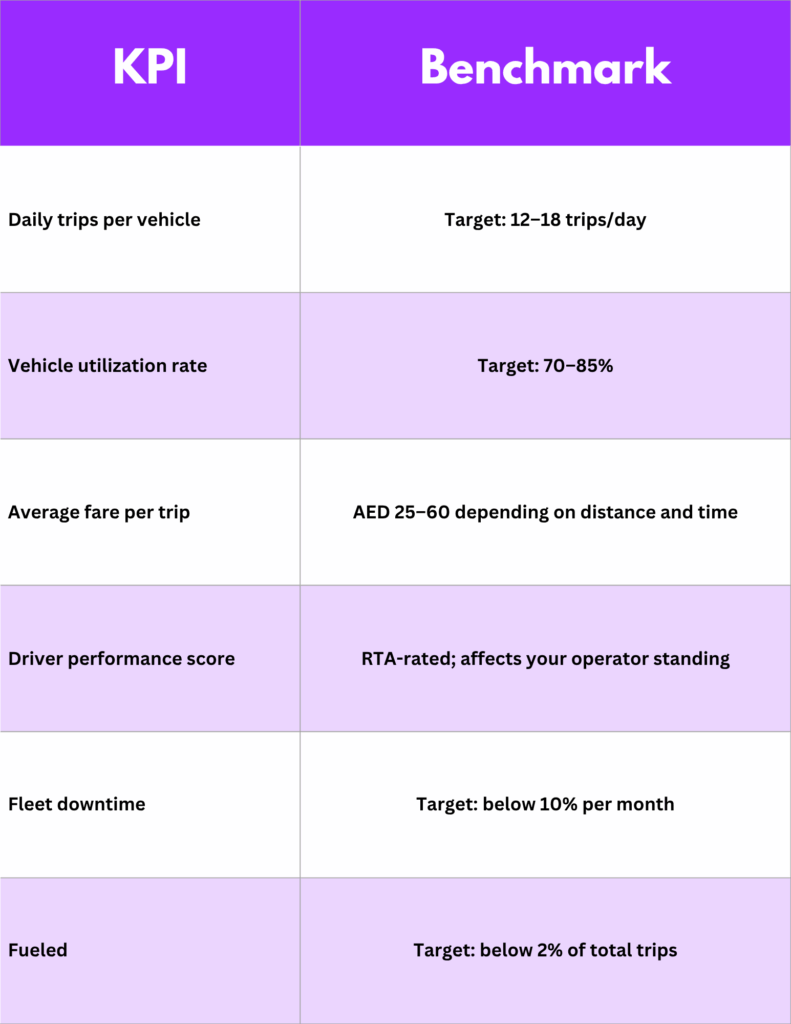
    The average daily trips per licensed taxi in Dubai range between 12 and 18 trips during peak periods. With the right location strategy and dispatch technology, operators can consistently hit the higher end of this range.

    Understanding the Taxi Operating Model in Dubai

    Core Functions and Processes

    Running a taxi business in Dubai involves several interconnected functions. Understanding these from day one helps you plan better and avoid costly operational mistakes.

    • Fleet Management — maintaining, scheduling, and tracking all vehicles
    • Driver Management — hiring, training, scheduling, and performance monitoring
    • Dispatch Operations — managing ride requests through apps, call centers, or both
    • Compliance Management — ensuring all vehicles, drivers, and operations meet RTA standards
    • Revenue Collection — processing metered fares, app payments, and corporate billing
    • Customer Service — handling complaints, feedback, and service quality control

    Operating KPIs to Track

    Operating KPIs to Track

    Requirements to Start a Taxi Business in Dubai

    There are two main regulatory bodies you need to work with when setting up a taxi business in Dubai.

    Roads and Transport Authority (RTA)

    The RTA is the government body that regulates all transport operations in Dubai. For taxi businesses, the RTA issues the taxi permit that allows you to legally operate passenger transport services. Without an RTA permit, you cannot legally run a taxi business, regardless of your trade license.

    Key RTA requirements include:

    • Minimum fleet of 30 vehicles to qualify for a franchise taxi permit
    • Vehicles must meet RTA specifications, age, condition, and equipment
    • Operators must provide a dedicated shelter and parking facility in Dubai
    • All drivers must complete RTA-approved training and hold valid UAE licenses
    • Technology systems, including GPS tracking and approved taximeters, must be installed

    Dubai Department of Economic Development (DED)

    The DED issues your trade license, which is the legal foundation for your business. Before the RTA processes your taxi permit, you need to have your DED trade license in place. The DED registers your business, assigns your activities (passenger transport), and ensures you are operating as a legitimate commercial entity.

    Business Structure Options

    Limited Liability Company (LLC)

    An LLC is the most popular structure for taxi businesses in Dubai. It allows up to 50 shareholders, provides personal liability protection, and is fully recognized by both the DED and RTA. As of 2021, UAE law allows 100% foreign ownership in many business categories, including transport services, meaning you no longer need a local sponsor in most cases.

    Sole Proprietorship

    A sole proprietorship is simpler to set up, but it limits your business to a single owner. It works well for small operators with one or two vehicles, but it carries personal liability risk and may face limitations when applying for larger RTA permits.

    Partnership

    A partnership allows two or more individuals to co-own the business. This is useful when you want to pool capital to meet the RTA’s minimum fleet requirement. Each partner’s share and responsibilities should be clearly documented in the Memorandum of Association (MOA).

    Easy Steps to Start a Taxi Business in Dubai

    Here is a clear, step-by-step breakdown of how to launch your taxi business the right way in Dubai.

    Step 1: Build Your Business Plan and Strategy

    Before applying for any license, you need a clear business plan. This helps you choose the right structure, calculate costs accurately, and present a serious application to both the DED and RTA.

    Choose your taxi service type:

    Traditional Taxi Services

    Standard metered taxis are operating across Dubai under RTA fare structures. This is the most common model and the one most customers recognize.

    App-Based Ride-Hailing

    Partnering with platforms like Careem or Uber, or building your own ride-hailing application. This model offers flexible booking and a wider customer reach.

    Luxury Limousine Services

    Premium vehicles catering to corporate clients, tourists, and high-end events. Higher fares and better margins, but require premium fleet investment.


    Specialized Services

    Ladies-only taxis, airport transfer services, school transport, or medical transport. These niche models often face less direct competition and can build loyal client bases.

    Step 2: Obtain Trade License from DED

    Required Documentation

    • Passport copies of all shareholders
    • Emirates ID (for UAE residents)
    • Proposed company name (must comply with DED naming rules)
    • Business activity description
    • Memorandum of Association (MOA)
    • Tenancy contract for office space (Ejari registered)
    • Initial approval certificate from DED

    License Categories

    For a taxi business, your DED license will fall under the commercial category with transport as your registered business activity. The process starts with trade name reservation (AED 620), followed by initial approval (AED 120), and then the full license issuance.

    Step 3: Secure RTA Taxi Permit

    Eligibility Requirements

    • Valid DED trade license for transport activities
    • Minimum 30 vehicles ready for inspection (for franchise permit)
    • Dedicated parking facility and shelter within Dubai
    • Fleet meets all RTA vehicle specifications
    • Business owner or director has a clean legal and financial record

    Application Process

    Submit your application to the RTA’s Passenger Transport Licensing section. You can contact the RTA directly at [email protected] for guidance. The RTA will review your application, conduct fleet inspections, and issue your permit upon successful compliance.

    Step 4: Vehicle Fleet Acquisition and Registration

    RTA-Approved Vehicle Models

    The RTA maintains an approved list of vehicles eligible for taxi operations in Dubai. These are typically mid-size to full-size sedans and SUVs from manufacturers including Toyota, Hyundai, and Nissan. Electric and hybrid vehicles are increasingly preferred and receive extended operational life under RTA rules.

    Vehicle Requirements

    • Maximum 3 years old at time of registration (for petrol/diesel vehicles)
    • Operational validity of 5 years (Category 1 & 3) or 7 years for EVs and hybrids
    • Must be equipped with RTA-calibrated taximeter
    • GPS tracking system (RTA-approved) must be installed
    • Approved branding, fare display, and roof sign required
    • Air conditioning, adequate passenger space, and safety features are mandatory

    Fleet Size Considerations

    If you are applying for a full RTA franchise permit, the minimum fleet is 30 vehicles. If you plan to start as an individual operator or under an alternative RTA program, smaller fleets may be permitted. It is worth confirming current requirements directly with the RTA, as programs and thresholds do change.

    Step 5: Driver Recruitment and Training

    RTA Driver Requirements

    •       Minimum age: 21 years

    •       Valid UAE driving license with at least 2 years of experience

    •       Clean criminal record

    •       Medical fitness certificate

    •       Good knowledge of Dubai roads and geography

    •       Basic English communication skills

    •       Completion of RTA-approved driver training program

    Training Programs

    The RTA operates certified training programs that cover defensive driving, customer service standards, knowledge of Dubai routes, and emergency procedures. All drivers must complete this training before they are permitted to operate a licensed taxi. As an operator, it is your responsibility to ensure every driver in your fleet is RTA-certified.

    Step 6: Insurance and Safety Compliance

    Mandatory Insurance Coverage

    • Third-party liability insurance — required by law for all vehicles
    • Comprehensive vehicle insurance — covers damage to your fleet
    • Driver’s personal accident insurance — protects your drivers
    • Passenger liability insurance — covers passengers in case of accidents

    Safety Requirements

    All vehicles must pass RTA annual safety inspections. Your business must maintain an accident log, an incident reporting system, and emergency contact protocols. Failure to maintain safety compliance can result in permit suspension or cancellation.

    No Jargon, No Fluff — Just the Real Cost Breakdown

    One of the most common questions from anyone starting a taxi business in Dubai is: how much does it actually cost? Here is a clear breakdown.

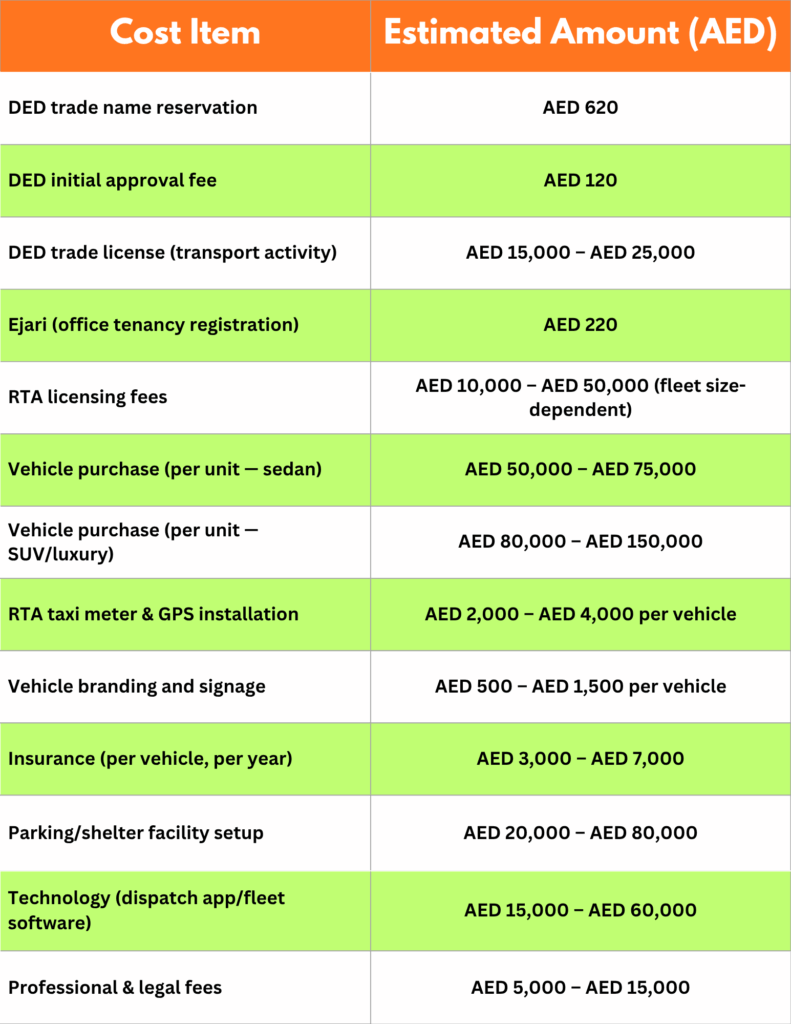
    Initial Setup Costs

    Initial Setup Costs of taxi business in Dubai
    Minimum estimated investment for a single-vehicle operation

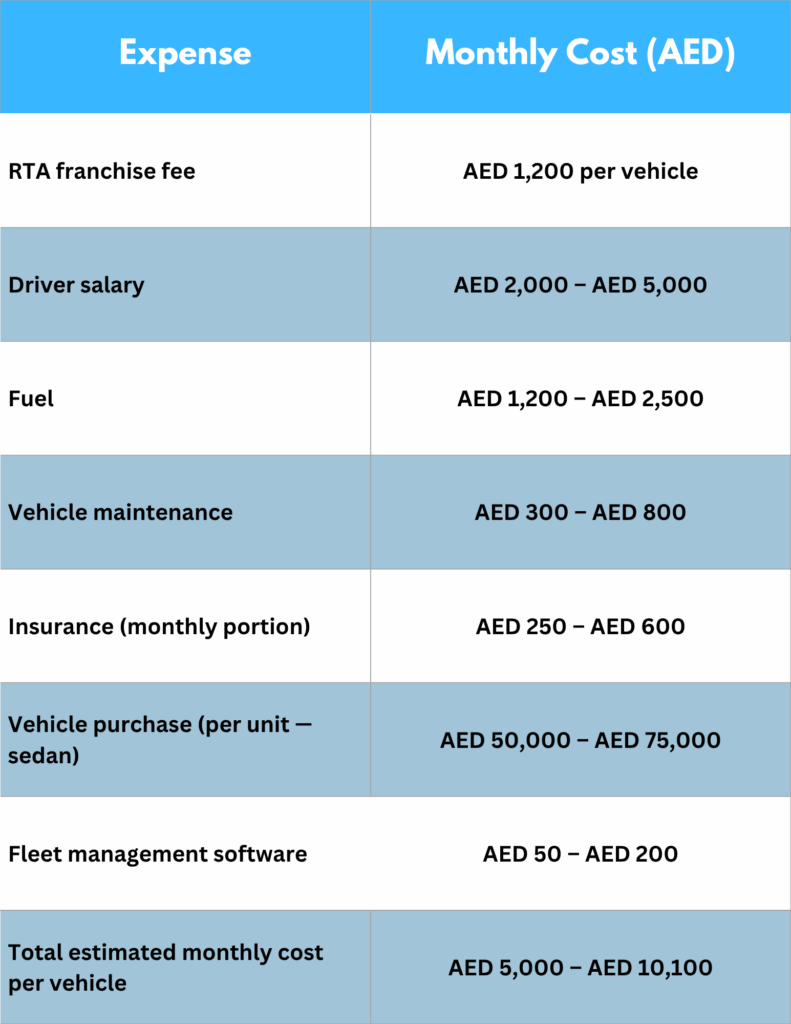
    Ongoing Operational Costs

    Monthly Expenses (per vehicle)

    Monthly Expenses (per vehicle)

    A Clear Look at Revenue and Profit Potential

    Revenue Streams

    Primary Revenue Sources

    • Metered taxi fares — standard trips billed by distance and time
    • Airport transfers — fixed-rate or metered premium fares
    • Corporate accounts — monthly billing agreements with companies
    • Hotel partnerships — exclusive or preferred supplier contracts
    • App-based bookings — commissions from platform integrations
    • Special events — premium pricing during major Dubai events

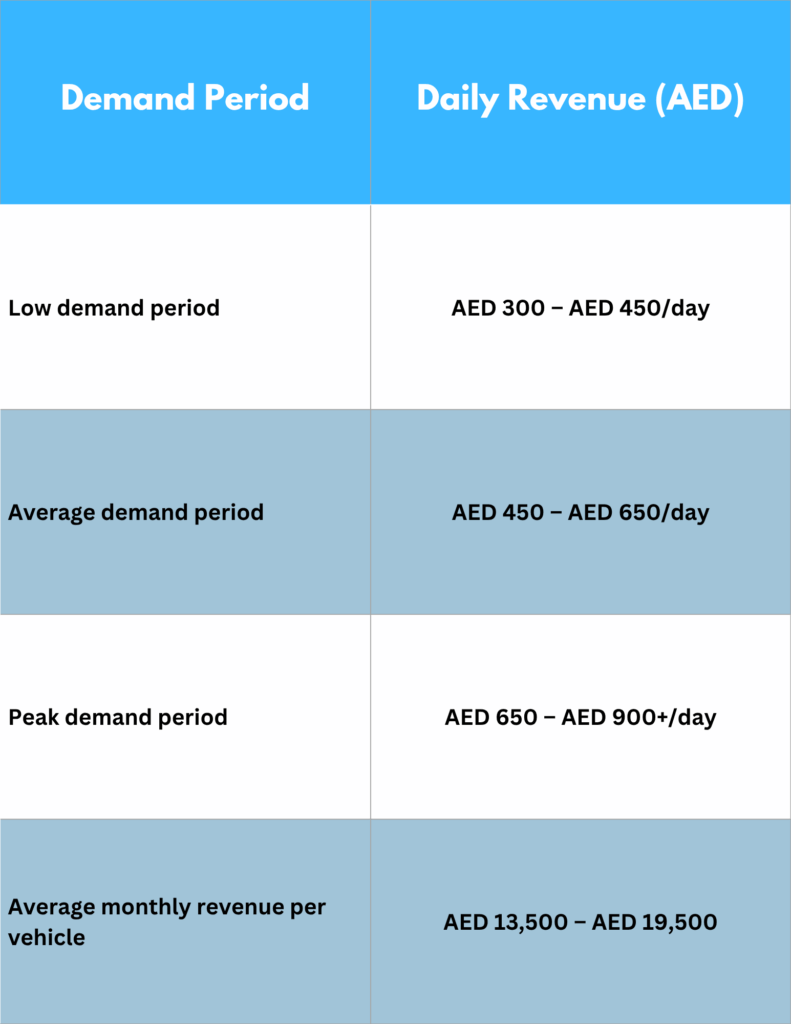
    Average Daily Revenue (per vehicle)

    Profit Margin Analysis

    Monthly Profit Calculation (per vehicle)

    Monthly Profit Calculation (per vehicle)

    Annual ROI Expectations

    For a single vehicle, you can expect to recoup your initial investment within 18 to 36 months, depending on demand, operating costs, and how efficiently the vehicle is managed. For a fleet of 10 to 30 vehicles, the business becomes substantially more profitable due to economies of scale — shared management costs, better insurance rates, and stronger bargaining power with corporate clients.

    How is Technology Driving Digital Transformation in the Taxi Industry?

    Technology is no longer optional for taxi businesses in Dubai. The RTA mandates certain technology systems, and customers expect digital convenience. The right technology stack can also significantly improve your fleet efficiency and revenue per vehicle.

    Essential Technology Systems

    Fleet Management Software

    Fleet management platforms allow you to track every vehicle in real time, monitor driver performance, manage maintenance schedules, and generate operational reports. Key features to look for include GPS tracking integration, trip history logging, fuel consumption monitoring, and driver behavior analytics. Popular platforms used in Dubai include Samsara, Verizon Connect, and regional solutions built specifically for UAE operators.

    Mobile Applications

    A dedicated mobile application for passenger bookings gives your business a professional edge and reduces reliance on street hails. Your app should support:

    • Real-time GPS tracking for passengers
    • Cashless payment — Nol card, credit/debit cards, Apple Pay
    • Ride scheduling and booking confirmation
    • Driver rating and feedback system
    • Corporate booking portal for business accounts

    Partnership Opportunities

    Rather than building your own app from scratch, many taxi operators in Dubai integrate with existing platforms:

    •   Careem Partner Program — list your fleet within the Careem ecosystem
    • Uber Fleet Integration — operate your vehicles within the Uber network
    • RTA eCab App — an official RTA platform for licensed taxis

    Partnering with these platforms gives you immediate market access and reduces your technology investment significantly, especially in the early stages of your business.

    Mainland vs. Free Zone Setup Options

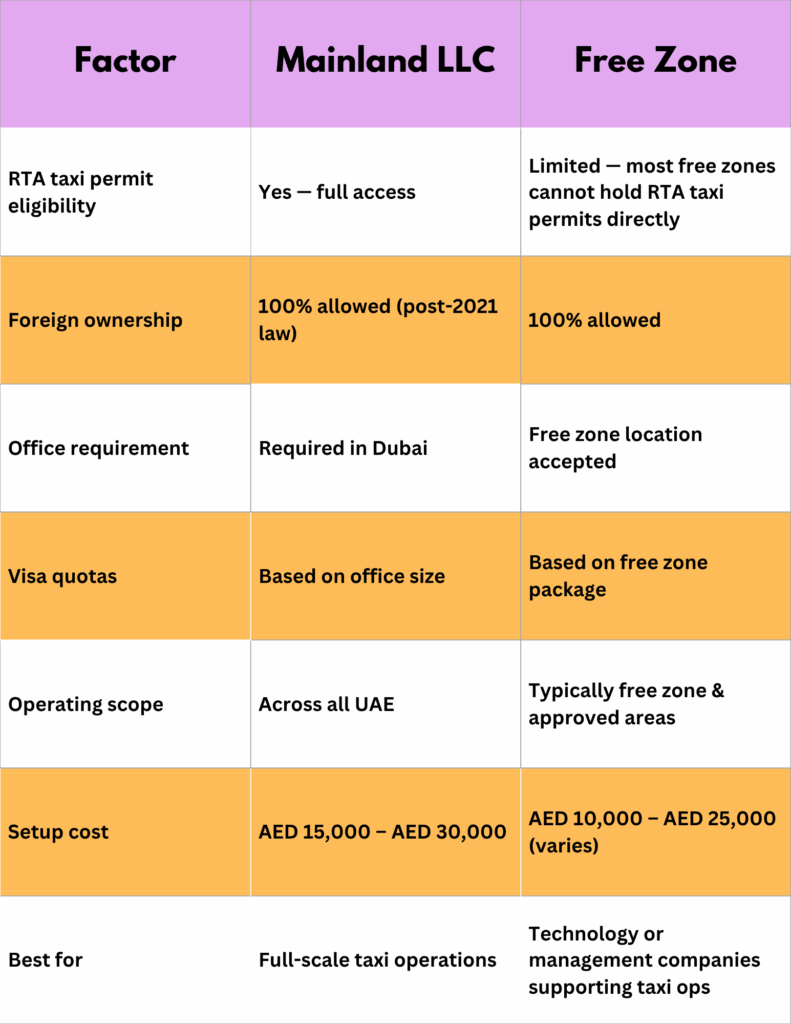
    A question many entrepreneurs ask is whether to set up their taxi business on the mainland or in a free zone. Here is a the clear comparison to help you decide the better:

    Mainland vs. Free Zone Setup Options
    Recommendation for taxi business in dubai

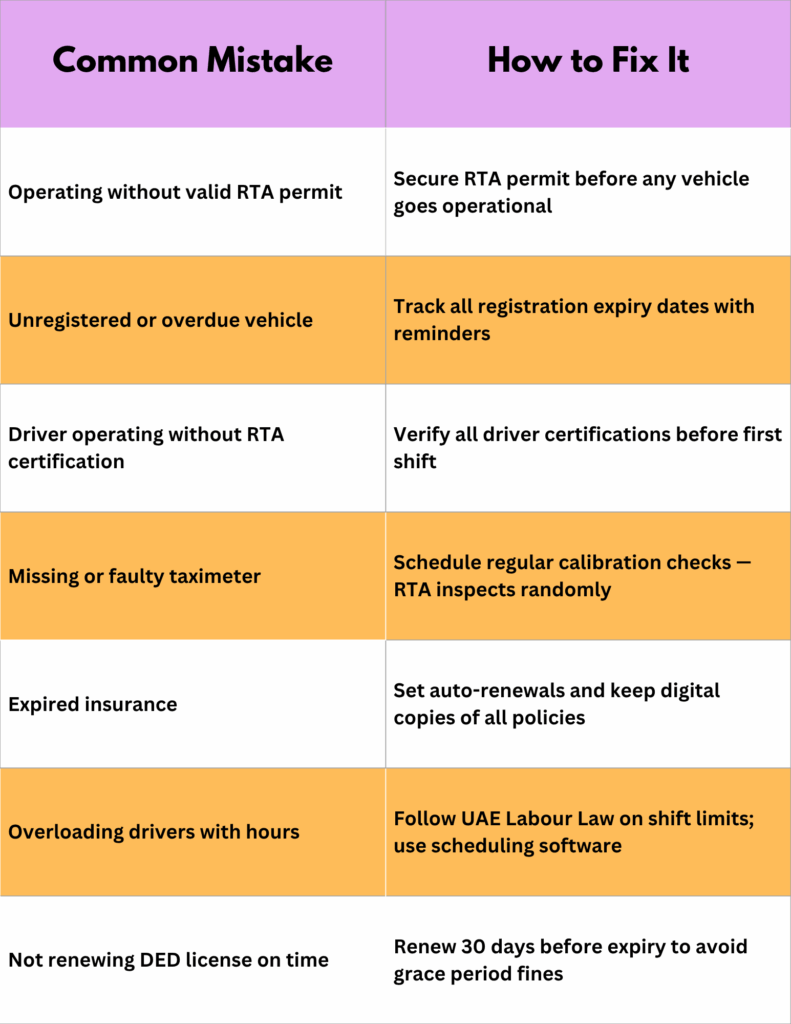
    How Can You Avoid Costly Mistakes with Compliance and Penalties?

    Non-compliance with RTA and DED requirements can lead to serious consequences — fines, fleet suspension, or license cancellation. 

    Common Pitfalls (and Fixes)

    Common Pitfalls (and Fixes)

    Can You Use Your Car as a Taxi in Dubai? What’s Allowed?

    This is one of the most searched questions on this topic, and the answer is: it depends on how you want to operate.

    Using your personal car as a licensed metered taxi without going through the proper RTA licensing process is not permitted in Dubai. The RTA requires all taxis to be registered, inspected, and branded under an approved operator license.

    However, there are two situations where your vehicle can enter the transport business:

    • If you register your vehicle under an RTA-approved taxi company or franchise operator, your car can be used as a fleet vehicle, provided it meets all RTA vehicle specifications
    • If you partner with Careem or Uber as a driver-partner, you can use your personal vehicle for ride-hailing, subject to those platforms’ own vehicle approval processes and RTA ride-hailing regulations

    Simply driving passengers in your own car without any RTA registration or platform affiliation is illegal and can result in significant fines. Always operate within the proper legal framework.

    What are the Challenges and Risk Management?

    No business is without challenges. A taxi operation in Dubai comes with specific risks that you need to plan for. Let’s take an honest look at each one

    Market Competition

    Challenge: Dubai’s transport market includes DTC (Dubai Taxi Corporation), Careem, Uber, and several other licensed operators. Competition is real and ongoing.

    Solution: Differentiate through service quality, reliability, and niche targeting. Corporate accounts, airport specialization, and luxury services are areas where independent operators can compete effectively against large players.

    Regulatory Compliance

    Challenge: Keeping up with RTA rule changes, annual renewals, vehicle inspections, and driver certification requirements takes time and attention.

    Solution: Assign a dedicated compliance manager or use a PRO (Public Relations Officer) service to handle all government-related paperwork. Use digital compliance calendars to track all deadlines across your fleet.

    Driver Retention

    Challenge: Dubai’s labor market is competitive. Drivers often switch employers for slightly better pay or conditions. High driver turnover increases training costs and disrupts operations.

    Solution: Offer competitive salaries, performance bonuses, flexible shift options, and clear career progression. Drivers who feel valued and well-treated stay longer. A stable, experienced driver workforce directly improves customer satisfaction and revenue.

    Operational Efficiency

    Challenge: Idle vehicles, poor route planning, and maintenance delays all eat into profitability.

    Solution: Invest in fleet management software from day one. Real-time tracking, smart dispatch, and predictive maintenance alerts can significantly reduce idle time and keep your fleet operating at optimal efficiency.

    Taxi Partnership and Franchise Options in Dubai

    RTA Partnership Programs

    The RTA offers structured franchise programs for large-scale operators. These programs give you access to the official RTA taxi dispatch network, RTA-branded vehicles, and a defined service area. In return, you operate under RTA quality standards and pay franchise fees per vehicle per month.

    Franchise operators benefit from RTA’s marketing and passenger trust. Passengers see an RTA-branded vehicle and immediately trust the service, which can be harder to build with a new independent brand.

    Ride-Hailing Platform Integration

    Both Careem and Uber have established programs for fleet operators in Dubai. Rather than individual drivers, these programs allow companies to register multiple vehicles and drivers under a single business account. This gives you the technology platform, booking infrastructure, and brand reach of a major platform — without building it yourself.

    For new operators with a small fleet, this is often the fastest route to generating revenue while you build your own brand and customer base.

    Future Trends and Market Evolution

    Sustainability Initiatives

    The Dubai government has committed to significantly increasing the share of electric and hybrid vehicles in the city’s taxi fleet by 2030. As an operator, planning your fleet acquisition with EVs and hybrids in mind will future-proof your business, reduce fuel costs, and align with RTA incentives for green operators.

    Technology Advancement

    Artificial intelligence in dispatch optimization, predictive maintenance systems, and advanced passenger analytics are already entering the Dubai transport market. Operators who adopt these tools early will have a meaningful efficiency advantage over those who resist the shift.

    Market Expansion

    Dubai continues to grow. New residential communities, expanded airport terminals, and mega-events through 2030 and beyond will continue to increase transport demand. Operators who build strong foundations now will be well-positioned to expand their fleets and service areas as the market grows.

    Licensing Renewal and Compliance

    Annual Renewal Requirements

    • DED trade license renewal — must be completed before the expiry date (typically annual)
    • RTA taxi permit renewal — annual, with updated fleet inspection
    • Vehicle registration renewal — per vehicle, annual
    • Driver’s license and certification renewal — per driver, as per the RTA schedule
    • Insurance renewal — per vehicle, coordinate with renewal dates
    • Ejari renewal — if the office tenancy contract changes

    Compliance Monitoring

    The RTA conducts regular inspections — both scheduled and random — of taxi fleets in Dubai. These cover vehicle condition, driver certification status, taximeter accuracy, and GPS system functionality. Maintaining a clean compliance record protects your permit and your reputation.

    Best Taxi Business ideas

    Business Setup Support and Professional Services

    Setting up a taxi business in Dubai involves multiple government interactions, documentation processes, and regulatory steps. For first-time operators, working with a professional business setup service can save significant time and reduce the risk of application errors.

    Professional setup consultants in Dubai can assist with:

    • DED trade license application and processing
    • RTA permit application and fleet registration
    • Company formation and Memorandum of Association drafting
    • Ejari and office tenancy registration
    • Visa processing for investors and employees
    • Insurance coordination and compliance documentation

    Typical fees for a full-service setup consultant in Dubai range from AED 5,000 to AED 20,000 depending on the scope of services and the complexity of your business structure.

    Why Choose Apptechies as Your Taxi App Development Partner in Dubai?

    Building the right technology for your taxi business is just as important as getting your licenses in order. Apptechies is a Dubai-based technology company with deep expertise in developing taxi and ride-hailing applications for the UAE market.

    Here is why taxi business owners in Dubai choose Apptechies:

    • UAE Market Expertise — deep understanding of RTA technical requirements, Nol payment integration, and Dubai-specific user behaviour
    • Full-Stack Taxi App Development — passenger app, driver app, and operator admin dashboard built as a complete, integrated system
    • Rta-compliant Technology — GPS integration, taximeter connectivity, and digital fare display built to meet RTA standards
    • Careem and Uber API integration — connect your fleet to major platforms without building from scratch
    • Scalable Architecture — your app grows with your fleet, from 5 vehicles to 500, without a complete rebuild
    • Arabic and English Language Support — essential for serving Dubai’s diverse customer base
    • Post-launch Support & Maintenance — ongoing technical support to keep your platform running smoothly
    • Affordable, Transparent Pricing — clear project quotes with no hidden costs

    Whether you are launching a new taxi brand in Dubai or looking to upgrade the technology behind an existing fleet, Apptechies delivers solutions that are built for the realities of the UAE transport market.

    Conclusion

    Starting a taxi business in Dubai in 2026 is a serious opportunity for the right entrepreneur. The market is large, the demand is consistent, and the regulatory framework — while strict — provides a structured environment where quality operators can thrive.

    The key decisions come down to three things: choosing the right legal structure, meeting RTA’s licensing and fleet requirements, and investing in the right technology from day one.

    Costs are real and need to be planned for carefully. But so is the revenue potential. A well-run fleet of even five to ten vehicles can generate meaningful and growing monthly returns.

    If you are serious about entering Dubai’s taxi market, use this guide as your starting point. Work with experienced professionals for your setup, stay compliant with RTA from day one, and invest in technology that helps your fleet run efficiently.

    2026 Verdict

    Frequently Asked Questions

    Q. What Is The Minimum Investment Required To Start A Taxi Business In Dubai?

    Ans: The minimum investment for a single-vehicle taxi operation in Dubai starts at approximately AED 126,000 to AED 265,000. This covers your DED trade license, RTA permit fees, vehicle purchase, taximeter and GPS installation, insurance, and basic setup costs. For a full 30-vehicle RTA franchise fleet, the investment ranges from AED 2.5 million to AED 4 million or more.

    Q. How Many Taxi Companies Are In Dubai?

    Ans: Dubai has several RTA-licensed taxi franchise operators operating alongside the government-affiliated Dubai Taxi Corporation (DTC). These include major operators such as Cars Taxi, National Taxi, Metro Taxi, Arabia Taxi, and City Taxi. In addition, Careem and Uber operate ride-hailing services under separate RTA approvals. The exact number of licensed operators changes as new permits are issued, so checking with the RTA for the most current list is advisable.

    Q. Can Foreigners Start A Taxi Business In Dubai?

    Ans: Yes. Following the 2021 amendments to UAE’s Commercial Companies Law, foreign nationals can own 100% of a mainland LLC in most business categories, including transport services. This means you do not need a UAE national partner or local sponsor to start a taxi business in Dubai as a foreigner. However, you must still meet all DED and RTA requirements just as a UAE national would.

    Q. Can I Use My Car As A Taxi?

    Ans: Not without proper registration. Using a personal vehicle as a taxi without RTA approval is illegal in Dubai. Your vehicle must be registered under an RTA-approved operator license or through a ride-hailing platform like Careem or Uber. Both platforms have their own vehicle approval processes and require your vehicle to meet specific standards before it can carry passengers for hire.

    Q. Do I Need Taxi Solicitors Or Legal Advisors?

    Ans: You are not legally required to hire a lawyer to set up a taxi business in Dubai. However, working with a legal advisor or a professional business setup consultant is strongly recommended, especially for first-time operators. They help you avoid documentation errors, choose the right business structure, and navigate the DED and RTA application processes more efficiently.

    Q. Is It Profitable To Start With One Taxi?

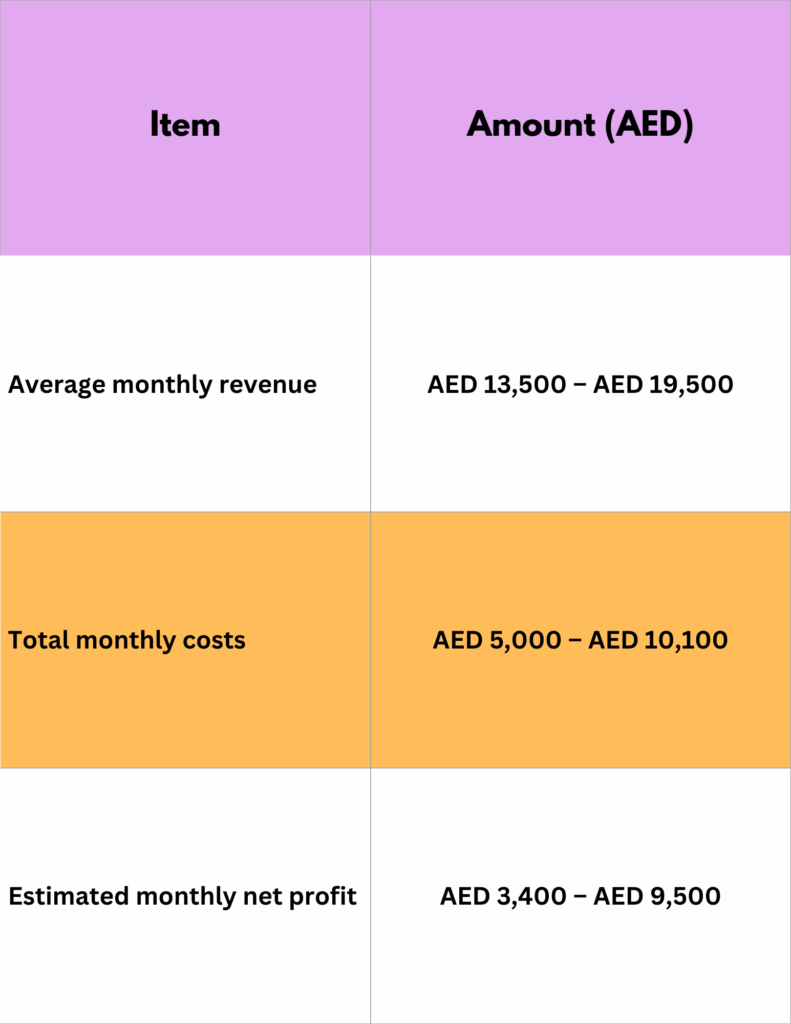
    Ans: Yes, a single taxi can be profitable in Dubai if managed well. A single vehicle can generate AED 13,500 to AED 19,500 per month in revenue and AED 3,400 to AED 9,500 per month in net profit after costs. The initial investment for a single vehicle can typically be recovered within 18 to 36 months. However, profitability improves significantly with scale — more vehicles mean lower per-unit costs and stronger revenue.

    Q. How Long Does The Licensing Process Take?

    Ans: The full licensing process — from DED trade license to RTA taxi permit and fleet registration, typically takes between 4 and 8 weeks when all documents are in order. Delays usually occur due to incomplete documentation, vehicle inspection failures, or processing backlogs during peak periods. Working with a professional setup consultant can help reduce this timeline significantly.

    Q. Can I Operate Both Traditional And App-based Services?

    Ans: Yes. Many taxi operators in Dubai run both metered street taxis and app-based bookings simultaneously. This dual-channel approach maximizes vehicle utilization and revenue. You can integrate your fleet with Careem or Uber while also operating under the standard RTA metered fare system. Your RTA permit will specify the modes of operation allowed, so ensure your application reflects both service types from the start.

    Author Name: Ajay Chaudhary

    Author Bio: AJ Chaudhary, CEO of Apptechies. He is a full-stack developer with 10+ years of experience developing web and mobile applications. He has successfully delivered projects for different industries and helped companies turn concepts into scalable solutions. Passionate about technology, he simplifies complicated tech topics for entrepreneurs and startups by sharing insights.

  • Top 15 Taxi Booking App Development Companies in Dubai in 2026

    Top 15 Taxi Booking App Development Companies in Dubai in 2026

    Did you know, according to Techsciresearch, the UAE online taxi market was estimated to be USD 337.2 million in 2024. And by 2030, it is projected to reach USD 433.78 million. So, if you want to start a taxi business, this is the right time.

    As the industry evolves, the taxi booking app market in Dubai, UAE has become competitive day by day. In 2026, success depends on regulatory awareness, tech expertise and real-world experience in taxi app development.

    Dubai’s mobility ecosystem runs on strict transport guidelines, advanced digital systems and high user demands. A taxi app development partner that ignores even one of these points can slow down the launch or increase long-term costs. Because of this, evaluation is required, particularly for fleet owners and startups who are entering this market for the first time.

    Our detailed blog helps you identify and compare the top 15 taxi booking app development companies in Dubai, UAE. We focus on market relevance, service coverage, and expertise in ride-hailing solutions. Our goal is clear, to provide you with valuable information so that you can easily hire taxi app developers in Dubai, UAE.

    You Can Also Read: Top 10 Taxi Business Idea for Startups to Launch in 2026

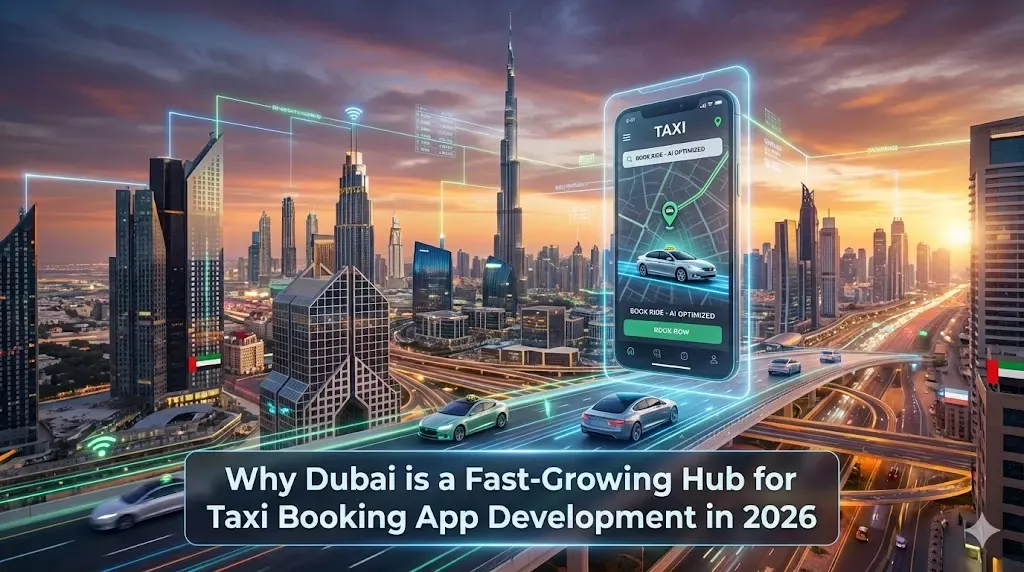
    Why Dubai is a Fast-Growing Hub for Taxi Booking App Development in 2026

    Dubai has become a global hub for smart transportation. Because of its well-structured transport policy, strong digital infrastructure and long-term smart city strategy. That’s why Dubai is the most preferred location for taxi app development expertise.

    Roads and Transport Authorities (RTAs) play a key role in developing the ride-hailing ecosystem. All taxi apps must follow defined licensing, driver onboarding and data privacy. When launching a taxi booking solution, this regulated environment creates clarity for businesses and reduces operational risk.

    Several practical factors continue to drive Dubai’s growth as a hub for taxi app development:

    Why Dubai is a Fast-Growing Hub for Taxi App Development

    Smart City Vision: Dubai actively integrates AI, IoT and automation into urban mobility, driving innovation in ride-hailing apps.

    High Demand for On-demand Transport: Tourism, daily commuters and corporate travel drive steady demand for taxi services.

    Strong Regulatory Framework: Clear RTA guidelines help businesses plan for a compliant taxi app from day one.

    Advanced Digital Infrastructure: High mobile penetration and reliable internet support real-time tracking and in-app payments.

    Effective Technology Ecosystem: Dubai hosts experienced developers and established taxi booking app development agencies.

    For businesses planning long-term growth, Dubai offers much more than development talent. This provides a stable, innovation-friendly environment where taxi apps can scale without constant regulatory surprises. This is why many businesses prefer to work with a taxi app development company in Dubai, UAE that understands the local transportation and compliance requirements.

    You Can Read Also: Top 10 Best Accelerator Programs in 2026

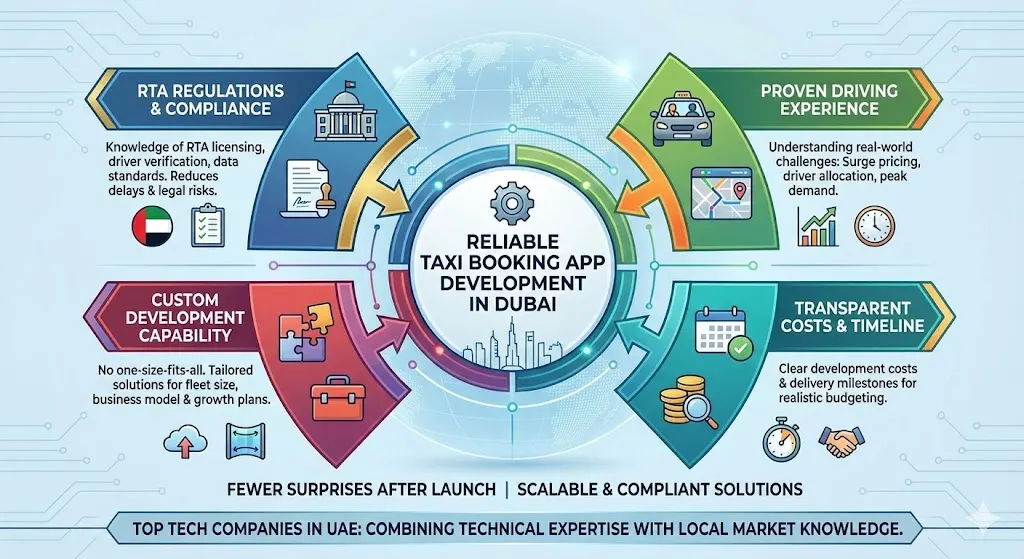
    What Makes a Taxi Booking App Development Company Reliable in Dubai

    Not all taxi booking app development companies can offer a platform that works in Dubai’s regulated and fast-moving mobility market. Reliability depends on experience, process and local understanding, not just technical skills. A reliable taxi booking app development company in Dubai, UAE, shows strength in the following areas:

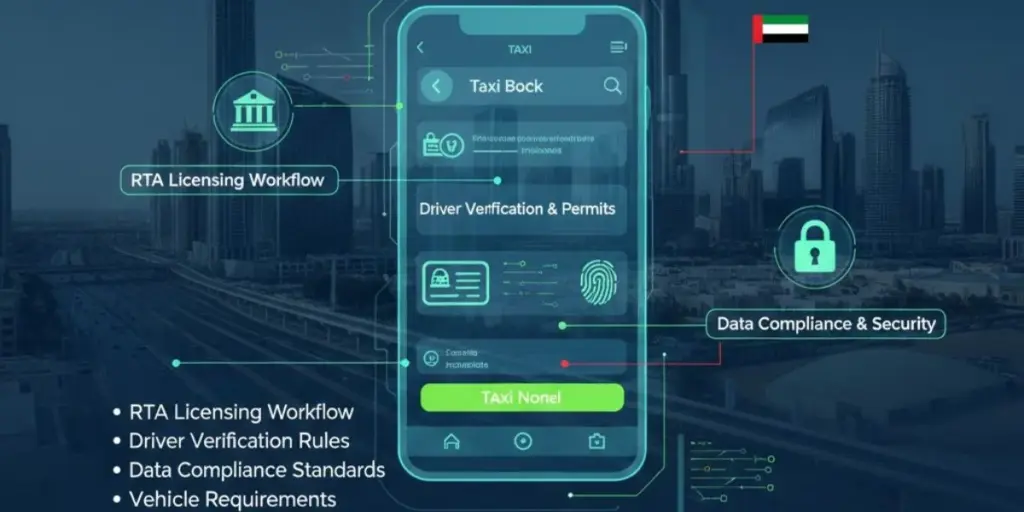
    Understanding of RTA Regulations: Companies should know the licensing workflow, driver verification rules and data compliance standards set by Dubai RTA. This reduces launch delays and legal risk.

    Proven Driving Experience: Teams with previous taxi projects understand real-world challenges such as surge pricing, driver allocation and peak hour demand.

    Custom Development Capability: Reliable companies avoid one-size-fits-all solutions. They offer custom taxi app development to suit fleet size, business model and growth plans.

    Transparent Costs and Timeline: Clear details of mobile app development costs and delivery milestones help businesses plan budgets realistically.

    What Makes a Taxi App Development Company Reliable in Dubai

    In Dubai’s competitive mobility sector, reliability means fewer surprises after launch. Top tech companies in UAE that combine technical expertise with local market knowledge offer taxi booking solutions that scale smoothly and remain compliant.

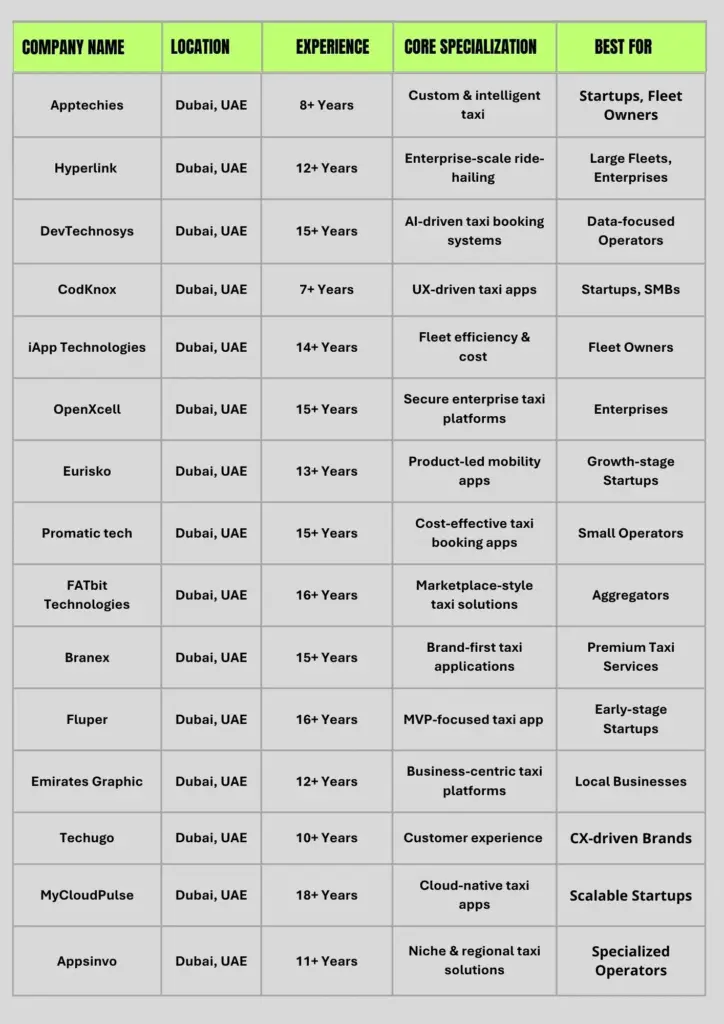
    List of Top-Rated Taxi Booking App Development Companies in Dubai

    Dubai’s ride-hailing market requires more than basic app development. They must balance technical scalability, regulatory compliance and real-world taxi operations. To help businesses choose the right partner, we’ve compiled a list of the top 15 taxi booking app development companies in Dubai, UAE. This list is created based on market presence, service relevance and experience with mobility solutions.

    The companies listed below have demonstrated the ability to build taxi booking apps suitable for the UAE market. This list focuses on clarity and usefulness rather than rankings driven by marketing claims.

    Apptechies

    Location: Dubai, UAE

    Year of Experience: 10+ Years

    Core Focus: AI-powered Taxi Booking App Development

    Apptechies is the best taxi booking app development company in Dubai, UAE. They are known for building taxi apps that combine AI-driven route optimization and smart fleet management. With highly functional features like a user app, driver app, admin panel and dispatcher dashboard. They provide a smooth experience with end-to-end custom taxi app development services in Dubai. Their taxi app solutions support real-time tracking, digital payments, dynamic pricing and security. They also offer white-label taxi apps based on specific business models.

    Apptechies Leading company in the UAE

    Key Strengths: Apptechies specializes in the UAE’s mobility requirements and can handle complexities with ease. They help businesses to maximize productivity and save time with cutting-edge technology. The company focuses on ease of use, high performance and long-term scalability rather than feature overload. Their transparent process and growth approach aligns well with Dubai’s regulated transport environment.

    Best For: Startups, large fleet owners looking for customized, scalable taxi booking app development solutions in Dubai.

    Hyperlink Infosystem

    Location: Dubai, UAE

    Year of Experience: 12+ Years

    Core Focus: On-Demand Taxi Booking App Development

    Hyperlink Infosystems is listed as one of the top taxi app development firms in Dubai, UAE. Their solutions support real-time GPS tracking, in-app payments, travel management and multi-location operations. They build scalable backend systems that can handle high user traffic and work with custom platforms.

    Key Strengths: The company has extensive experience in building on-demand taxi booking apps. Their well-structured mobile app development process makes them suitable for growing taxi businesses. Hyperlink InfoSystem focuses on performance stability and intuitive user experience.

    Best For: Fleet operators, growing entrepreneur planning multi-city taxi booking solutions in Dubai and UAE.

    DevTechnosys

    Location: Dubai, UAE

    Year of Experience: 15+ Years

    Core Focus: Ride-hailing App Development

    DevTechnosys is a leading Dubai based taxi app development firm. They build driver apps, user apps, dispatch panels and operational dashboards. The company provides feature-driven apps that support dynamic pricing and optimize ride allocation.

    Key Strengths: They focus on functional depth rather than surface-level features. They are experienced in handling operational challenges such as driver availability and booking conflicts. Their solutions are suitable for businesses that prioritize operational control and system reliability.

    Best For: Fleet owners and mid-sized taxi operators are looking for structured, operations-focused taxi app development in Dubai.

    CodKnox

    Location: Dubai, UAE

    Year of Experience: 7+ Years

    Core Focus: Rider-centric and UX-driven Taxi Booking App Solutions

    CodKnox is a reliable ride-hailing app development company in Dubai, UAE. They offer seamless user experiences for both riders and drivers. Their services include interactive maps, AI-powered route suggestions and loyalty programs. With analytics dashboards that help fleet owners track performance and customer trends.

    Key Strengths: They integrate customer engagement features like in-app promotions and rating systems. Their strategy combines technology and usability. This makes it easier for taxi business owners to effectively expand their customer base.

    Best For: Startups and small to medium-sized taxi operators in Dubai who want a feature-rich app with high user engagement.

    iApp Technologies

    Location: Dubai, UAE

    Year of Experience: 14+ Years

    Core Focus: Custom Mobility Solutions

    iApp Technologies specializes in building customizable taxi platforms for local and regional markets. Their services include real-time tip monitoring, automated driver scheduling and smart fleet optimization. This helps businesses to cut down on idle time and improve per trip revenue.

    Key Strengths: The company emphasizes efficiency and cost-effectiveness taxi app development. They help businesses reduce operating costs while maintaining service quality. Their on-demand taxi apps are particularly strong in backend analytics.

    Best For: Fleet operators and startups are looking for reasonable, data-driven taxi booking solutions in Dubai.

    You Can Read Also: Top Trending App Ideas for Startups in 2026

    OpenXcell

    Location: Dubai, UAE

    Year of Experience: 15+ Years

    Core Focus: Custom Taxi App Development Services

    OpenXcell provides an enterprise-centric taxi booking platform with robust backend architecture, real-time analytics and multi-city operations. Their services also include custom workflow automation for driver assignment, tour matching and invoicing systems tailored for larger fleets.

    Key Strengths: OpenXcell is known for handling large volume operations and complex fleets. Their expertise lies in scalability and system stability, making them suitable for operators planning long-term expansion in Dubai and the wider UAE.

    Best For: Large taxi companies and multi-city fleet operators are looking for scalable and reliable apps.

    Eurisko

    Location: Dubai, UAE

    Year of Experience: 13+ Years

    Core Focus: Taxi Booking App Development Services

    Eurisko focuses on intelligent ride-hailing solutions that combine GPS optimization, automated dispatch and user-friendly mobile interfaces. Their apps include features such as dynamic route management, driver incentives and real-time driving updates tailored for urban mobility.

    Key Strengths: The company’s strength lies in technology innovation – they integrate AI-based routing and predictive analytics to improve efficiency and reduce waiting time. Their solutions are ideal for businesses that value operational intelligence.

    Best For: Fleet owners and startups in Dubai are looking for smart, technology-driven taxi booking solutions.

    Promatic Technologies

    Location: Dubai, UAE

    Year of Experience: 15+ Years

    Core Focus: Taxi Booking App Development Platforms

    Promatic Technologies specializes in user-centric taxi apps with seamless booking flow, secure payment integration and multilingual support for Dubai’s diverse population. Their development approach emphasizes ease of use and quick onboarding for both riders and drivers.

    Key Strengths: They excel in improving the user experience and simplifying operational management. Their app helps reduce dropouts during booking and ensures smooth fleet operations, which is important for startups and small taxi operators.

    Best For: Startups and mid-sized fleet operators are looking for an easy-to-use, customer-friendly taxi app in Dubai.

    FATbit Technologies

    Location: Dubai, UAE

    Year of Experience: 16+ Years

    Core Focus: Taxi Booking App Development

    FATbit Technologies is one of the popular in the list of top taxi booking app development companies in Dubai, UAE. They build taxi platforms with a marketplace mindset. Multiple fleet owners or driver groups can operate under one system. Their solutions often include commission management, role-based access and service category segmentation. They offer custom taxi app development tailored to fit complex business models.

    Key Strengths: The company is known for handling multi-vendor and multi-fleet logic efficiently. This capability helps businesses expand beyond a fleet while maintaining operational control. Their familiarity with marketing platforms gives flexibility for growth.

    Best For: Businesses and aggregators planning to run multi-fleet taxi booking services in Dubai.

    Branex

    Location: Dubai, UAE

    Year of Experience: 15+ Years

    Core Focus: Custom-built Taxi Booking App Development

    Brainex is one of the leading taxi booking app development companies in Dubai. They focus on creating smooth interaction flows and user-friendly interfaces. This makes their taxi apps visually appealing and easy to navigate.

    Key Strengths: The company’s core strength lies in combining design with business storytelling. Brainex helps taxi businesses stand out in crowded markets by creating apps that feel professional and trustworthy. This approach works well where the brand experience influences the user’s choice.

    Best For: Taxi startup and premium mobility services in Dubai that wants a strong brand presence and sophisticated user experience.

    Fluper

    Location: Dubai, UAE

    Year of Experience: 16+ Years

    Core Focus: Uber like Taxi Booking App Development

    Flupper focuses on building a future-ready taxi booking platform with a clear MVP-first approach. Their taxi app developer team prioritizes core booking logic and quick iteration cycles. This helps entrepreneurs quickly validate ideas and optimize based on real user feedback.

    Key Strengths: Flupper’s core strength lies in its rapid growth mindset. The company works closely with startups to refine features, optimize costs and plan phased releases. This approach minimizes early risk and prevents unnecessary development costs. which is important for new taxi companies.

    Best For: Startups and early stage entrepreneurs in Dubai are looking for scalable taxi booking apps with expansion potential.

    Emirates Graphic

    Location: Dubai, UAE

    Year of Experience: 12+ Years

    Core Focus: Custom Taxi Booking App Development Services

    Emirates Graphic is a UAE based taxi booking app development agency. They create custom taxi apps with a specific focus on management visibility and business operations. Their solutions assist businesses in maintaining control across everyday operations. They focus on booking control, service monitoring and administrative reporting. Their solution also supports integration with existing business systems.

    Key Strengths: The company’s strength lies in aligning technology with business operations. Their application helps owners track performance, manage service quality and maintain fleet consistency. This structured approach is suitable for businesses operating in regulated markets such as Dubai.

    Best For: Established taxi operators and local businesses seeking stable, business-focused taxi booking solutions.

    Techugo

    Location: Dubai, UAE

    Year of Experience: 10+ Years

    Core Focus: User-Centric Taxi App Development

    Techugo specializes in building taxi apps that prioritize smooth travel for customers. Their work focuses on responsive design and fast booking, ensuring users can book rides with ease. This strategy improves taxi application adoption in competitive urban markets.

    Key Strengths: The company’s main strength is its focus on user behavior and app performance. Techugo improves functionality and lowers drop-off rates by using data from user interactions. Their taxi apps often show strong engagement and retention metrics when executed correctly.

    Best For: Taxi startups and mobility brands in Dubai looking to compete through better customer experience and value.

    MyCloudPulse

    Location: Dubai, UAE

    Year of Experience: 18+ Years

    Core Focus: Cloud-based Taxi Booking platforms

    MyCloudPulse specializes in cloud-based taxi applications designed for flexibility and scalability. Their solutions focus on real-time data processing, high availability and seamless scaling. With this they help taxi companies manage fluctuations in demand without performance issues.

    Key Strengths: The company’s core strength is its expertise in cloud infrastructure. By optimizing hosting, data storage and system performance. MyCloudPulse helps reduce long-term operating costs. This approach works well for businesses that intend to plan stable growth in several service areas.

    Best For: Taxi operators and startups in Dubai are looking for cloud-first, scalable taxi booking solutions with long-term cost-effectiveness.

    Appsinvo

    Location: Dubai, UAE

    Year of Experience: 11+ Years

    Core Focus: Taxi Booking App Development for niche and regional

    Appsinvo is one of the reputed taxi booking app development companies in Dubai UAE. They specialize in creating taxi app development software tailored for your business needs. They design apps based on defined service models and operational requirements.

    Key Strengths: The company’s flexibility and adaptability are its strongest points. Appsinvo is a good fit for businesses that have specific needs, such as fixed-route services or contract-based rides. Their solutions help operators maintain control while serving targeted customer segments in Dubai.Best For: Taxi companies and service providers are looking for purpose-built, niche-focused taxi booking solutions.

    Comparison Table of the Top 15 Taxi Booking App Development Companies in Dubai

    Comparison of the Taxi Booking App Development Companies in Dubai

    What is the Cost of Taxi Booking App Development in 2026

    Taxi app development cost in 2026 starts from $25,000 and reaches up to $110,000+. This all depends on the app, whether it’s basic, medium or advanced because every app has its own requirements. There is no fixed price but Apptechies offer cost-effective taxi app development solutions.

    How Much Does IT Cost to Create a Taxi App

    App’s features, complexity, compliance requirements, and long-term scalability goals affect the development cost. Additional factors affecting cost include AI, third-party integration, data security standards, and post-launch support. Trusted development partners like Apptechies always provide transparent pricing and step-by-step delivery plans before development begins.

    In most cases, development costs fall into three practical categories:

    Basic MVP ($25,000 to 40,000)

    Suitable for startups that want to validate a business idea. This includes the essential booking workflow, basic dispatch logic, and core administration tools.

    Mid-tier platforms ($45,000 to 70,000)

    Designed for growing taxi businesses. It supports advanced booking logic, fleet coordination, real-time monitoring and performance optimization.

    Enterprise-Scale Solutions ($80,000+)

    Built for large operators with complex operations, multi-location services and high compliance requirements. These systems prioritize stability, security and long-term scalability.

    You Can Read Also: AI in the Automotive Industry

    Top Essential Features for a Dubai Taxi Booking App in 2026

    A successful taxi app in Dubai must meet the high expectations of users by following the local transportation standards. In 2026, basic booking functionality is insufficient. Users expect speed, accuracy and reliability every step of the way.

    Every modern taxi booking solution in Dubai should include the following key features:

    Real-time Driving Tracking

    Live GPS tracking helps riders monitor their driver’s location and estimated time of arrival. This feature improves trust and transparency.

    Smart Driver Allocation

    Smart matching reduces waiting times by assigning drivers based on proximity, availability and traffic conditions.

    Digital Payment Integration

    Support for cards, wallets and regionally accepted payment methods ensures smooth transactions.

    Multilingual Support

    Dubai’s diverse population makes language flexibility essential for riders and drivers alike.

    Secure Authentication

    Strong validation protects user data and supports regulatory requirements.

    Operational Dashboard

    Centralized control enables operators to monitor trips, drivers and service quality in real time.

    You Can Read Also: How AI is Revolutionizing the Future of Social Media

    Dubai Taxi App Regulations You Must Know Before Developing Your App

    Dubai has strict but clear regulations for taxi services. These rules exist to protect travelers, ensure the quality of service and keep transport systems organized. If you are planning to build a taxi booking for Dubai, understanding these rules in advance will help you avoid delays, rework, and legal issues.

    Dubai Taxi App Regulations

    Regulatory Authority You Need to Know

    • The Road and Transport Authority (RTA) governs taxi services in Dubai, UAE.
    • The RTA defines who is permitted to run taxi services.
    • It established guidelines for drivers, vehicles and prices.
    • Taxi apps must be compatible with Dubai’s framework for smart transportation.

    Licensing and Operating Approval

    • Without authorization, a taxi booking app cannot operate independently.
    • To operate, drivers need to be licensed and authorized.
    • For business use, vehicles need to be registered and approved.
    • Business model of the taxi app must align with approved taxi categories.

    Requirements for Driver and Vehicle

    • Passenger safety is a priority in Dubai, UAE.
    • Drivers must full-fill the qualification and background requirements.
    • Vehicles must comply with inspection and maintenance guidelines.
    • Driver and vehicle details should be traceable within the app.

    Rules for Fare Transparency

    • Fair pricing is highly valued in Dubai.
    • Before making a booking, users should view the estimated fares.
    • The price logic should be clear and consistent
    • Digital receipts should be available after each trip

    Data Security and User Privacy

    • Taxi apps handle sensitive data such as location and payment.
    • User and driver data must be kept safely.
    • Payment information must follow secure processing guidelines.
    • The system must prevent unauthorized data access

    Must Read: Top 10 AI Development Companies in 2026

    Benefits of Choosing Apptechies as your Taxi App Development Partner

    For long-term business success, choosing the right taxi app development company plays an important role. Apptechies offers AI-powered, feature-rich, reliable, secure, and scalable solutions. They built a taxi app that supports actual taxi operations in Dubai and throughout the UAE. Here are several benefits you get after partnering with Apptechies, given below:

    Custom Taxi Booking App Built for Business Growth

    Apptechies offers tailor-made taxi booking solutions that match your specific business model. They focus on essential operations such as booking, driver management and administration controls. Their taxi app development expertise makes the platform easier to operate and scale.

    White-Lable Taxi App Solution for Faster Market Entry

    Enter the market quickly with Apptechies’ white-label taxi app solutions. There are multiple benefits of white-label app development solutions. These apps allow future modification as the business grows without compromising the quality.

    Local Market Understanding for Dubai Taxi Apps

    A deep understanding of the local market helps Apptechies design taxi apps that match Dubai’s mobility ecosystem. This covers user experience that aligns with local standards, stable performance and clear fare visibility.

    User-Centric Design for Better Engagement

    Apptechies creates simple, clear, user-friendly interfaces for riders and drivers. An intuitive UI/UX design is the foundation of a successful taxi app. This helps businesses to retain users, reduce booking time and improve trust without adding complexity.

    Long-Term Technical Support and Platform Stability

    Taxi platforms require continuous improvement. They provide long-term technical support to maintain performance, fix issues and introduce updates as per business requirements.

    Optimized Taxi App Development for Better ROI

    Every feature is planned for efficiency and scalability. Whether you want Android or iOS app development, they ensure consistent performance across platforms. This structured approach helps businesses minimize operational challenges and achieve sustainable returns over time.

    Are you planning to build a Taxi Booking App in Dubai in 2026

    Most taxi apps fail in Dubai for one common reason, they are created as generic ride offers and then modified later. By 2026, the Dubai market will reward apps that launch with operational clarity. This means knowing who sets prices, how drivers are approved and how trips are monitored before a line of code. Apps that ignore this rebuild the original logic after launch.

    Another common mistake is to underestimate payment expectations. Users in the UAE quickly abandon apps if a payment delay or failure occurs. Reliability is not a feature, it’s a basic need.

    If you’re planning to build a taxi booking app in Dubai, the real question is whether your app is designed for how taxis actually operate in the city. Experienced software development teams like Apptechies focus on building platforms based on actual operations. They help companies avoid early mistakes and launch securely.

    Conclusion

    Our list of top 15 taxi booking app development companies in Dubai, UAE is perfect for taxi business owners in UAE, ride-hailing startups. Dubai is developing as a leading hub for smart transportation and digital mobility. As the demand for reliable taxi platforms increases, partner with an ideal app development agency that drives success. Each element plays a key role, from UI/UX design and platform selection to post-launch compliance and support. Choosing the best taxi booking app development firm in Dubai saves time, money and future rework.

    Frequently Asked Questions

    Q. How Much Does it Cost to Build a Taxi Booking App in the UAE?

    Ans: The cost of building a taxi booking app in the UAE usually ranges between $25,000 to $80,000+. Basic apps cost $25,000 to $35,000, moderate apps cost $40,000 to $60,000 and enterprise-grade apps $65,000 to $80,000+ (AI features, automation, scalability). The final price depends on the complexity of the app, Android and iOS platforms, integrations and ongoing technical support. 

    Q. Which is the Best Taxi Booking App Development Company in Dubai, UAE?

    Ans: Apptechies is a trusted taxi booking app development company in Dubai, UAE. They are known for building scalable and compliant ride-hailing solutions. The company offers customized taxi booking solutions and white-label taxi apps for the Android and iOS platforms with a special focus on long-term ROI.

    Q. How Much Time is Needed to Develop a Taxi App?

    Ans: Depending on the features and complexity, it usually takes 3 to 6 months to develop a taxi booking app. A basic app takes 8-12 weeks, an intermediate app takes 12-16 weeks and an advanced app takes 4-6 months or more. With Apptechies taxi app development expertise, they successfully deliver apps on time.

    Q. How to Choose the Right Taxi Booking App Development Partner?

    Choosing the right partner requires considering features more than price. Experience with taxi platforms, understanding of local regulations, transparent communication and post-launch support are more important. Companies like Apptechies provide clarity in timelines, realistic feature planning and long-term technical reliability.

    Q. What Services do Taxi App Development Companies Offer?

    Ans: Taxi app development companies typically offer full-cycle services. It includes product planning, UI/UX design, mobile and backend development, testing, deployment, and ongoing maintenance. With Apptechies, companies get access to custom development models and ongoing support that helps maintain app performance and long-term ROI.

    Author Name: Ajay Chaudhary

    Author Bio: AJ Chaudhary, CEO of Apptechies. He is a full-stack & AI Mobile app developer with 10+ years of experience developing web & mobile applications. He has successfully delivered projects for different industries and helped companies turn concepts into scalable solutions. Passionate about technology, he simplifies complicated tech topics for entrepreneurs and startups by sharing insights.

  • Top 15 Tech Companies in UAE Leading Innovation and Growth

    Top 15 Tech Companies in UAE Leading Innovation and Growth

    Tech companies in UAE play a crucial role in shaping a digital-first economy that is sustainable and fast-growing. The country has become a global technology hub, attracting startups, investors and top talent from across the world. If you check out cities like Dubai and Abu Dhabi, the transformation is clearly visible. They are highly invested in AI, cloud computing, fintech and innovation. Digital payments, app-based platforms and smart government services are now a part of everyday life. With world-class infrastructure, high internet usage and easy access to the regional and foreign market. This directly contributes to the success of IT companies and a booming mobile app development company. This expansion allows them to shape the future of business and technology.

    In 2024, the market of UAE Information and Communication Technology (ICT) was estimated at approximately $47.36 billion. And by 2029, it will reach over $77.28 billion, representing an attractive 10%+ annual growth rate. The UAE is one of the fastest-growing digital powerhouses in the world. The market is evolving, which makes it an ideal environment for tech companies in Dubai to grow, experiment and lead.

    Are you a startup or an investor and looking for the best software companies in Dubai? Read this blog where we listed the top 15 best tech companies in UAE. This blog helps you to find reputable, well-established and emerging technology leaders. We did a deep analysis and curated this list so that you can decide who to choose according to your requirements.

    Why the UAE is a Global Technology Hub

    UAE is a technology hub, as they adopt a futuristic approach and supportive government policies. Many innovators, entrepreneurs and investors from all around the world are interested. Here are some key factors that show why the UAE is a unique global technology leader:

    why UAE is technology hub

    Strong Government Support

    The government of UAE actively supports digital transformation. Tech companies develop and grow easily. Programs like Smart Dubai and the UAW National AI Strategy 2031 offer frameworks, funding and incentives.

    Startup-Friendly Policies

    Free zones such as Dubai Internet City and Abu Dhabi’s Hub71 offer tax savings, easy licensing, and financing opportunities. These guidelines make the UAE a perfect place for startups and scale-ups to test ideas and expand quickly.

    High Demand for Digital Solutions

    UAE residents are tech-savvy and involved in the digital world. Over 70% of people used mobile apps in 2024 for payment, shopping or public services. This increased the demand for innovative solutions from both local and international companies.

    Worldwide Tech Brand Presence

    Global tech giants such as IBM, Microsoft, AWS, and SAP, together with regional leaders such as G42 and Injazat. Competition, collaboration, and technical advancement are promoted by this combination of local and global expertise.

    Eco-Friendly IT Innovation

    The UAE is making investments in eco-friendly technology. It includes green data centers, energy-efficient cloud services and renewable-powered infrastructure. These initiatives show that digital development and environmental responsibility are both possible.

    Smart Cities with Digital Strength

    Dubai and Abu Dhabi rank among the world’s smartest cities with high-speed internet. They use IoT, AI and big data to improve transport, healthcare, security and citizen services. This digital backbone supports innovation between Dubai’s tech companies.

    Startup Rising with Global Support

    The UAE attracts foreign investment, venture capital, Startup Accelerators and international partnerships. By 2024, Dubai-based startups raised more than $1.3 billion. This shows the high-level of international trust in UAE tech ecosystem.

    Skilled Workforce and Talent Acquisition

    In the UAE, there is a mixture of local and foreign talent. Government programs in AI, coding and technical education ensure a skilled workforce for startups and established technology companies in Dubai.

    AI and Blockchain for Smarter Systems

    About 42% of UAE businesses are already using AI to improve operations, analytics and customer service. Blockchain adoption is growing in finance, healthcare and supply chains, making systems smarter and more transparent.

    Cybersecurity and Data Protection Policies

    Strong cybersecurity regulations and data protection laws give confidence to businesses and consumers. These guidelines are critical for fintech, healthcare and public services, and ensure secure digital operations across the country.

    You Can Also Read: Top Trending App Ideas for Startups in 2026 

    How We Selected the Top Tech Companies in UAE

    When choosing the right tech company in Dubai, it is not about popularity or flashy branding. We followed structured evaluation methods that prioritize actual performance, trust and long-term value. We curated the list of the top 15 tech companies in UAE. Each company included here meets a number of practical criteria important to businesses operating in the UAE.

    Expertise And Industry Experience

    We prioritized companies with practical expertise in a variety of industries such as finance, healthcare, logistics, retail, and government. Proven delivery record and long-term market presence are the main key elements.

    Technology Stack

    Businesses were evaluated based on how they use modern technologies. This involves frameworks, cloud platforms, AI tools and backend systems suited for long-term growth.

    Innovation Capability

    The innovation was evaluated through actual implementation. We focused on companies that are actively using new techniques and technologies. This improves performance and efficiency.

    Security Standards And Compliance

    We focus on those tech companies in Dubai who follow established security procedures. It was crucial to comply with UAE industry and data protection laws.

    Scalability Protocols

    Scalability is important in all projects. Companies that design systems to manage growth without sacrificing performance ranked higher.

    Customization

    A preferred company that provides custom solutions. The key advantage was being able to customize products according to the business-specific needs.

    Client Feedback

    Reviews and testimonials from customers played an important role. Continuous feedback helped to validate service quality and delivery standards.

    Market Reputation

    Long-term credibility is reflected by a company’s reputation. We considered collaborations, recognition and industry presence within the UAE tech ecosystem.

    Support And Maintenance

    Technology requires constant attention. We prefer companies that offer ongoing support, updates and performance monitoring after project delivery.

    Long-Term Engagement

    Finally, we looked at whether companies function as long-term partners. The best tech companies in the UAE focus on growth, improvement, and strategic collaboration, not one-time projects.

    Top 15 Tech Companies in UAE in 2026

    Apptechies

    apptechies logo

    Founded: 2018

    Headquarters: USA, UK, UAE, India

    Employee Strength: 260+

    Price Per Hour: $19 to $58

    Apptechies is one of the best tech companies in UAE. They provide custom web and mobile app development solutions for startups and growing businesses. Whether it’s an Android or iOS app development, they build scalable, secure and user-centric digital products that align with real business goals. They help businesses transform ideas into reliable apps. While maintaining the flexibility for future growth. Their understanding of regional market demand and technology standards. It makes them a trusted technology company in Dubai. Apptechies deliver digital solutions that support long-term growth by combining technical expertise with business understanding. 

    Key Services:

    • AI Development
    • Mobile App Development
    • Web App Development
    • UI/UX Design
    • Blockchain App Development
    • Internet of Things
    • AR VR App Development

    Industries Served

    • Startups and SaaS
    • Ecommerce
    • Logistics
    • Healthcare
    • Education
    • FinTech
    • Grocery
    • Automobile
    • Real Estate
    • Retail

    Why Choose Apptechies?

    • Develop innovative custom IT solutions for modern businesses that meet actual operational requirements.
    • Experienced team of IT professionals with industry knowledge. Whether it’s education, grocery, logistics, taxi app development or any industry, Apptechies delivers high-quality digital solutions.
    • Increased return on investment with performance-driven products by using advanced technologies.
    • Follows a transparent mobile app development process and delivers projects on time.
    • Cost-effective development solution that supports businesses’ long-term growth.
    EliteFishin Developed By Apptechies

    Brainvire

    Brainwire Logo

    Founded: 2012

    Headquarters: Ahmedabad, India, (Branch in Dubai)

    Employee Strength: 2,500+

    Price Per Hour: $30 to $60

    Brainvire is one of the well-known global tech companies in UAE. They build digital solutions that offer scalable, functional and long-term transformation. They help businesses modernize systems and enhance digital experiences, aligning with their goals. They have experience in several domains, which is why they offer services worldwide.

    Key Services:

    • E-commerce Development
    • Mobile App Development
    • Full Stack Development
    • ML & AI Development
    • Cloud Services

    Industries Served

    • Retail
    • Transportation
    • Real Estate
    • Finance
    • Education
    • Logistics
    • Healthcare

    Read Also: Artificial Intelligence in Education

    Onpassive

    ONPassive Logo

    Founded: 2018

    Headquarters: Orlando, Florida, USA, (Branch in Dubai, UAE)

    Employee Strength: 1200+

    Price Per Hour: $30 to $50

    Onpassive is a reputable tech company in Dubai that specializes in creating digital products and automation platforms. They design ready-to-use software that streamlines the marketing process and business communication. Onpassive offers cloud-based tools to help companies increase productivity and reduce manual efforts.

    Key Services:

    • Software Development
    • AI Solutions
    • Business Consulting
    • Marketing Solutions
    • Cloud Services

    Industries Served

    • Retail
    • Transportation
    • Real Estate
    • Finance
    • Education
    • Logistics
    • Healthcare

    You Can Also Read: 

    Cognizant

    cognizant Logo

    Founded: 1994

    Headquarters: Teanech, New Jersey, USA (Brand in Dubai, UAE)

    Employee Strength: 1500+

    Price Per Hour: $50 to $150

    One of the most well-known tech companies in UAE is Cognizant. They provide IT consulting and extensive digital transformation services to businesses. The company works closely with organizations that operate in regulated and data-intensive environments. Cognizant combines strategic consulting with deep technical execution. They specialize in digital resilience, operational efficiency and system modernization.

    Key Services:

    • Software Development
    • AI Solutions
    • Business Consulting
    • Marketing Solutions
    • Cloud Services

    Industries Served

    • Retail
    • Manufacturing
    • Insurance
    • Finance
    • Healthcare

    Wipro

    Wipro logo

    Founded: 1945

    Headquarters: Bengaluru, India, (Branch in Dubai)

    Employee Strength: 230,000+ Globally

    Price Per Hour: $50 to $120

    Wipro is a well-known worldwide IT services provider with extensive presence among top tech companies in Dubai. They offer IT consulting, system integration and modernized services. As one of the best software companies in Dubai, their focus is on reliability, security and operational continuity. They cater to organizations that require stable technology ecosystems and long-term IT partnerships. Wipro plays a pivotal role in the region’s digital transformation landscape for enterprises.

    Key Services:

    • IT Consulting and System Integration
    • AI & Data Analytics
    • Application Development and Management
    • Cloud and Infrastructure
    • Cybersecurity and Risk Management

    Industries Served

    • Retail
    • Manufacturing
    • Energy and Utilities
    • Finance
    • Public Sector

    Capgemini

    Capgemini Logo

    Founded: 1967

    Headquarters: Paris, France (Brand in Dubai, UAE)

    Employee Strength: 350,000+ Globally

    Price Per Hour: $70 to $150

    Capgemini is a global consulting and tech services firm with a strong reputation among top tech companies in UAE. They help businesses adopt strategies for digital transformation, cloud migration and technology modernization. As a technology company in Dubai, Capgemini combines technical expertise with business consulting. Their focus on scalability, cross-system integration and compliance. It plays a significant role in enterprise innovations in the UAE.

    Key Services:

    • Cybersecurity and Managed IT Services
    • Data Analytics and AI Solutions
    • Business Consulting
    • Enterprise Application Services
    • Cloud Services

    Industries Served

    • Retail and Consumer Goods
    • Manufacturing
    • Energy and Utilities
    • Banking and Finance
    • Public Sector

    HCL Technologies

    HCL Technologies Logo

    Founded: 1976

    Headquarters: Noida, India, (Brand in Dubai, UAE)

    Employee Strength: 220,000+ globally

    Price Per Hour: $50 to $150

    HCL Technologies is one of the well-recognized tech companies in the UAE. They help businesses with significant IT services and digital transformation projects. HCL works with organizations that require stable, secure and scalable technology systems. With a strong presence across the Middle East, including Dubai. It helps businesses modernize apps and migrate to cloud environments. They also manage complex IT infrastructure while meeting regional compliance standards.

    Key Services:

    • Application Development
    • Digital Engineering and Automation
    • Enterprise IT Consulting
    • Cybersecurity and Risk Management
    • Cloud Infrastructure

    Industries Served

    • Retail
    • Manufacturing
    • Banking and Financial
    • Telecommunications
    • Healthcare and Life Science

    KNZ Solutions

    KNZ Solutions Logo

    Founded: 2017

    Headquarters: Dubai, UAE

    Employee Strength: 250+

    Price Per Hour: $50 to $120

    KNZ Solution is a technology company in Dubai that provides digital and IT services in the UAE to businesses. The company is well-known among emerging tech companies in UAE. They focus on delivering practical solutions that support day-to-day business operations. They offer software development, IT support and digital transformation services. The company understands regional business needs, compliance expectations and infrastructure requirements.

    Bluechip Computer System LLC

    Bluechip Computer System LLC Logo

    Founded: 2012

    Headquarters: Dubai, UAE

    Employee Strength: 50+ globally

    Price Per Hour: $49 to $130

    Bluechip Computer System LLC is a reputable technology company in Dubai. They provide IT solutions all around the United Arab Emirates. Bluechip supports businesses that are looking for reliable system integration, IT support and infrastructure upgrade. Among the best tech companies in UAE, Bluechips is the one that better understands the demand for technology and local compliance.

    Key Services:

    • IT Infrastructure 
    • System Integration 
    • Managed IT Support
    • Enterprise Hardware and Software Solution
    • Cloud and Virtualization

    Industries Served

    • Government and Public Sector
    • Corporate Enterprise
    • Education
    • Healthcare
    • Retail

    Accenture

    accenture logo

    Founded: 1989

    Headquarters: Dublin, Ireland, UAE

    Employee Strength: 700,000+ worldwide

    Price Per Hour: $70 to $150

    Accenture is a global professional services company with a strong presence in the United Arab Emirates. They support businesses through large-scale digital transformation. Accenture is well-known for combining strategy, technology and operations. They work closely with organizations to modernize systems, improve efficiency and adapt to changing market demands. By using cutting-edge technologies, they help businesses to launch and scale faster. 

    Key Services:

    • Digital Transformation and IT Consulting
    • Cloud Migration and Infrastructure Modernization
    • Data Analytics and AI-Driven Solutions
    • Enterprise Application Development
    • Cybersecurity and Risk Management

    Industries Served

    • Government and Public Sector
    • Banking and Financial Services
    • Retail and Supply Chain
    • Healthcare and Life Sciences
    • Energy and Utilities

    Bayzat

    Bayzat Logo

    Founded: 2013

    Headquarters: Dubai, UAE

    Employee Strength: 500+ 

    Price Per Hour: $50 to $150

    Byzat is a technology company in Dubai and is well-known for its cloud-based employee benefits and HR systems. Bayzat, one of the top tech companies in UAE, specializes in making human resource management easier for businesses of all types. They offer digital tools that help organizations manage payroll, insurance and employee engagement. With their effective solutions, it improves transparency, compliance and the workforce experience.

    Key Services:

    • HR Management Software
    • Employee Benefits Platforms
    • Payroll and Compliance Tools
    • Insurance Management Solutions
    • Workforce Engagement Systems

    Industries Served

    • Small and Miz-Sized Businesses
    • Corportae Enterpise
    • Startups
    • Professional Services
    • Technology-driven Organizations

    Read Also: Top 15 Alternative App Stores for iOS & Android in 2026

    Fingent

    Fingent Logo

    Founded: 2003

    Headquarters: New York, (Branch in Dubai, UAE)

    Employee Strength: 700+ 

    Price Per Hour: $40 to $80

    Fingent is a global software development company with a growing presence among technology companies in the UAE. The company specializes in creating customized software solutions. Fingent works closely with businesses to design applications tailored to specific operational needs. They support organizations looking for specialized technology that easily integrates with current processes.

    Key Services:

    • Custom Software Development
    • Web and Mobile App Development
    • Enterprise System Integration
    • Cloud Solutions
    • Application Support and Maintenance

    Industries Served

    • Healthcare
    • Manufacturing
    • Logistics
    • Education
    • Financial Services

    IBM Middle East

    Founded: 1911

    Headquarters: Armonk, New York, USA (Dubai, UAE)

    Employee Strength: 280,000+ 

    Price Per Hour: $40 to $70

    IBM Middle East represents one of the most established global brands among technology companies in the UAE. They provide cutting-edge technology solutions to businesses and government agencies. They specialize in enterprise infrastructure, cybersecurity, AI and hybrid cloud. They are dedicated to data protection, innovation and digital transformation projects.

    Key Services:

    • Hybrid Cloud Solutions
    • AI and Data Analytics
    • Cybersecurity Services
    • Enterprise IT Infrastructure
    • Digital Transformation Consulting 

    Industries Served

    • Government and Public Sector
    • Banking and Financial Services
    • Healthcare
    • Energy
    • Telecommunications

    EchoGlobal

    Echo Logo

    Founded: 2013

    Headquarters: Kyiv, Ukraine (Branch in Dubai, UAE)

    Employee Strength: 200+ 

    Price Per Hour: $35 to $60

    EcoGlobal is an IT and software development company. They provide their services in UAE and international markets. The company focuses on delivering practical software solutions that support digital growth. Because of its service-driven approach, it is suitable for businesses seeking technical expertise. EcoGlobal partners with startups and mid-sized companies.

    Key Services:

    • Custom Software Development 
    • Web and Mobile App Development
    • Dedicated Development Teams
    • IT Consulting
    • Ongoing Technical Support

    Industries Served

    • Startups
    • SaaS Platforms
    • Ecommerce
    • Professional Services
    • Technology-driven Businesses

    Oracle

    Oracle Logo

    Founded: 1977

    Headquarters: Austin, Texas, USA (Branch in Dubai, UAE)

    Employee Strength: 500+ 

    Price Per Hour: $60 to $180

    Oracle is a multinational enterprise company that has a strong presence among the leading tech companies in UAE. They provide database solutions, cloud infrastructure and corporate apps in Dubai and Abu Dhabi. As a well-established technology company in Dubai, their services align with the region’s demand. Oracle helps businesses manage data securely, modernize core systems and improve digital operations. 

    Key Services:

    • Database Management Systems
    • Customer Experience Platforms
    • Enterprise Resource Planning (ERP)
    • Cloud Infrastructure and Applications
    • Data Security and Compliance Solutions

    Industries Served

    • Healthcare
    • Telecommunications
    • Retail
    • Government and Public Sector
    • Banking and Financial Services 

    Read Also: Top 15 Dating Apps in USA

    Types of Technology Services Offered by UAE Tech Companies

    The growth of tech companies in the UAE has given rise to a diverse technology services ecosystem. It supports startups, businesses and government initiatives. Technology providers in UAE covers the entire digital lifecycle. From Abu Dhabi’s commercial and public-sector projects to Dubai’s fast-growing startups. Here are the types of technology services offered by UAE tech companies are given below;

    Custom Software Development

    Several tech companies in UAE provide software development tailored to business-specific needs. Custom solutions help businesses automate operations, increase productivity, accuracy and scalability. One of the best software companies in Dubai, UAE offers custom software development services for every size of business

    Mobile App Development

    The use of smartphones is increasing globally that’s why mobile-first solutions are crucial. A trusted mobile app development company in UAE builds high performing and secure apps for iOS and Android devices. Before building an app, you should know the difference between iOS and Android. It improves internal operations and customer engagements.

    SaaS and Web App Development

    SaaS products, dashboard and e-commerce platforms are all powered by web applications. Many tech companies in Dubai deliver highly efficient web apps that work on all devices and allow future expansion. They are focused on developing responsive, user-friendly, secure and cloud-ready web apps.

    Cloud Solutions and IT Infrastructure

    Cloud usage continues to expand throughout the region. Technology companies in UAE assist businesses with infrastructure management, DevOps practices and cloud system migrations. These services increase system scalability and reliability while reducing operating costs.

    Artificial Intelligence and Data-driven Solutions’

    AI and data analytics tools have become useful business tools. Top AI development companies build advanced reporting, automation and predictive analysis solutions. It helps companies make better and quicker decisions.

    Cybersecurity and Compliance Services

    Security always continues to be a topmost concern as digital operations expand. The best software companies in Dubai offer cybersecurity services. They focus on risk assessment, data security and regulatory compliance for multiple industries.

    Enterprise IT Consulting

    IT consulting services help companies plan and manage digital transformation. To support long-term goals, this includes evaluating current systems, creating a technology roadmap and choosing the right platforms.

    On-going Support and Maintenance

    Technology requires constant attention. UAE tech companies provide maintenance, monitoring and managed services. This makes sure that the systems remain secure, up-to-date and operational as business needs change.

    Read Also: Top 10 Web Application Examples in 2026

    How to Choose the Right Tech Company in UAE

    Choosing the ideal partner can be stressful among the best tech companies in UAE. But if you focus on the right fit, capability and long-term growth instead of branding. The most important elements businesses should consider before making a choice are listed below;

    Define Your Goal

    First, make sure you know exactly what you need. Clarity helps you choose the best technology company in Dubai that aligns with your business goals. Whether you’re looking for cloud support, enterprise software or mobile apps, choose wisely.

    Check Relevant Experience

    Look for companies that have expertise in your sector. Knowledge of related projects increases delivery quality and lowers learning curves.

    Review Technical Skills

    Make sure that the company uses advanced, scalable technologies. Future-ready technology stack supports performance, security and long-term growth.

    Prioritize Security

    Data security is crucial. Trusted tech companies in Dubai follow strong security practices. They should be aware of the legal requirements specific to the UAE market.

    Ask for Customer Success Stories

    Customer success stories provide real insight into a company’s performance. They highlight problem-solving ability, delivery quality and long-term reliability beyond marketing claims.

    Consider Scalability

    Choose a partner who can drive your business forward. Scalable architecture and ongoing support ensure your technology continues to work over time.

    Communication and Transparency

    Clear and transparent communication app development cost keeps projects on track. A good technical partner explains decisions, timelines and risks without technical terms.

    Compare Value Not Just Cost

    Value matters more than cost. Many of the best software companies in Dubai stand out by offering stable, well-supported solutions that generate long-term returns.

    Benefits of Working With Apptechies in UAE

    Working with the right technology provider can determine how effectively a business grows. Among the many tech companies in UAE, Apptechies focuses on practical solutions. They deliver clear communication that supports real business outcomes rather than short-term gains. They also offer AI development services that improve productivity without excessive complexity. 

    benefits of working with apptechies in UAE

    Understand the Local Market

    Apptechies understand how businesses operate in the UAE. This includes awareness of regional user behavior, compliance expectations and infrastructure needs. They are helping projects move forward faster with fewer modifications.

    Prioritizing Business Development

    Technology decisions at Apptechies start with business logic. Each solution is designed to solve a specific problem, whether it involves customer engagement, internal efficiency or product scalability.

    Flexible Engagement Models

    Apptechies offer flexible engagement options suitable for businesses of any size. Whether it’s startups, growing companies and established businesses without unnecessary complexity.

    End-to-End Project Support

    From planning and UI/UX design to development and maintenance after launch. Apptechies provides ongoing support. This ensures long-term stability and consistent performance after deployment.

    Clear Communication and Transparency

    When requirements are clear, projects are successful. Apptechies emphasize regular updates, realistic timelines and direct communication during the development process.

    You Can Also Read: What is the Role of AI in Mobile App Development

    Conclusion

    The UAE has established itself as a global leader in digital innovation. With the help of strong infrastructure and the increasing need for cutting-edge technology solutions. Tech firms in UAE continue to have a significant impact on sectors like finance, healthcare, retail, logistics and smart cities from Dubai to Abu Dhabi.

    Leading tech companies in Dubai, UAE are highlighted by their experience and proven track record of client success in this blog. The UAE provides an innovative and diverse tech ecosystem. Whether you’re a startup searching for one of the best mobile app development companies.

    Choosing the right technology company in Dubai UAE requires more than comparing prices or portfolios. This includes understanding business goals, long-term scalability and trust. With this detailed blog, you can confidently pick ideal tech companies in Dubai that provide long-term growth.

    Frequently Asked Questions

    Q. What is a Tech Company?

    Ans: A tech company designs, develops or manages digital solutions. They offer software, mobile apps, AI tools or IT infrastructure. If you are in search of an ideal tech company in Dubai UAE consider Apptechies. They offer customized digital solutions that fulfill your business goals.

    Q. Which are the Top Tech Companies in UAE in 2026? 

    Ans: Without a doubt, Apptechies is one of the top tech companies in the UAE in 2026. Apptechies stand out for their proven delivery track record, advanced tech stacks and vast industry experience. They offer custom software, web and mobile app development that aligns with your business goals. Their innovative and problem-solving advanced digital solutions make them the best technology company in Dubai UAE.

    Q. Why work with a Digital Tech Company in UAE?

    Ans: Working with an ideal digital technology company in the UAE provides access to advanced infrastructure. You also get skilled talent and a welcoming workplace. Technology companies in Dubai like Apptechies, combine global standards with local market knowledge. This helps companies create secure, scalable and future-ready digital solutions.

    Author Name: Ajay Chaudhary

    Author Bio: AJ Chaudhary, CEO of Apptechies. He is a full-stack & AI Mobile app developer with 10+ years of experience developing web & mobile applications. He has successfully delivered projects for different industries and helped companies turn concepts into scalable solutions. Passionate about technology, he simplifies complicated tech topics for entrepreneurs and startups by sharing insights.

  • Top 10 AI Development Companies in 2026

    Top 10 AI Development Companies in 2026

    In 2026, AI development companies in the USA will not just transform but drive real business growth. AI is a trend and AI is the Future. Every industry is shifting to Artificial Intelligence and if you are not, then your business is on the edge. Transform your business with a trusted AI development Company now before it’s too late. According to market research, the U.S. AI market was estimated to increase $307.56 billion by 2031.

    AI is in demand and it is crucial for businesses to be in the competition. There are a lot of AI software development companies in the USA, but not all AI providers provide real value. Now the real question is how to find the right custom AI development company.

    In this guide, we have curated a list of the top 10 best AI development companies with real insights. We focus on companies that deliver real results, support multiple industries and have a track record of successful AI projects. So you can use it easily without wasting your time. Whether you’re a startup exploring custom solutions by partnering with the best custom AI development company can boost your business.

    Global Ai App Development Market

    How We Selected the Top AI Development Companies

    Choosing the right AI development partner in the US can be costly. Hundreds of AI development companies that claim expertise, but few deliver real business results. We have carefully created a list based on performance, US market experience and proven client results. Here’s what we considered:

    Verified Experience with AI Projects

    We verified that each company has delivered AI development solutions in the US. From machine learning platforms for enterprises to generative AI tools for startups. Real-world case studies mean more than marketing claims.

    Industry-Specific Use Cases

    We have prioritized companies that deliver solutions in the US with expertise in multiple industries. Whether you are looking for a healthcare, fintech, retail, logistics and SaaS project.

    Customer Reviews and Reputation

    We listed top AI development companies based on trusted customer reviews & industry recognition. This ensures that they maintain high standards of reliability and delivery.

    Technology Stack and Innovation

    We make sure that these AI software development companies use the latest technologies. Such as TensorFlow, PyTorch, OpenAI API, NVIDIA GPU infrastructure and cloud AI platforms. Best practices and innovation are used because these are the key elements in AI development.

    Business Impact and ROI

    We also focus on how these top AI development companies tackle actual business issues. They should be able to reduce AI app development cost, improve user experiences and optimize operations.

    Customer Support

    We also consider those companies that offer 24-hour customer support. Because development doesn’t stop after launch, that’s why customer support is needed so that your app works flawlessly.

    By following these criteria, we ensure that each company on our top 10 AI development companies list is giving businesses confidence. In addition, businesses get credible, innovative and results-driven app development.

    Quick Comparison Table of 10 Best AI Software Development Companies

    Quick Comparison Table of AI Development Companies

    Top 10 AI Development Companies in the USA in 2026

    Apptechies

    Apptechies Logo

    Apptechies is a reputable web and mobile app development company globally. Founded in 2018, with highly skilled 150+ developers and years of experience. They successfully delivered 1500+ projects across multiple industries. Apptechies is recognised as one of the best AI development companies in the USA. They specialize in creating user-centric design & secure AI solutions according to business models. They combine machine learning, computer vision, NLP and automation. They provide custom AI development services that improve customer satisfaction and operational efficiency. Whether you are a startup or a business owner Apptechies is the best choice as a trusted AI development company. They understand your business vision and offer advanced AI solutions. They use the latest and smartest technologies to take your business to the next level. It helps businesses drive engagement, long-term growth and solve real problems.

    Key AI Services

    • Custom AI Software Development
    • Machine Learning Solutions
    • NLP and Text Analytics
    • Generative AI
    • LLM and AI Integration
    • AI Agent and Automation Systems
    • Chatbots & Conversational AI
    • Predictive Analytics

    Industries Served

    Why Choose Apptechies As a Trusted AI Development Company?

    • Apptechies offers tailored AI development solutions with measurable ROI for startups or enterprises of all sizes.
    • Team of industry experts and hands-on experience in custom AI integrations and scalable deployment.
    • Cost-effective AI software development services with a transparent app development process from UI/UX design to deployment.
    • Proven track record of successfully delivered projects across various industries and well-recognized by Clutch, DesignRush and TopDevelopers.
    • An expert QA team ensures bug bug-free products with efficient performance. Their 24/7 support team is available to resolve your issues immediately.

    You Can Also Read: AI in the Automotive Industry | Benefits & Top Use Cases

    Azumo

    Azumo is located in San Francisco, California and was founded in 2016. They have delivered over 100+ projects for various industries and served in more than 20+ countries. They are known for their expertise in custom AI and machine learning solutions, which makes them one of the top AI development companies in USA.

    Key AI Services

    • Enterprise AI Development
    • Machine Learning Software
    • Generative AI
    • AI Integration
    • Predictive Analytics

    Industries Served

    • FinTech
    • Healthcare
    • Education
    • Manufacturing

    Why Choose Azumo?

    • Enterprise-focused AI solutions
    • Strong ML model development expertise
    • Proven track record in predictive analytics
    • Experience with U.S regulated industries

    Read Also: Benefits of AI in Education: How AI is Transforming Learning

    AppMakers USA

    AppMakers USA, headquartered in Los Angeles. They specialize in developing AI-enhanced mobile and web apps for startups or small businesses. They combine AI with user-centric design to create engaging apps. AppMakers is one of the well-established AI software development companies in USA. With their expertise, your business stays ahead in a competitive industry.

    Key AI Services

    • AI Software Development
    • Conversational AI (Chatbots)
    • Predictive Analytics
    • AI-driven Automation

    Industries Served

    • Retail
    • Manufacturing
    • Finance
    • Healthcare

    Why Choose AppMakers USA?

    • Focus on startups and SMBs in the USA.
    • AI-powered design to improve user interaction.
    • Custom AI development services.
    • Real-time analytics combine with an agile development approach

    Biz4Group LLC

    Biz4Group LLC, based in Orlando, Florida. They deliver AI-driven solutions to businesses looking for end-to-end software development. Known for its work in predictive analytics and conversational AI, Biz4Group LLC is one of the top AI development companies. They built an AI-powered solution that drives long-term growth. 

    Key AI Services

    • AI Software Development
    • Conversational AI (Chatbots)
    • Predictive Analytics
    • AI-driven Automation

    Industries Served

    • Healthcare
    • Retail
    • Logistics
    • Finance

    Why Choose Biz4Group LLC?

    • They offer complete AI development services from start to finish.
    • Prefer user experience first by providing AI-powered tools.
    • Focus on delivering a unique Artificial Solution for large businesses.
    • Proven results in customer satisfaction and operational efficiency.

    Coherent Solutions

    Coherent Solutions logo

    One of the most popular names in best AI development companies is Coherent Solutions. They are located in Minneapolis, Minnesota, and are known for their enterprise-grade AI solutions. They combine AI and data engineering for large enterprises. Their innovative AI development solution assists businesses in transforming their operations.

    Key AI Services

    • AI Product Development
    • AI Strategy Consulting
    • Enterprise AI solutions
    • AI Implementation
    • AI Accelerators

    Must Read: Top 10 Best Startup Accelerator Programs in 2026

    Industries Served

    • Finance
    • Healthcare
    • Manufacturing
    • Retail
    • Logistics

    Why Choose Coherent Solutions?

    • Focuses on large businesses by providing AI and complex data integration solutions.
    • Deliver a high-performing Artificial Intelligence solution for industries under regulation.
    • Combine strong data engineering skills with AI expertise.
    • A track record of transforming business for big data applications.

    Talentica Software

    Talentica Software logo

    Among AI software development companies, Talentica software stands out for building intelligent systems. They provide top-notch AI development services. Their full-stack engineers, GenAI professionals and ML experts develop smart solutions for businesses. Their product is accurate, reliable and accelerated.

    Key AI Services

    • AI Software Development
    • AI-driven Insights
    • Generative AI & AI Agents
    • Vertical LLMs & Classical ML
    • AI in Architecture

    Industries Served

    • Healthcare
    • Retail
    • Logistics
    • Finance

    Why Choose Talentica Software?

    • AI-native product engineering to create innovative technology products.
    • Focus on MLOps techniques and scalable Machine Learning models.
    • In-depth expertise in developing AI solutions for tech startups.
    • Proficient in building AI products from prototype to final production.

    Xavor

    Xavor logo

    Xavor is a well-known custom AI development company in USA. They deliver enterprise-quality intelligent digital products. With over two decades of experience, the company has built a strong reputation. They help organizations modernize their systems and adopt advanced technologies. Xavor’s approach is based on research, engineering and a deep understanding of how the business operates. 

    Key AI Services

    • AI & Data Services
    • Enterprise Solutions
    • Custom App Development
    • Cloud Solution & IT Infrastructure
    • Robotics & Embedded Engineering

    Industries Served

    • Healthcare
    • Retail
    • Logistics
    • Finance

    Why Choose Xavor?

    • They committed to delivering AI solutions that provide real value to businesses.
    • Focus on innovation, reliability and enterprise-grade quality.
    • Technical expertise with a deep understanding of business needs.
    • Offer practical, scalable and aligned with the business model.

    RTS Labs

    RTS Labs logo

    RTS Labs is located in Richmond, Virginia. They are known for their strategic and analytical approach to AI. The company specializes in creating intelligent systems that assist businesses. With their smart system, the organization overcomes operational challenges & seizes new opportunities. The expertise of a strong understanding of data, business processes & long-term digital transformation.

    Key AI Services

    • AI Consulting and Strategy
    • Custom Machine Learning Models
    • MLOps and AI Deployment
    • Predictive Analytics and Automation

    Industries Served

    • SaaS
    • Education
    • Healthcare
    • Financial

    Why Choose RTS Labs?

    • Compete AI solutions covering strategy, development and distribution.
    • Focuses on predictive analytics while specializing in business solutions.
    • Proficiency with AI for automation process and data-driven decision-making.
    • Significant progress in improving business intelligence systems.

    Addepto

    addepto logo

    Addepto is a global AI consulting and development company. They are known for their data-driven approach and robust engineering culture. They focus on assisting companies in implementing AI in a responsible, scalable and future-proof way. Their AI developers are recognized for their accuracy, technical proficiency & managing complex projects.

    Key AI Services

    • AI Software Development
    • Data Science & Analytics
    • Generative AI Consulting
    • Machine Learning & AI
    • Cloud-based Data Solutions

    Industries Served

    • Aviation
    • Manufacturing
    • Automotive
    • Finance
    • Retail
    • Logistics

    Why Choose Addepto?

    • Offer AI solution which focuses on data for companies handling big data.
    • Focus on streamline processes and cut expenses of companies.
    • Years of experience in developing predictive models.
    • Prioritize scalable and practical Artificial Intelligence solutions.

    Solulab

    Solulab logo

    Solulab is a reputable digital engineering company and one of the most popular AI development companies. Known for its strong focus on AI, Blockchain, and next-generation software solutions. Its headquarters is in the United States, and the company has grown steadily. They assist organizations in modernizing their operations with intelligent and scalable technologies. SoluLabs provides AI development services with a well-structured and smooth app development process.

    Key AI Services

    • AI/ML Consulting Service
    • Generative AI Development
    • AI Product Development
    • AI Agent/Copilot Development
    • AI Integration Services
    • Enterprise AI Development
    • AI App Development

    Industries Served

    • Finance & Banking
    • Fashion
    • Manufacturing
    • Education
    • Healthcare
    • Real Estate

    Why Choose Solulab?

    • Offers AI solutions to multiple industries such as healthcare, finance and more.
    • Majorly focus on customized AI applications and system integration.
    • Knowledge of AI-driven digital transformation for small and medium-sized businesses.
    • Focus on practical AI applications for real business value.

    Read Also: Top Trending App Ideas for Startups in 2026

    Why Your Business need AI development Services

    How to Choose the Right AI Development Company for Your Business?

    Choosing the right custom AI development company is necessary to successfully implement AI in your business. A trustworthy company solves real business issues. And also streamline business operations and drive growth. Here is a practical guide to making the right choice:

    Clearly Define Your AI Goals

    • Before contacting best AI development companies, be clear about your requirements:
    • Looking for predictive analytics, generative AI or computer vision solutions?
    • Do you need AI integrated into existing systems, or a completely customized AI product?
    • Clear objectives help you match your needs with the company’s expertise.

    Confirm Company Proven US Experience

    • Look for companies that have delivered projects in the US market. Check it out:
    • Case studies with measurable results and customer testimonials.
    • Recognition awards or industry certifications.

    Assess Innovation and Technology Stack

    AI is advancing rapidly. Choose best AI development companies that use cutting-edge, scalable tools and frameworks such as:

    • Machine learning libraries: TensorFlow, PyTorch
    • Cloud AI Services: AWS AI, Google Cloud AI
    • MLOPS and Model Distribution Pipeline

    Companies that leverage these tools can accelerate growth while ensuring reliability and scalability.

    Examine Industry Expertise

    AI functions best when paired with domain expertise. Select those app development companies in USA that have delivered solutions as per your industry:

    • Healthcare: Predictive patient analysis, clinical support or many more.
    • FinTech: Fraud detection, personal banking or many more.
    • Retail: Recommendation engine, supply chain optimization or many more.
    • Logistics: Route optimization, warehouse automation or many more

    Pay Attention to Business Results, Not Just Features

    • The best AI development company prioritizes results over technology. Ask:
    • How will AI improve revenue, efficiency or customer satisfaction?
    • Can they provide actual ROI calculations from previous projects?
    • Do they offer tailor-made solutions adapted to your company?

    Consider Long-term Support

    AI solutions require constant monitoring, updating and scaling. Make sure that the custom AI development company offers:

    • Ongoing model maintenance and assistance.
    • Adaptable modes of engagement models (project-based or long-term)
    • Guidance on privacy, security and US-specific rules.

    By following these steps, you are able to identify a partner that aligns with your business goals. So that they deliver measurable results, and help you stay competitive in the evolving AI market

    You May Be Interested: Top 15 Alternative App Stores for iOS & Android in 2026

    Why Apptechies Is a Trusted AI Development Company?

    When it comes to AI development services in USA, Apptechies is the best choice for your business. With the combination of technical expertise, industry experience and proven results. They mainly focus on business outcomes. Apptechies serves multiple sectors, whether its startups, entrepreneurs or businesses of all sizes. From Education, Transportation, Music Apps, Logistics, Dating Apps, to Healthcare and others.

    AI Development Services and Expertise

    Apptechies offers a wide range of AI development services designed to meet modern business needs:

    • Custom AI software development tailored to specific business goals
    • Machine learning solutions for predictive analytics and automation
    • Generative AI applications for content creation, personalization and intelligent workflow
    • AI integration with existing business systems and cloud infrastructure

    With best practices & latest AI frameworks, like TensorFlow, PyTorch, & cloud-based AI platforms. They also use AWS and Google Cloud AI, to ensure scalable and reliable solutions.

    Conclusion

    In terms of both invention and AI landscape United States is continues to lead globally. And the role of AI in app development is vast and profitable. Many companies are upgrading their businesses by integrating AI-powered solutions. And choosing a trustworthy custom AI development company is no longer optional. This directly affects performance, scalability, and long-term growth. 

    The companies listed in this guide represent some of the top AI development companies in the USA in 2026. Each company has a proven track record, a strong technical foundation, and real business results. So consider wisely, because the right partner is one that understands your industry and is aligned with your goals. And also delivers an AI solution that deals with real problems rather than adding complexity.

    Frequently Asked Questions

    Q. How Long Does It Take to Develop an AI Solution with a US-based AI Development Company?

    Ans: The scope of the project and data complexity determine how long it will take to develop an AI solution with a US-based AI development company. A basic AI proof of concept may take 4 to 6 weeks. A fully customized AI software solution, including training, testing and system integration, may take 3 to 6 months.

    Q. How Much Does it Cost to Hire an AI Development Company?

    Ans: The level of customization, type of solution and duration of the project affect the cost of hiring an AI development company. A Simple AI integration costs $25,000 to $50,000. And a fully customized AI application typically costs between $60,000 and $150,000. The more you want advancement, the more you pay. Most AI development companies charge you per hour. But Apptechies offer cost-effective AI development solutions. For more details, get in touch with us now!

    Q. What Services do AI Development Companies Offer?

    Ans: AI development companies offer AI software development, machine learning model building, AI integration, generative AI solutions and ongoing support. At Apptechies, they provide complete, end-to-end AI development services. Whether it’s smart automation, NLP systems, or advanced chatbots. Their AI development solutions are fast, secure and highly efficient.

    Q. Which Industries Benefit the Most From AI Development Companies?

    Ans: Businesses that rely significantly on data, automation and real-time decision making expect to benefit the most from AI development companies. For example, healthcare, Fintech, Retail, Logistics, Technology and SAAS. If you want to integrate AI in your business, then consider Apptechies. They serve multiple industries all over the world.

    Q. What AI Technologies Should I Look for in an AI Development Company?

    Ans: Look for experience in ML, computer vision, NLP, predictive analytics and Generative AI while choosing an AI development company. Also, check that companies should use modern frameworks like PyTorch and TensorFlow along with cloud-based AI platforms such as AWS or Google Cloud.

    Author Name: Ajay Chaudhary

    Author Bio: AJ Chaudhary, CEO of Apptechies. He is a full-stack & AI Mobile app developer with 10+ years of experience developing web & mobile applications. He has successfully delivered projects for different industries and helped companies turn concepts into scalable solutions. Passionate about technology, he simplifies complicated tech topics for entrepreneurs and startups by sharing insights.

  • How Much Does it Cost to Build an App in 2026: A Detailed Guide

    How Much Does it Cost to Build an App in 2026: A Detailed Guide

    Quick Answer: Mobile app development cost in 2026 ranges from $15,000 for a simple MVP to $300,000+ for a complex enterprise app. Most business apps fall between $50,000 and $120,000. Your final number depends on app size, platform, feature count, and where your development team is based.

    One question comes up in almost every early conversation we have with founders and business owners: How much will my app actually cost?

    The honest answer is: it depends. But that answer is only useful if you know what it depends on.

    In this guide, we’ll walk you through real 2026 pricing, the six factors that push costs up or down, hidden expenses most people miss, and how to estimate your own budget before you talk to a single developer.

    By the end, you’ll have a clear picture of what to expect and a formula you can use right now.

    How Much Does It Cost to Build an App in 2026?

    If you need a fast reference, here it is. We’ll unpack each tier in the sections below.

    mobile app development cost table

    What Makes an App Cost More?

    App costs are not random. Six things decide your final number. Once you understand each one, you can start making smart choices before you spend a dollar.

    App Size and Complexity

    The bigger and more complex your app, the more hours it takes to build. More hours means more cost.

    Here’s a simple way to measure your app’s size:

    • Small app: 5–10 screens, 1–2 core functions (login, display content, simple form)
    • Mid-size app: 12–25 screens, 6–12 functions (user accounts, payments, search, notifications)
    • Large app: 25+ screens, 12–20 functions with third-party integrations
    • Enterprise app: 25+ screens, 20+ functions, high security and compliance needs

    In my experience, most founders start thinking their app is a “mid-size” project. After we go through the feature list together, it often turns out to be larger. That’s not a bad thing — it just means planning the budget accurately from the start matters a lot.

    A small app needs roughly 300–600 development hours. A large one can need 2,000–5,000+ hours. That’s the core reason for the wide price range you see in the market.

    The Platform You Choose

    Your platform decision affects your budget more than most people realize — not just today, but for years of maintenance ahead.

    Here are your main options:

    iOS only: Cheapest way to start. Good if your audience is iPhone users.
    Android only: Larger global market share, especially outside North America.

    Both platforms (native): Nearly twice the cost. Two distinct codebases, two test sets, and two release sets.

    Cross-platform (Flutter or React Native): One codebase runs on both iOS and Android. Costs 30–50% less than building two native apps.

    Progressive Web App (PWA): Works like an app inside a browser. No App Store needed. Good for content-heavy apps with tight budgets.

    how much app development cost in 2026

    For most business apps in 2026, cross-platform is the smarter financial choice. The performance gap between cross-platform and native is small — usually 5–15% — and most business apps never need that extra performance.

    Features and Integrations

    Every feature adds development hours. And some features cost a lot more than they seem.

    Here’s a realistic cost range for common app features:

    The complexity version costs more because it needs more error handling, more testing, and ongoing maintenance as the third-party service changes over time.

    One thing many founders underestimate: third-party integrations are rarely plug-and-play. Connecting your app to Salesforce, Stripe, or a legacy ERP system takes real engineering time.

    Design Quality

    Design is often where budget gets squeezed, and it’s usually the wrong place to do it.

    Apps with good design keep users. Apps with poor design lose them in the first session. That’s not an opinion; it’s measurable in retention and review data.

    Here’s what different design levels cost:

    • Template-based design: $5,000 – $15,000. Functional, but generic. Works fine for internal tools or early MVPs.
    • Custom UX/UI design: $15,000 – $50,000 Branded, user-tested, and built around your specific workflows.
    • Premium interactive design: $50,000+ Sophisticated animations, micro-interactions, and competitive differentiation.

    If you’re building a consumer-facing app in a crowded market, design is not where you cut corners. If you’re building an internal field tool for 20 technicians, a clean template works perfectly well.

    Where Your Dev Team Is Based

    Location is one of the biggest levers in your budget. The same 1,000-hour project costs very different amounts depending on where your team sits.

    Where Your Dev Team Is Based

    Offshore development can reduce your total project cost by 40–70% compared to US-based teams.

    The key is how the team is managed, not where they’re located. A well-run offshore team with daily updates and clear documentation consistently outperforms a disorganized local one. We have witnessed both US-based projects that exceeded budget twice and outstanding projects constructed in India. Location is a factor; process is the bigger one.

    AI Features

    AI is no longer a high-end add-on in 2026.
    In 2026, AI is no longer a premium add-on. Users expect smart features as a baseline.

    Here’s what different AI features cost:

    • AI chatbot using an existing API (like OpenAI): $6,000 – $20,000
    • Personalized recommendation engine: $15,000 – $40,000
    • Custom machine learning model trained on your data: $50,000+

    Most businesses do not need custom AI. Using existing APIs delivers strong results at a fraction of the cost. A $10,000–$20,000 AI budget is enough to add genuinely useful intelligent features to most apps.

    Plan for AI from the start, though. Adding it to an architecture not designed for it costs two to three times more than building it in from day one.

    iOS, Android, or Cross-Platform: Which Costs Less?

    Let’s go one level deeper.

    Native development makes sense when your app needs deep hardware access, Bluetooth, NFC, advanced camera processing, ARKit, or high-performance graphics. Games and AR apps are good examples.

    Cross-platform development makes sense for the vast majority of business apps, booking tools, service portals, e-commerce apps, dashboards, and field service tools. The cost savings are real, and the performance gap is negligible for these use cases.

    PWAs are worth considering if your app is content-focused and you want to avoid App Store approval delays (which can take 1–3 weeks). They won’t appear in app store search results, which limits discoverability.

    Quick decision guide:

    • Pick cross-platform if your app is a standard business app, you need both iOS and Android, and budget matters.
    • Pick native if you need cutting-edge hardware features or are building a graphics-heavy consumer product.
    • Pick PWA if you need a fast, low-cost launch and App Store presence isn’t critical.

    Costs Most People Forget to Budget For

    This is where most app budgets fall short. The development quote is real. But it’s not the full number.

    Here’s what to add on top of your development cost:

    QA and Testing 15–25% of dev cost: Testing isn’t a checkbox at the end. It runs throughout the project. It covers functional testing, load testing, security checks, and device compatibility. Skip this, and you’ll pay for it in one-star reviews.

    App Store Fees: Apple charges $99 per year. Google charges $25 once. Small numbers, but easy to miss.

    Cloud Hosting $200 to $5,000+/month: Every live app needs a backend. For a small app under 10,000 users, expect $200–$500/month on managed services like Firebase or AWS. That scales fast as users grow.

    Compliance Costs $5,000 to $60,000+: If your app handles personal data, processes payments, or serves regulated industries, compliance is its own budget line.

    Compliance Costs

    Year 1 Maintenance 25–35% of dev cost: The standard industry figure is 15–20% annually. But in year one, it’s almost always higher — closer to 25–35%. Real users find issues that testing didn’t catch, and you’ll iterate faster based on actual usage data.

    User Acquisition $3,000 to $30,000+ for launch: An app no one downloads delivers zero ROI. Budget at least $3,000–$5,000 for a launch campaign. Apps that launch with no acquisition strategy often stall for weeks.

    App Development Cost by Industry

    If two apps have the same functionality but one is for healthcare and the other is for retail, their prices may range significantly. Industry determines compliance requirements, security architecture, and data handling complexity.

    eCommerce App Cost

    • Simple catalog app: $30,000 – $60,000
    • Full platform with AI recommendations and AR previews: $150,000 – $350,000+

    Main cost drivers: inventory sync with ERP systems, multi-currency payment handling, and GDPR-compliant data management for EU customers.

    Healthcare App Cost

    • Wellness or fitness app (no health data): $40,000 – $80,000
    • Telehealth or patient portal (HIPAA required): $100,000 – $250,000+

    If your app touches any protected health information, HIPAA compliance is non-negotiable. Budget an extra $15,000–$40,000 for this alone.

    Fintech App Cost

    • Personal finance or budgeting app: $50,000 – $100,000
    • Full digital banking or lending platform: $200,000 – $500,000+

    KYC (Know Your Customer) verification, AML transaction monitoring, and PCI-DSS compliance add $20,000–$60,000 to a standard development budget in this space.

    On-Demand / Delivery App Cost

    • Simple booking or scheduling app: $40,000 – $80,000
    • Full marketplace with real-time tracking (Uber-style): $200,000 – $500,000+

    On-demand apps need separate experiences for users and service providers, real-time GPS tracking, two-sided payment flows, and rating systems. That’s where the cost comes from.

    Real Estate App Cost

    • Basic property listing app: $40,000 – $65,000
    • Full marketplace with MLS integration and AI valuation: $150,000 – $400,000+

    MLS/property API integration alone adds $10,000–$30,000 to a real estate app budget.

    How to Get a Rough Cost for Your App in 5 Steps

    You don’t need a developer to get a working estimate. Here’s a simple process you can run right now.

    Step 1: List your must-have features only: Write down the 5–8 features your app absolutely needs at launch. Drop everything else. Features that are “nice to have” should be in version 2, not version. Every extra feature adds cost non-linearly.

    Step 2: Count your screens: Go through your feature list and count the unique screens. 5–10 screens = small app. 12–25 = mid-size. 25+ = large. This one number gives you a solid starting point.

    Step 3: Choose your platform: Single platform = lowest cost. Cross-platform (Flutter or React Native) = best balance of cost and market reach. Two native apps = the highest cost and the longest timeline.

    Step 4: Estimate your development hours:

    • Small app (5–8 features): 300–600 hours
    • Mid-size app (10–15 features): 800–2,000 hours
    • Large app (15+ features with integrations): 2,000–5,000+ hours

    Step 5: Apply hourly rates and add a 35% buffer: Multiply your hours by the hourly rate for your target region. Then add 30–40% to cover QA, hosting, and the first three months post-launch.

    Formula: Total Budget = (Dev Hours × Hourly Rate) + 35% Buffer

    Example: 1,000 hours × $50/hr = $50,000 + $17,500 buffer = $67,500 total

    How to Lower Your App Development Cost (Without Compromising Quality)

    These are the strategies that actually work. We’ve seen all of them used on real projects.

    1. Start with one platform only. Launch on iOS or Android first. Validate the idea with real users. Then add the second platform once you know what to build.
    2. Build an MVP, not a complete app. Launch with 5–8 core features. Gather user feedback. Invest in the next set of features based on what users actually want — not what you assumed they’d want.
    3. Choose cross-platform development. Flutter and React Native both save 30–50% vs. building two native apps. For most business apps, the trade-off is worth it.
    4. Use third-party APIs instead of building from scratch. Payments, authentication, maps, push notifications, and AI features are all available as proven services at a fraction of the custom build cost.
    5. Do a discovery and scoping phase first. A 2–4 week scoping engagement costs $5,000–$15,000. It prevents the most expensive thing in app development: unclear requirements discovered mid-build.
    6. Split must-haves from nice-to-haves ruthlessly. Every feature you push to version 2 is money saved for features users actually request after launch.
    7. Consider an offshore or hybrid development team. India and Eastern Europe offer experienced developers at 40–70% lower cost than US-based teams. Quality comes down to process, not location.
    8. Reuse UI component libraries. Building on an established design system in the first two weeks saves 15–20% of total front-end hours over the project lifecycle.

    Frequently Asked Questions

    Q. How Much Does It Cost To Build An App In 2026?

    Ans: Between $15,000 and $300,000+ depending on size and complexity. Most business apps fall between $50,000 and $120,000. The biggest factors are feature count and where your development team is based.

    Q. What Is The Time Frame Required To Develop A Mobile Application?

    Ans: Simple apps take 3–4 months. Mid-level apps take 5–8 months. It can take 12 to 18 months or longer to develop complex enterprise apps. Timeline depends on the feature.

    Q. What Is The Affordable Way To Build A Mobile App?

    Ans: Build an MVP with cross-platform technology (Flutter or React Native) using an offshore development team. This combination can bring a solid basic app in under $25,000 while keeping quality high.

    Q. Do I Need To Budget For App Maintenance After Launch?

    Ans: Yes. Plan for 15–25% of your original development cost per year. In year one, expect 25–35% because real user data drives faster changes than testing alone can predict.

    Q. What Hidden Costs Do Most People Miss?

    Ans: QA testing, cloud hosting, compliance costs (GDPR, HIPAA), App Store fees, and year-one maintenance. Together, these add 30–40% on top of your base development quote.

    Author Name: Ajay Chaudhary

    Author Bio: AJ Chaudhary, CEO of Apptechies. He is a full-stack & AI Mobile app developer with 10+ years of experience developing web & mobile applications. He has successfully delivered projects for different industries and helped companies turn concepts into scalable solutions. Passionate about technology, he simplifies complicated tech topics for entrepreneurs and startups by sharing insights.

  • Top 10 Best Startup Accelerator Programs in 2026

    Top 10 Best Startup Accelerator Programs in 2026

    Want to launch your startup in 2026 and need funds, but you have no clarity. Don’t worry! We are here to help you. All you need is a Startup Accelerator Program. For Entrepreneurs or Startups, this program gives you a competitive edge. The process of finding and choosing the right accelerator program for startups or entrepreneurs can be difficult. There are multiple factors you should consider before joining an entrepreneur accelerator program. Here are some famous successful startups like Airbnb, Reddit, Coinbase, Dropbox, Instacart, and DoorDash that started with startup accelerator programs. One thing that matters the most in today’s fast-paced world is speed, driven by AI-powered tools and rapidly shifting market expectations. Accelerators are no longer just about mentorship, capital and resources. Today, they function as global innovation hubs, equity accelerators and technology accelerators. They provide initial funding, product support, market access and high-impact networks in exchange for equity. In this blog, we’ll explain what is startup accelerator program, what they actually do, what are startup accelerators, and why they are important. Also, we have carefully curated the list of the top 10 best startup accelerator programs in 2026, from which you can choose according to your preference.

    What is a Startup Accelerator Program?

    The accelerator program is specifically designed for entrepreneurs or startups to provide initial or seed funding, expert mentorship, networking, tools and resources in return for equity. The Startup Accelerator Program helps to scale early-stage startups to grow faster from development to deployment. Behind most successful startups, an accelerator program played a major role. Educational institutions, venture capital, or companies that funded the Accelerator Program. For entrepreneurs with an amazing startup idea, joining an accelerator program is the best choice. Startup Accelerator Program

    Why Founders Are Choosing Accelerators in 2026

    The startup landscape is highly competitive right now. An accelerator program is crucial for startups seeking investors to grow quickly and build credibility in a competitive market. Only having an excellent idea is not sufficient. Being an early-stage founder is not easy; there are so many risks you have to face. The accelerator program for startups provides the most important elements that are speed, network, funding and execution, which reduce your stress. Here are the following reasons why the founders are prioritizing the entrepreneur accelerator program;

    Access to Investors

    Accelerators open doors that most early-stage founders don’t have access to. Startups can meet angels, VCs and corporate investors who are actively looking for new opportunities through investor meetings, pitch sessions and demo days. This makes accelerators one of the most reliable ways to get ready for funding quickly.

    Initial Funding

    Many technology accelerators provide seed funding. Entrepreneurs can focus on building rather than worrying about immediate expenses. For many founders, this early support, often provided through equity accelerators. It helps them stay focused on their idea full-time rather than managing multiple responsibilities.

    Mentorship and Expertise

    One of the major reasons to choose a tech accelerator program for startups is that in-depth guidance is available. Founders, engineers, marketers and domain experts who understand the real startup challenges. These insights assist entrepreneurs in avoiding costly mistakes. By this, they can refine their product and improve decision-making from day one.

    Network Expansion

    For networking, accelerators are quite effective. Founders meet potential customers, business associates, beta users and other entrepreneurs. In the future, they might become advisors, investors or even collaborators. This type of network can significantly accelerate market entry and partnerships, but it is challenging to build on your own.

    Credibility and Validation

    Startups get instant boosts when they are accepted by a prestigious accelerator. Investors are aware of this. And even customers trust products backed by established entrepreneurship programs. This validation helps entrepreneurs gain popularity quickly.

    Operational Support & Resources

    Accelerators provide resources that help startups run smoothly. From workspace to technical tools, brand support, legal guidance and GTM planning. With these benefits, entrepreneurs can focus on actual product development rather than managing operational difficulties. Operational Support & Resources You Can Read Also: Top Trending App Ideas for Startups

    Top 10 Startup Accelerator Programs in 2026

    Apptechies Startup Accelerator Program

    For many founders, the biggest challenge is executing an app idea without a roadmap. Especially without proper design, development, marketing and funding support. Apptechies is a trusted mobile app development company. They offer a Startup Accelerator program, which is specifically designed to address these same issues. It is one of the few innovation tech accelerator programs that offers end-to-end product development, AI-driven execution and direct investor pitching under a structured system. When you join the Apptechies Entrepreneurs Accelerator Program, you get:

    UI/UX Design (User-first Digital Experience)

    Apptechies design team focuses on intuitive, user-centric interfaces that meet market expectations. Their approach guarantees that your app is not only visually appealing but is built to retain users.

    Process: From Concept to Investor-ready Execution

    Each app starts with a proof of concept (POC) to make sure your idea is solid before presenting it to the private investor network. The streamlined process reduces development time and ensures fast, high-quality launches on the App Store or Play Store.

    Wireframing (Blueprint of Your App)

    A well-defined wireframe acts as a structural map of your app. Apptechies use AI-powered wireframing to enhance clarity, reduce revisions and accelerate development. This accelerated development program is ideal for entrepreneurs seeking early validation or seed funding.

    Narrator (Technical and Functional Guidance for Your App)

    A strong technical narrative ensures that everyone understands the flow. From developers to investors, everyone can easily interact and learn about the functionality of your app. Apptechies created an easy-to-read guide for investors and prepared a clear, investor-friendly manual. They even pitch directly to investors on your behalf.

    Prototype (Before Your App is Built)

    Apptechies prototypes help you test concepts, improve UX and win over investors by simulating actual user interactions. A well-polished prototype increases investor confidence and reduces costly development errors.

    One Page Website (For Visibility and Investor Attraction)

    To help startups get found, Apptechies creates a clean, SEO-optimized one-page website. It represents your app’s purpose, features, and value. It is ideal for pitching to angel investors, starting early access, or running pre-launch campaigns.

    Marketing Strategy (Data-driven, User-centric Growth Planning)

    Apptechies creates a comprehensive digital marketing strategy tailored to your target audience. These include: SEO, Social Media Marketing, Content Marketing, Performance tracking, and User acquisition strategy. This guarantees that your app reaches the right users at the right time. Marketing Strategy

    Planning for Revenue (Monetization & Growth)

    Whether it’s in-app purchases, subscriptions, advertising, affiliate revenue or a freemium model. In this tech accelerator program, Apptechies assists in defining a revenue strategy that increases conversions and long-term retention.

    Social Media Profile Setup

    Founders receive social media, Facebook and Instagram profiles that are optimized, including: Professional bios, Brand consistency, Keyword integration, Content strategy, plans for audience engagement. This enhances trust early and improves discovery.

    Branding (Strong Identity for Your App)

    Apptechies creates a unique brand identity with the following: Logo and icon design, color palettes, taglines, brand messages. This ensures that your app stands out in a crowded market.

    Pitch Preparation (Investors Love Clarity)

    In this tech accelerator program, Apptechies creates a compelling investor pitch deck that highlights: Market potential, product price, revenue model, go-to-market strategy, and competitive advantage. One-on-one coaching helps entrepreneurs present with confidence.

    Investor Pitch (direct access to private investors)

    The Apptechies team introduces you to four private investors and makes an offer on your behalf. This maximizes your chances of securing seed capital.

    Funding Cap (Up to $100,000)

    Startups in this accelerator can secure funding of up to $100,000. It all depends on the idea, prototype and traction.

    Y Combinator

    One of the most reputable brands in the startup community is still Y Combinator. With a large alumni group, ongoing mentorship and strong investor relationships. YC continues to assist early-stage entrepreneurs worldwide. Startups that join YC get structured mentoring, weekly office hours and an exceptional founder community that lasts long after the program ends. 500 Global 500 Global is renowned for its global reach and data-driven mentoring approach. It places a strong emphasis on assisting entrepreneurs in developing a scalable solution, understanding customer behavior and accelerating revenue growth. Founders from various industries, including fintech, consumer tech and digital marketplaces, are pulled to its programs. MassChallenge MassChallenge operates a zero-equity accelerator. It is a top choice for entrepreneurs who want support without giving up ownership. It focuses on helping startups improve their business models, connect with mentors and gain initial momentum. MassChallenge continues to have a significant global presence with programs in the USA, Mexico, Europe and Israel.

    Techstars

    Techstars offers highly exclusive programs in cities such as New York, London, Toronto, Berlin and Bangalore. Techstars’ mentor-driven approach, which gives each startup access to 100+ experienced operators, entrepreneurs and investors. This is what makes Techstars apart. Who needs clarity on customer discovery, business model and fundraising? Their structured learning model makes it ideal for entrepreneurs. Plug and Play Tech Center Plug & Play is known for its strong corporate partnerships. Startups that are approved into its tech accelerator programs gain direct access to corporate customers in various industries such as mobility, fintech, sustainability, healthcare and retail. This is particularly beneficial for B2B and enterprise-focused entrepreneurs who need business exposure, pilot programs or technological validation. AngelPad For SaaS, B2B and IT entrepreneurs, AngelPad is a selective mentorship-focused accelerator. Personalized consultation from seasoned entrepreneurs is guaranteed due to small batches. AngelPad is known for deep help with positioning, product clarity and investor introductions.

    SOSV

    SOSV makes investments via specialized accelerators like: HAX (Hardware and Robotics), IndiBio (biotechnology), and Orbit Startups (Emerging Markets Tech). SOSV is known for its technical facilities, laboratories and global support network. It is ideal for deep technology, biotechnology, hardware and frontier technology startups.

    Startupbootcamp

    With programs across Europe, Asia and the Middle East, Startupbootcamp offers theme-based accelerators (fintech, commerce, mobility, sustainability). Expert advice, focused mentoring and chances to network with business partners for pilots and collaborations. are all advantageous to founders.

    Alchemist Accelerator

    Alchemist is a B2B-focused accelerator program built specifically for startup companies. The curriculum is designed to help founders build initial sales systems, find product-market fit, and pitch to venture-focused investors.

    How Apptechies Stands Out Among Top Accelerator Program for Startups

    In a landscape dominated by well-established accelerators such as Y Combinator, Techstars and Plug & Play, Apptechies Accelerator Program for startups sets a new standard by addressing the gap that most founders still struggle with: “I have a great idea, but I don’t have the right team, technical expertise or investor access to bring it to life.” Mostly traditional accelerators focus primarily on mentorship and networking. But Apptechies Startup Accelerator Program adopts a fully product-first, execution-first approach. This guarantees that founders get more than advice. They actually build, launch and grow their application with a dedicated team of experts. Here’s what really makes Apptechies Startup Accelerator Program unique in 2026: A Hybrid Model: Accelerator + App Development Partner Most accelerators give founders advice on what to build. Apptechies help entrepreneurs in building it. From UI/UX design to wireframes, prototyping, marketing, branding and investor pitch preparation. The program provides hands-on execution support that reduces founder workload and eliminates guesswork. This is the only tech accelerator program for startups that offers technology development and business acceleration under one roof.

    Investor-Ready Product Strategy

    Startups often join accelerators but still struggle to attract investors because their product is not polished or validated. investor ready product Strategy Apptechies solves this by offering:
    • Market Research
    • Product Verification
    • Investor-oriented Prototype
    • Pitch polishing and presentation Support
    • Direct Exposure to Private Investor Groups
    This ensures that founders present a strong product story backed by real execution. This increases their chances of securing pre-seed or seed funding. AI-Powered Design and Development Apptechies uses AI-driven optimization at every stage of the app-building process, such as:
    • Smart Wireframing
    • Predictable UX Improvements
    • Rapid Iterations of the Prototype
    • AI-based Performance Analysis
    This accelerated development program reduces development time, eliminates unnecessary modifications, and increases app launch speed while maintaining quality. End-to-End Brand, Marketing and Revenue Planning Unlike other accelerators that only focus on business mentors. Apptechies entrepreneur accelerator program supports startups throughout the digital journey:
    • Creation of a One-Page Website
    • Conversion-focused Branding
    • Setting up a Profile on Social Media
    • Revenue Model Planning
    • Market Launch Strategy
    This provides founders with a development roadmap ready to deploy, rather than leaving them to figure out marketing after the program ends.

    Access to Private Investors + Funding up to $100,000

    One of the strongest advantages of Apptechies is its direct link to the private investor network. Founders receive
    • Four Investors Introduction
    • Personal Pitch Support
    • Financing Options up to $100,000
    • Guidance on Equity, Valuation and Negotiations
    This is especially valuable for early-stage entrepreneurs who need capital to expand quickly.

    Faster Launch Cycle with a Structured, Proven Process

    Each startup in the accelerator follows a carefully optimized process:
    • Visual Clarity
    • Wireframe
    • UI/UX Design
    • Prototype
    • Brand Layout
    • Prepare a Pitch
    • Investor Introduction
    • Launch and Marketing
    This creates momentum and ensures that startups get to market faster with fewer mistakes and a much stronger foundation.

    A Real Partner, Not Just a Mentor

    Where traditional accelerators provide guidance, Apptechies becomes the long-term execution partner. Founders get
    • Committed Design and Development Teams
    • Weekly Strategy Meeting
    • Direct Communication with Experts
    • Guidance even after the launch of a product.
    It is convenient, useful and convenient for entrepreneurs who want to accelerate both product and business development. You can read also: How to Write an Effective Business Plan for Your Mobile Apps?

    Who Should Apply for the Apptechies Startup Accelerator Program

    Apptechies Accelerator Program is designed for startups that seek a complete execution partner. They assist you in quickly and precisely designing, developing, validating and launching a high-quality digital product. If you are an early-stage entrepreneur looking to transform a concept into a market-ready app, this accelerator is exactly for you. You’ll get a full implementation partner. They help you design, build, validate and launch a high-quality digital product with speed and accuracy. who should Apply for Apptechies Accelerator Program Here’s who should consider applying
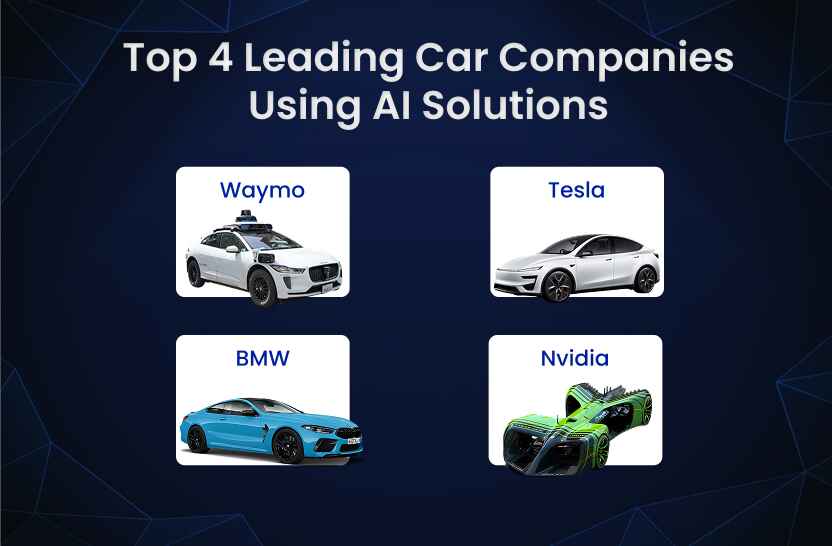
    First-Time Founders Who Need Strong Technical Support

    Not all entrepreneurs have an in-house software development team or CTO. If you have a powerful idea but lack the engineering, UI/UX or product skills to bring it to life. Apptechies gives you access to expert designers, developers and strategists to execute it right. Apptechies accelerator program is specially developed for technology-driven products. Whether it’s an Artificial Intelligence app, marketplace, delivery service, productivity tool or industry-specific software. Apptechies helps you create a polished MVP in line with market expectations and investor criteria. Entrepreneurs Seeking Investor-Ready Prototypes and Funding Support This accelerator is perfect if you want to raise pre-seed or initial funding. Apptechies prepare wireframes, prototypes, pitch decks and one-page websites. And then introduce you to a private network of investors who actively support early-stage innovations. Founders Who Want to Validate Their Idea Quickly If you want to avoid months (or years) of uncertainty, Apptechies is perfect for you. Through structured market validation and UX testing, you will know if there is real demand for your idea before investing heavily in full-scale mobile app development. Bootstrapped Founders Who Need Cost-Effective, Fast Execution It might be difficult and costly to hire separate teams for design, development, branding, and marketing. Apptechies brings all of this together in one streamlined accelerator program for startups. This helps you reduce expenses, prevent errors and accelerate time-to-market.

    Startups Preparing for Product Launch

    If you aim to launch your app in the next 6-12 months, the program will assist you:
    • Create a strong MVP
    • Prepare marketing materials
    • Make a revenue model
    • Increase brand awareness
    • Get user engagement fast
    Everything is optimized to help you live faster and stronger.

    Ambitious Founders Looking for Long-Term Guidance

    The accelerator is more than simply a 12-week experience. Apptechies help founders even after the program ends. This accelerator guarantees you’re never creating alone. You get long-term assistance, growth mentorship, and strategic direction.

    Inside the Apptechies Accelerator Program Structure

    The Apptechies Startup Accelerator program is designed to support founders at every stage of their journey. They ensure that your app idea doesn’t just stay on paper. They help you transform your idea into a fully functional, market-ready product that attracts investors. This is how our program works: Idea Validation Before development starts, it’s important to make sure your app idea has real market potential and that it solves real problems. In this phase, they help startups:
    • Conduct thorough market research
    • Gather feedback from potential users
    • Refine and optimize the app concept
    Validating your idea early reduces risk, saves time and creates a strong foundation for growth.

    Guidance & Mentorship

    Every startup benefits from experienced guidance. At Apptechies accelerator program, entrepreneurs gain access to a network of industry experts and advisors who provide:
    • Strategic guidance for developing a scalable business model
    • Insight into market trends and user behaviour
    • Tailored assistance to overcome challenges during the startup journey
    This mentorship ensures you make better decisions and avoid common pitfalls in the early stages of your startup.

    One-Page Design & Development Support

    Once the app idea is validated, we provide practical design and development support. Startups receive:
    • One-page app design showing core functionality
    • A clickable prototype to demonstrate your vision to potential investors
    This stage enables you to evaluate user interactions and effectively convey your idea. Prepared you for real-world development without delays.

    Investor Pitch Support

    A convincing pitch is necessary to secure funds and the Apptechies accelerator program for startups offers:
    • Professional guidance for creating a compelling pitch deck
    • Tools and techniques for successfully communicating your startup vision
    • Coaching to improve investor engagement and presentation skills
    With the right preparation, your startup is in a position to make a strong impression on investors.

    Startup Funding

    In the Accelerator program, startups can secure early-stage investment from our investor network in exchange for equity after a strong pitch. This funding allows you to:
    • Build and scale your mobile application efficiently
    • Launch a product more quickly without limiting resources
    • Concentrate on expansion and confidently enter new markets.
    Our structured approach minimizes delays and maximizes success. They ensure that entrepreneurs proceed smoothly from idea to funding.

    Key Benefits and Opportunities for Founders

    Faster MVP Launch

    Bring your product to life in record time. With dedicated engineering support, you can reduce development timelines from months to just a few weeks. This helps entrepreneurs test ideas faster. Collect real user feedback and reach the market ahead of the competition.

    Access to Funding & Investor Networks

    Connect with the right people at the right time. Angel investors, venture capital firms, and international finance partners extend a cordial introduction to founders. This significantly increases your chances of securing seed, pre-seed or Series A investment.

    Continuous Mentorship

    Never build alone. You get weekly 1:1 and group coaching sessions with product experts, business strategists, technology leaders and marketing experts. Every decision, from product roadmap to growth strategy, is guided by seasoned mentors with prior expertise.

    Marketing & Branding Support

    Start with confidence. Accelerator offers practical support in developing your marketing plan, content and brand strategy. This ensures that your product not only works well, but also looks good and reaches the right audience from day one.

    Alumni Network & Long-Term Guidance

    Your journey does not end after the launch. You will have lifelong access to a strong alumni network, ongoing mentoring, special events and long-term advisory support. Stay connected to an ecosystem that constantly opens new doors, opportunities and collaborations.

    Application Process For Applying to the Accelerator Program

    Application Process For Applying to the Accelerator Program-Apptechies

    Submit Your Application

    Start by filling out an application form with your startup details, product vision and founder information. This helps our team understand your idea and the problem you are solving.

    Team & Product Evaluation

    Our professionals assess the background, market potential, viability of the product, and general preparedness of your team. We evaluate how well your startup aligns with the accelerator’s goals.

    Initial Interview

    Shortlisted founders are invited to a one-to-one interview. This conversation helps them to understand your motivation, long-term vision and the challenges you are trying to solve.

    Program Acceptance

    If your startup meets the selection criteria, you will receive an official acceptance letter with the next steps, timelines and onboarding guidelines.

    Sign the NDA (Non-Disclosure Agreement)

    Before sharing any sensitive information, both parties sign an NDA. This guarantees trust and confidentiality. It protects your idea, product details and business plans.

    E-Sign Agreement

    Founders complete the formal onboarding process by e-signing the Accelerator Agreement. This specifies program parameters, mentorship engagement and expectations.

    Schedule Meeting

    Once the paperwork is complete, schedule an introductory call with the accelerator team to align goals, timelines, and your customized program roadmap.

    Begin Your Accelerator Journey

    Now that everything is in place, you’re officially ready to get started! Engage in growth activities, product development, workshops, and mentoring sessions to help your startup succeed.

    Final Thoughts

    For startups, 2026 is a crucial year, the market will be dominated by those who act quickly, build efficiently and make use of expert networks. A startup accelerator program can be the difference between struggling for years and scaling in months. Now you know what are startup accelerators, we curated a list of top 10 best startup accelerator programs, so you can choose according to your needs. While global giants like Y Combinator, Techstars, and 500 Global remain strong contenders, Apptechies stands out as the most practical, execution-focused accelerator program for startups or entrepreneurs who want real product results, not just advice. If you’re ready to build, launch and scale your startup faster than ever, an accelerator like Apptechies could be your starting place.

    Author Name: Ajay Chaudhary

    Author Bio: AJ Chaudhary, CEO of Apptechies. He is a full-stack & AI Mobile app developer with 10+ years of experience developing web & mobile applications. He has successfully delivered projects for different industries and helped companies turn concepts into scalable solutions. Passionate about technology, he simplifies complicated tech topics for entrepreneurs and startups by sharing insights.
  • AI in the Automotive Industry | Benefits & Use Cases

    AI in the Automotive Industry | Benefits & Use Cases

    The automotive industry is undergoing a massive transformation, and AI in automotive industry is at the forefront of this revolution. AI is transforming how cars are made, built, and used, from self-driving vehicles to smart manufacturing systems. For companies and startups looking for mobility solutions, understanding automotive AI is no longer optional; it’s essential. According to Grand View Research, the size of the global artificial intelligence market is expected to reach a remarkable CAGR of 23.4% from 2025 to 2030. By 2030, it is projected to reach USD 14.92 billion. This rapid growth highlights how important AI technology has become for businesses. If you want to integrate AI into your business then consider the best AI development company like Apptechies and stand out among your competitors. Whether it’s optimizing supply chains, safety enhancement, or improving customer experiences, the benefits of Artificial Intelligence in the automotive industry are numerous and demanding. In this blog, we will explore how AI is changing the automotive sector, highlight the most popular use cases, discuss future trends, and address key challenges.

    What is AI in Automotive Industry?

    When we talk about AI in the automotive industry, we are referring to the integration of machine learning, computer vision, data analysis, and decision automation technologies into vehicles, manufacturing processes, supply chains and mobility services. In practice, this means systems such as: When we talk about AI in automotive industry, we are referring to the integration of machine learning, computer vision, data analysis, and decision automation technologies into vehicles, manufacturing processes, supply chains and mobility services. In practice, this means systems such as:
      • Understand and interpret the environment (e.g., cameras in vehicles, lidar, radar).
      • Learn from large amounts of operating or usage data.
      • Make predictions (e.g., when a part will fail, which route is optimal), and
      • Perform or assist tasks (eg, smart maintenance scheduling, automatic braking).
    For example, according to Intel, Artificial Intelligence in automotive industry can “generate insights about vehicles, their drivers and road conditions. It also assists in educating near-real-time decision-making,” whether human or automated. Another perspective is that AI is the brain and nervous system overlay on top of the traditional mechanical and electronic vehicle/platform architecture. From an ecosystem perspective, this also means that if you work with or are part of an AI app development company. The role of AI in mobile app development is growing rapidly, you are not just building a mobile app, you are pushing the potential of intelligence, connectivity, UX, and service platform layers of the vehicle. AI assisted driving autonomy levels

    Impact of Artificial Intelligence in Automotive Industry

    The use of artificial intelligence in the automotive industry is changing all aspects of automobile operations. From production to customer interaction. The impact is not limited to traditional car manufacturers. AI is also shaping mobility services and taxi businesses. It provides opportunities for startups looking for ways to start a taxi business.

    AI in Manufacturing Processes

    AI-powered manufacturing optimizes production lines, reduces downtime and improves quality control. Smart robotics, predictive maintenance and data-driven analytics. Automakers can build vehicles more efficiently and cost-effectively. This ensures that both traditional cars and fleet vehicles for taxi services are built to high safety and performance standards.

    AI in Dealership Services

    AI is used by dealers to offer personalized experiences, predictive maintenance alerts and real-time customer support. For entrepreneurs planning to start a taxi business. These AI insights can inform better vehicle selection, fleet management and service offerings. Similar AI-powered solutions can be integrated into your own mobility platform by partnering with a taxi app development company.

    AI in Dealership Marketing

    AI-powered marketing helps retailers target the right customers with personalized campaigns and promotions. By analyzing customer behavior and preferences, companies can increase conversions and improve ROI. Startups considering the cost of building a taxi app like Uber can use AI marketing tools. It helps to attract riders, optimize campaigns and effectively grow their taxi business.

    Benefits of AI in Automobile Industry

    The benefits of AI in automotive industry are diverse. Impacting operations, production, safety, customer experience, and business models. Here are few of the key advantages:

    Better Safety and Driver Experience

    AI-driven solutions that reduce accident rates such as advanced driver assistance systems (ADAS). By identifying risks, detecting road conditions, and reacting faster than human drivers. Voice, gestures, and adaptive interfaces are examples of personalized in-car. It improves comfort and engagement.

    Efficiency in Manufacturing and Operations

    AI makes it possible for smarter production lines, automated robotics, and predictive maintenance for machinery and quality control. It reduces costs, minimizes downtime and accelerates time to market. It is one of the major benefits of AI in automotive industry.

    Supply-chain Optimization and Logistics

    AI in the automotive sector helps cut waste, decrease lead times. It better matches production with market demand. AI improves the responsiveness and efficiency of supply chains from demand forecasting to inventory optimization.

    Data-driven Design and Innovation

    AI enables digital twins of vehicles, simulation of crash/structural behaviour, rapid prototyping of new functions and insight-driven function development. This helps manufacturers react to change faster and speeds up innovation.

    Cost Savings and Profitability

    AI Adoption leads to measurable cost savings in operations, maintenance and production. The worldwide automotive AI market is projected to grow $21 billion by 2030. It highlights the potential for producers and service providers.

    Improved Customer Experience

    AI provides more intelligent after-sales services, predictive maintenance alerts and customized in-car experiences. In addition to creating chances for new revenue streams like subscription-based features and mobility platforms as a service, this increases brand loyalty. You Can Also Read: Must have AI Features in Your Uber Like Taxi Booking App

    Top Use Cases Of AI in Automotive

    Advanced Driver Assistance System (ADAS)

    AI ha a bug impact on driving. Adaptive speed control, lane assistance, collision avoidance and automated emergency braking are among the features of ADAS. Real-time data from sensors, cameras and radars is analyzed by these systems. It improves driving comfort and reduces collisions. As the technology advances, ADAS keeps opening the door to fully driverless cars.

    Autonomous Vehicles

    Self-driving cars are one of the most revolutionary use cases of AI in automotive industry. AI enables automobiles to access their surroundings, make quick decisions and drive safely without human help. The ability of autonomous cars to understand traffic conditions has increased safety and efficiency.

    Driver Monitoring

    AI-powered driver monitoring systems identify fatigue, distraction or drowsiness using behavioral analysis, facial recognition, and eye tracking. To ensure safe driving conditions, the system issues a warning or takes corrective action. If a driver shows symptoms of inattention. Many car manufacturers are integrating these features to meet global safety regulations and reduce the risk of accidents.

    Artificial Intelligence in Manufacturing

    In modern car factories, AI is transforming production through automation, robotics and predictive maintenance. AI-powered smart robots increase production accuracy. It reduces human errors and performs quality checks in real time. Additionally, its predictive analytics assist in identifying any equipment failures before they occur. It improves operations and lowers downtime.

    Personal Assistant

    AI-powered in-car personal assistants, such as voice or gesture-controlled systems. Drivers may control music, climate, navigation, and other features without using their hands. Over time, these assistants learn driver preferences, making the experience intuitive and personalized. This use case is a key differentiator for premium and next-generation connected vehicles.

    Passenger Experience

    AI enhances the whole passenger experience. It offers customized lighting, temperature, entertainment and seat position. It also supports an infotainment system that adjusts to individual mood and schedule. Every trip should be safer, smarter, safer and more pleasurable.

    Supply Chain Management

    AI helps automotive companies optimize their supply chain operations. It includes demand forecasting, logistics and inventory management. With predictive analytics, manufacturers can predict material shortages, shorten lead times. It assures on-time production and delivery. This results in reduced costs and improved efficiency in the supply chain.

    Automotive

    Insurance AI is transforming automotive insurance by using predictive modeling and telematics data to assess driving behavior and risk profiles. Insurance companies can provide customized premiums. It also detects false claims and improves the speed of the settlement of claims. AI ensures transparency and fairness for both drivers and insurance companies.

    Quality Control

    AI-powered quality control systems utilize computer vision to inspect every part of the vehicle during production. These systems can detect even small imperfections that the human eye might not notice. As a result, manufacturers achieve higher accuracy, lower recalls and improved customer satisfaction.

    Connected Cars

    The concept of connected cars depends mainly on AI and data analysis. Vehicles communicate with each other and the infrastructure (V2X – Vehicle-to-Everything). It allows real-time data sharing for safety alerts, navigation updates and traffic management. This interconnected ecosystem increases road safety, reduces congestion and improves mobility in cities.

    AI in Designing

    AI uses generative design, simulation and digital twins to speed up the vehicle design process. Before building real prototypes, engineers can test new ideas virtually and optimize performance. This allows more innovative and sustainable vehicle designs to reduce development cycles. You can also read: Benefits of AI in Education

    Top 4 Leading Car Companies Using AI Solutions

    BMW

    BMW uses advanced AI solutions in production which control quality and predictive maintenance. Their smart factories utilize AI-powered robots to increase productivity. This reduces errors and improves safety. BMW is also integrating AI into connected car experiences and driver assistance functions.

    Tesla

    Tesla is one of the most well-known innovators in the use of AI in the automotive sector. From autonomous driving to real-time decision-making using neural networks. Tesla’s vehicles continuously learn from millions of miles of road data. Their AI-powered autopilot system sets a global benchmark for self-driving technologies.

    Waymo

    Waymo, a subsidiary of Alphabet, is focusing heavily on completely autonomous vehicles. Perception, prediction and planning algorithms are all parts of the AI stack. It helps vehicles in navigating complex situations. Waymo is also a leader in robot taxi services. Many entrepreneurs have been motivated by this model to learn how to start a taxi business using modern technology.

    Nvidia

    Nvidia’s AI chips and systems, such as Derive AGX, powers the automobile industry. This makes it possible for automakers to create vehicles smarter, safer and more autonomous. Their hardware and software ecosystem enhances machine learning, real-time analytics and vehicle simulation. It is crucial for any taxi app development company who wants to build a future-ready mobility app.

    Future of AI in Automotive Industry

    The future of AI in automotive industry is moving fast and based on real, measurable speed. According to a recent study by McKinsey & Company, AI-enabled opportunities throughout the vehicle value chain could produce approximately USD 215 billion in value by 2025. Meanwhile, the global automotive AI market is estimated to grow between USD 21 billion to USD 24 billion by 2030. These numbers show how artificial intelligence in the automotive industry will move. From autopilot projects to business operations. It is anticipated that cars and mobility services will become more autonomous. Connected and software-defined, enabled by AI plus edge/cloud computing, 5G, advanced sensors, and IoT in the automotive industry. For businesses integrating AI with a trusted mobile app development company. This shows how Artificial Intelligence revolutionizes the industries. It makes new business models such as predictive maintenance, voice/gesture interfaces and smart car features. It also provides adaptive user experiences and mobility as a service. It’s about intelligent ecosystems. Brands that use Artificial Intelligence now will lead the future of the mobility industry.

    Challenges & Risks of Adopting AI in the Automotive Sector

    key challenges how to solve them You Can Also Read: How AI is Revolutionizing the Future of Social Media

    Final Thought

    The use of AI in automotive industry is revolutionizing, driving innovation, efficiency and personalized experiences. From factories to vehicles to mobility services. The benefits of artificial intelligence in automotive industry are clear. Businesses that adopt AI via can unlock new revenue streams. Although challenges exist, careful planning and strong infrastructure are needed. Also, strategic partnerships make Artificial Intelligence adoption possible and highly beneficial. The use of AI in automotive industry is revolutionizing by driving innovation, efficiency, and personalized experiences. From automobiles to factories to transportation services. The benefits of artificial intelligence in automotive industry are clear. Businesses that adopt AI via mobile app development companies can unlock new revenue streams. Although challenges exist but careful planning and robust infrastructure are required. Adoption of AI is also possible and very beneficial through strategic partnerships.

    Frequently Asked Questions

    Q. How Much Does it Cost to Integrate AI in Mobile App Development?

    Ans: There are a number of elements that affect the cost of integrating AI into mobile app development. Size, features, platform and computing requirements and complexity. A simple AI integration can start from $10,000 to $30,000. A completely AI-enabled app, such as a ride-hailing platform, can cost over $100,000. If you want to build an app partnering with a trusted taxi app development company like Apptechies is the best choice.

    Q. What is the Role of AI in Automotive Industry?

    Ans: The role of AI in the automotive industry is transformative.Better passenger experiences, autonomous driving, predictive maintenance, and production are all made possible by AI. It also powers intelligent fleet management and connected cars. Entrepreneurs who want to launch a taxi business can use AI to monitor driver behavior and optimize routes. They can also offer personalized services to ensure safer and more efficient operations.

    Q. What are Examples of AI in Automotive Industry?

    Ans: Some practical examples of artificial intelligence in the automotive industry include:
      • To prevent crashes and lane changes, use advanced driver assistance systems (ADAS).
      • Predictive maintenance with data from vehicle sensors
      • Autonomous and semi-autonomous vehicles
      • Telematics and fleet management driven by AI
      • Infotainment systems and personal assistants in automobiles
    These examples show how the use of artificial intelligence in the automotive industry can improve safety, efficiency, and customer satisfaction in both traditional vehicles and mobility services.

    Author Name: Ajay Chaudhary

    Author Bio: AJ Chaudhary, CEO of Apptechies. He is a full-stack & AI Mobile app developer with 10+ years of experience developing web & mobile applications. He has successfully delivered projects for different industries and helped companies turn concepts into scalable solutions. Passionate about technology, he simplifies complicated tech topics for entrepreneurs and startups by sharing insights.
  • Top 10 Taxi Business Ideas for Startups to Launch in 2026

    Top 10 Taxi Business Ideas for Startups to Launch in 2026

    If you are a taxi business owner and want to build your own taxi app, then partnering with a trusted taxi app development company is an ideal choice. A well-designed taxi business app helps your business attract more customers and derive long-term growth. This is the right time to dive into this industry. You can choose from eco-friendly rides to luxury chauffeur services. There are countless taxi business opportunities that combine innovation and profitability.

    In this blog, we will discover the top taxi business ideas that Startups can use in 2026 to start a successful and profitable ride service. These innovative business ideas will help you create a profitable business model.

    Why Start a Taxi Business?

    The future of the taxi business is brighter than ever. According to recent reports, the global taxi market size is estimated to reach $347.86 billion by 2030. It increases at a significant rate due to the rise of ride-sharing platforms. The growing dependency on technology and shifting customer priorities towards on-demand mobility options. In addition, due to the need for advanced technology of ride-hailing systems, the market size of taxi apps is predicted to grow from $56.16 billion in 2021 to $180.53 billion by 2026. This rapid growth is driven by the rising demand for online taxi booking apps.

    why start a taxi business

    Starting a cab business in 2026 helps startups to leverage this rising demand and capitalize on the ease people now expect. There are multiple benefits of taxi app development that help businesses grow and be visible. It improves operational productivity, increases business revenue, and reduces expenses. Several cities use app-based driving solutions. Startups need to integrate Artificial Intelligence in their taxi business services. With this, your taxi business gets excellent market positioning and long-term scalability.

    10 Best Taxi Business Ideas for Startups in 2026

    The taxi sector provides a variety of opportunities for entrepreneurs. Here are 10 innovative taxi business ideas, each thoroughly described, along with growth strategies to maximize success:

    Airport Transfer Taxi Services

    Airport transfers are reliable and in high demand. Travelers want comfortable, trusted, and on-time transportation. VIP pickups, luggage assistance, and pre-booking are a few examples of this service. Airports are crowded places where travelers need to get transport reliably and quickly. This makes airport taxi services one of the most profitable cab business ideas.

    How It Works

    Customers choose the type of vehicle when booking rides through a taxi business app. The drivers keep track of flight schedules and modify the pickup time accordingly. Driver allocation, schedules, and payments are automatically managed by taxi service software.

    Growth Tips

    Partner with airlines, hotels, and travel agencies. Introduce loyalty programs for frequent passengers and provide premium services such as Wi-Fi and refreshment. To optimize revenue during periods of high demand, implement surge pricing.

    Corporate Taxi Solutions

    Companies need well-planned, reliable transport for employees and clients. A corporate taxi service is an important business opportunity and scalable cab business idea because it offers digital management, convenience, and safety.

    How It Works

    Businesses use taxi service software to subscribe to a package. Employees book rides through an app, while the software manages scheduling, invoicing, and analytics.

    Growth Tips

    Provide specialized packages for different company sizes, give priority to executive,s and emphasize professionalism and time punctuality. Operational planning can be enhanced by analytical reporting.

    Women-Only Taxi Services

    Women-only taxis are a profitable niche and highly in demand due to safety concerns. These businesses provide safe travelling options for female passengers by hiring female drivers and integrating safety features.

    How It Works

    Women travelers book rides through a ride-hailing app with SOS Alert, GPS tracking, and secure messaging. Only verified female drivers are assigned.

    Growth Tips

    Target university students, corporate offices, and urban ladies. Emphasize safety certifications, provide referral incentives, and collect user feedback to improve the quality of the service.

    Electric Vehicle (EV) & Eco-Friendly Taxi Service

    Eco-friendly transport is a growing trend, and sustainability is no longer a choice. This is one of the most demanding cab business ideas for startups or entrepreneurs. An EV taxi service appeals to environmentally conscious commuters and reduces operational costs over time.

    EV taxi services

    How It Works

    Use a fleet of electric or hybrid or electric cars that are managed by taxi business software. The software can assist with tracking environmentally friendly incentives, scheduling charging, and battery level monitoring. Customers can choose electric vehicle (EV) rides in-app.

    Growth Tips

    Collaborate with EV charging networks for discounts. Promote your business as “green transport” to attract conscious consumers. Explore state incentives and grants for environmentally friendly projects.

    Rural and Intercity Taxi Business

    Urban markets may look saturated, but there is often a lack of reliable taxi services in rural and intercity sectors. Making them one of the top taxi business ideas, your startup can stand out by serving these areas.

    How It Works

    Drivers provide on-demand or scheduled transportation between urban and rural areas. Booking can be done via a taxi business app, with customized fares for longer trips.

    Growth Tips

    Participated with bus stations, train stations, and local businesses. Provide ride packages for frequent passengers. Prioritize safety, punctuality, and vehicle comfort, which are often lacking in rural transport.

    Luxury Taxi or Chauffeur Services

    Luxury taxi services are perfect for high-net-worth individuals, corporate professionals, and tourists who appreciate comfort, style, and exclusivity.

    How It Works

    Using a taxi business app, customers reserve long limousines, SUVs, or luxury sedans. Chauffeurs receive customer service and polite behavior training. The services may include airport pickup, city tours, or event transportation.

    Growth Tips

    Work together with hotels, event planners, and travel agencies. Provide hourly rentals for weddings, parties, and business events. Invest in luxury vehicles and maintain exceptional cleanliness and service.

    Ride-Sharing and Carpooling App

    Urban passengers want cost-effective, environmentally friendly solutions. Ride sharing reduces traffic and provides a reasonable travel option.

    How It Works

    Users can share rides with others traveling to the same route by using the taxi business app. Automatic payment, route optimization, and GPS tracking in real time improve efficiency.

    Growth Tips

    Introduce referral programs to promote the adoption of apps. Collaborate with companies to encourage carpooling among employees. Highlighting benefits for the environment to attract eco-conscious users.

    Senior Citizen Taxi Services

    Elderly people often face mobility challenges. Taxi services dedicated to the elderly prioritize comfort, safety and assistance. This niche is profitable and the smartest taxi business idea for startups and entrepreneurs.

    How It Works

    Drivers receive special training to help the senior passengers. Wheelchair accessibility, medical appointment scheduling, and notifications about caregivers in real time are the features that the taxi business app can offer.

    Growth Tips

    Collaborate with clinics, hospitals, and pension communities. Provide packages based on subscriptions for regular visits. Highlighting credibility, safety, and personal service.

    Bike Taxi Service

    In crowded cities, bike taxis are perfect for short trips. They provide fast, affordable trips and are especially popular with students and daily travelers.

    How It Works

    Passengers book or schedule rides through an app. Taxi service software manages GPS tracking, riding and fare calculation.

    Growth Tips

    Focus on busy areas such as the marketplace, colleges, and business districts. Make sure drivers follow safety rules and provide subscription packages or discounts during peak hours.

    On-Demand App-Based Taxi Business

    The market for ride-hailing services is still dominated by on-demand taxi services. Convenience, speed and reliability make it a profitable model and one of the most popular taxi business ideas.on demand taxi app development

    How It Works

    Users book a trip through a taxi business app. The app connects them to drivers nearby in real time, provides fare estimates and offers cashless payment options. Service quality is ensured by rating.

    Growth Tips

    Offer easy-to-use app features such as live tracking, estimated fares, and loyalty rewards. Expand to niche markets such as luxurious rides, only taxis for women, or EV options. Invest in marketing campaigns that emphasize security, convenience, and reliability.

    Key Features Every Taxi Business Should Have

    Whether you are planning to launch a local taxi service or a large-scale ride-hailing platform. The key to success for every taxi business app is having the right features that deliver convenience, safety, and efficiency. These features not only increase customer satisfaction but also streamline the operations, which helps startups to run a profitable cab service.

    Here is the list of key features every taxi business should have:

    Real-Time GPS Tracking

    Real-time tracking is the most important feature in every taxi business app. This feature provides details about the live location of the driver, estimated arrival time and route to the passengers. On the business level, GPS tracking helps operators monitor the movements of the fleet and optimize routes that improve the overall ride experience. It also increases transparency and trust with customers.

    Multiple and Secure Payment Options

    Today’s riders want to experience uninterrupted digital payment like credit/debit cards, mobile wallet, UPI and cash. It improves convenience and ensures that you never lose customers due to limited payment options. Keeps the transaction safe and flawless by integrating safe payment gateways with your taxi software.

    In-App Booking and Scheduling

    An easy-to-use booking system is the foundation of your taxi business software. It should allow users to book immediate trips, schedule future trips, or make bookings for special events. This flexibility also appeals to those who like to plan in advance.

    Real-Time Notifications and Ride Alerts

    Push notifications keep passengers informed throughout their trip, from driver appointment to arrival, ongoing ride status and the confirmation of the payment. Drivers receive information about route changes and new ride requests. These features reduce misunderstandings and ensure clear communication.

    Driver and Passenger Rating Reviews

    Rating from customers is essential to maintain the quality of service. An integrated rating system promotes responsibility among drivers and builds trust for new riders. By monitoring feedback by using taxi business apps, Startups can quickly spot problems early and reward top-performing drivers.

    SOS and Safety Features

    Safety is the topmost priority for the passengers, especially for women, elderly people, and late-night travelers. By implementing an SOS button, real-time live ride sharing with contacts and driver verification, which provides a crucial layer of trust. These security measures make your taxi business services more credible and attractive.

    Automated Fare Calculation

    Eliminates the need for manual negotiating by integrating an automated fare system. Taxi business apps should calculate fares based on factors such as distance, time, and surge prices. Before and after every ride, transparent fare details which minimize conflicts and build customer trust.

    Advanced Admin Dashboard

    Your taxi business software must have a powerful admin panel to manage rides, drivers, customers and transactions. A centralized dashboard enables real-time data tracking, performance analysis and business forecasting. This helps you make informed decisions and maximize profitability.

    Referral Rewards and Loyalty Programs

    Keeping customers is just as important as attracting new customers. Rewarding frequent riders with discounts, referral bonuses or loyalty points keeps them engaged. Including reward features in a taxi business app can greatly increase user retention and generate referral marketing.

    24/7 Customer Support Integration

    Customers’ satisfaction increases due to providing reliable 24/7 support. Whether via call assistance, in-app chat, or AI-powered chatbots, a quick solution to problems helps create credibility and enduring confidence.

    Multi-Language and Multi-Currency Support

    If your goal is to expand globally or serve diverse demographics, this feature becomes necessary. Multilingual and currency options ensure that your taxi application is available for the wider user base. It improves usability and customer experience.

    multi language-currency support in taxi app

    Analytics and Reporting Tools

    Modern taxi service software should provide detailed information about the frequency of the ride, performance of the driver, revenue and behavior of the customer. These analytics let you spot trends to make smart decisions and optimize operations for better performance.

    Things to Know Before Starting a Taxi Business

    Starting a cab business in 2026 is one of the most profitable taxi business ideas, but success does not come by chance. It comes with proper planning, strategy and wise use of technology. Whether you want to build a small local taxi service or one of the best taxi business ideas like EV taxis, women-only rides or business solutions. There are some essential things you should know before deciding how to start a taxi business. Understanding these key factors will help you minimize the risk, attract more customers, and run your business more effectively.

    Research Your Target Market

    Before investing in the start of the taxi, Analyze your local market and audience behavior before investing in your cab business. Find out who needs your taxi service most: senior citizens, daily commuters, airport travelers, or corporate employees. Identifying your target audience helps you choose the best niche from the top taxi business ideas and design features to satisfy your users. For example, if there is heavy airport traffic in your area, a taxi service for airport transfer can provide a profitable business.

    Choose the Right Taxi Business Model

    Your business model defines how you will generate revenue. You can run your own fleet, collaborate with independent drivers, or create a commission-based ride-hailing platform.

    • The fleet ownership model gives you authority over vehicles and drivers, but it requires a higher investment.
    • The aggregator model (like Uber) connects riders and drivers, and offers high scalability with low costs.
    • Hybrid models are excellent for long-term growth as they combine both strategies.

    Choosing the right model ensures that your cab business idea fits in the budget and future expansion.

    Get Proper Licensing and Legal Approvals

    Each city or country has specific laws for taxi operations. Before launching your cab services, collect all the required licenses, background checks on drivers, inspection of vehicles, permits, and insurance coverage. If these are neglected, it can lead to fines or shut down your business. Before launching, make sure your taxi business app operates within legal boundaries and that all drivers meet licensing standards. Adherence not only builds credibility but also increases the customer’s trust.

    Invest in a Reliable Taxi Business App

    Technology drives success in the modern ride-hailing industry. A well-designed taxi app lets users easily book rides, track drivers in real-time and make payments safely. Using taxi business software transforms your idea from a traditional cab setup into a scalable, modern and customer-centric taxi service.

    Build a Strong Driver Network

    Your drivers are the foundation of your taxi business. The primary goal is to hire experienced, polite and skilled drivers. Provide incentives, rewards and flexible schedules to maintain the driver’s loyalty and consistency in their work.

    Prioritize Vehicle Maintenance and Safety

    A clean, well-maintained and comfortable vehicle which quickly wins customer trust. Routine inspections, maintenance plans and cleanliness checks are necessary. Every vehicle should be equipped with emergency features and a GPS tracker. In the competitive taxi industry, reliability and security are what make one-time travelers to loyal users.

    Plan Your Pricing Strategy Wisely

    Prices can create or break your cab business. Maintain a balance between customers’ affordability by setting competitive rates. To maximize the highest revenue, many successful taxi business ideas use dynamic pricing models that charge slightly higher prices during peak hours or high-demand periods. Makes it easy and transparent if your taxi service software has automated fare calculating.

    Focus on Branding and Marketing

    Strong branding helps your service stand out. Design a professional logo, color scheme and tagline that reflects your business values. Market your taxi business app through social media, SEO and Google Ads. Referring bonuses, loyalty points and discounts on the first ride help your best taxi booking app increase user engagement and ride bookings.

    Use Data and Analytics to Improve Operations

    The key to growing any successful taxi service is data. Your taxi app can provide real-time insights on bookings, popular routes and client ratings. Use this data to refine prices, optimize the routes and identify areas with high demand. Making decisions based on data helps you stay ahead of the competition and lets you provide more personalized customer service.

    Prioritize Customer Experience

    Customer satisfaction is a must in every business, it drives repeat bookings and referrals. Focus on comfort, punctuality and offer polite service. Prompt driver communication and transparent pricing and a seamless in-app booking experience are all very important. Encourage feedback through your taxi business app and respond to it immediately. Excellent service makes first-time users loyal riders and builds the long-term reputation of your taxi business.

    How Does a Taxi App Support Your Business Ideas?

    A taxi business app is crucial to making your cab business ideas into a profitable taxi service. A well-designed app allows users to schedule trips, book rides immediately, track drivers’ live location and make payment safely. These features improve customer satisfaction and encourage repeated use.

    On the management side, startups can monitor fleets, assign rides effectively, analyze riding data and optimize operations. Features such as automatic price calculation, driver verification and security alerts build trust between riders and drivers.

    Startups can reduce operating costs, improve productivity and expand their services by combining a user-friendly taxi business app for customers with strong backend software for operations. This approach ensures that your service is up to date, reliable and listed among the best taxi business ideas of the year.

    How to Build a Taxi Booking App?

    In today’s fast-paced world, a taxi booking app is no longer optional. It is important. If you want to transform your taxi business ideas into a modern, scalable and profitable taxi service app. Whether you are planning airport transfers, women-only rides or environmentally friendly taxis, a well-designed app can make your cab business successful. Here is the step-by-step guide to build a taxi booking app.

    how to build a taxi booking app

    Define Your Concept and Features

    Start by identifying your target audience and niche. Choose the essential features such as easy ride booking, live GPS tracking, price calculation, secure payments, driver assessments and notifications. Clear planning at this stage ensures that your app meets the expectations of both rider and driver.

    Choose the Right Platform

    Before choosing the platform, first know the difference between Android and iOS apps. You can build a native app for iOS (Swift) and Android (Kotlin/Java) for the best performance. You can also use cross-platform frameworks such as Flutter or React Native to save time and reach more users.

    Design a User-friendly Interface

    Your app should be simple and easy to use. For riders and drivers. Intuitive navigation, clear buttons, the booking process is easy with smooth navigation, live updates and easy payment options.

    Choose the Right Tech Stack

    Choosing the right tech stack is important for developing a scalable, high-performing and secure taxi app. It ensures that your app is able to handle each process without any delay.

    Testing & QA

    Before launch, test the app for ease of use, performance and security. Resolve the errors to deliver a smooth and reliable experience from day one.

    Launch, Promote and Maintain

    After your app launches, market your app through social media, app stores and referral campaigns. Regular updates, performance monitoring and new features help your taxi business app to remain competitive and user-friendly.

    Why to Choose Apptechies for Taxi App Development Services?

    When planning to build a taxi booking app, the most crucial step is choosing the right taxi app development partner, which makes a lot of difference, and Apptechies is the right choice because they have expertise in this industry.

    Apptechies is a leading web and mobile app development company in the USA. They offer feature-rich, AI-powered iOS, Android and cross-platform app development services for startups, businesses and enterprises across multiple industries. With a deep knowledge of digital transformation and mobility solutions, they help multiple companies transform their taxi business ideas into high-performing, scalable and profitable on-demand taxi applications.

    Here is the reason why businesses all over the world trust Apptechies for taxi app development services:

    Expertise in Taxi App Development

    With highly skilled taxi app developers and designers who have 10+ years of experience in building fully functional taxi booking apps according to different business models. Whether it’s airport transfers and corporate rides to environmentally friendly and luxurious taxi services, they are all set.

    Custom-Built Solutions for Every Business Model They understand that every business is unique and so are their requirements. That’s why they offer custom taxi app development solutions that match the brand, goals and their targeted audience.

    AI-Powered Features for Smart Operations

    Apptechies integrate advanced AI-powered features such as smart route optimization, dynamic prices, predictive demand forecasts and intelligent driver allocation. These features help businesses reduce their operating costs, improve productivity and boost user experience for both drivers and passengers.

    Scalable and Future-Ready Technology

    They use the advanced technology stack and cloud-based architecture to build your taxi applications. They make sure if you expand your business, then your app performs fast, safe, and reliable.

    Exceptional User Experience

    Their experienced designer team focuses on creating a user-friendly interface that allows users to book rides easily, quickly and safely. Each feature is designed to provide maximum convenience, from live tracking to in-app payment.

    End-to-End Development Services

    Apptechies provide full support from idea validation and UI/UX design to development, deployment and maintenance. For your taxi business app, you get a reliable partner who drives growth and success.

    Ongoing Support and Upgrades

    They believe that long-term success depends on continued care. They provide support after your app launch, which ensures that your app stays up to date with the latest trends and performs flawlessly

    Proven Industry Expertise

    With a strong portfolio of successful on-demand taxi booking apps and mobility solutions, Apptechies has gained confidence in customers across the world. When choosing Apptechies, you choose innovation, reliability and technology that is suitable for the future of mobility. Their AI-driven taxi app development services help transform your cab business ideas into a profitable and scalable app.

    Final Thought

    The taxi industry offers various opportunities for startups and entrepreneurs in 2026. From airport transfers to bike taxis and Electric Vehicle services, each sector has its own potential and challenges. If your business utilizes taxi business software and a well-designed taxi business app, it improves customer satisfaction and accelerates growth. To excel in this competitive market, you should prioritize client happiness, technology integration and reliability while exploring taxi business ideas for your startups.

    Frequently asked questions​

    Q. What is the Future of Taxi Businesses?

    Ans: The future of the taxi business looks incredibly promising, driven by technology, automation and sustainability. The industry is moving toward more intelligent and environmentally friendly models as a result of the growth of AI-powered taxi apps, electric cars and on-demand mobility platforms. Data-driven decision-making and a taxi business app can help startups develop more quickly and increase client satisfaction.

    Q. What is the Cost to Build a Taxi booking App?

    Ans: The cost of building a taxi booking app depends on various factors such as the complexity of the app, platform (iOS, Android or cross-platform), designs and features. On average, a basic taxi app can cost between $20,000 – $40,000, while advanced apps with AI-powered features, real-time analyses and tracking can cost $50,000 – $100,000+. Collaborating with a professional taxi app development company, such as Apptechies, ensures that you get the best value and scalability of your investment.

    Q. Is the Taxi Business Profitable?

    Ans: Yes, with careful management, the cab business can be very profitable. Commission-based rides, subscriptions and surge pricing are some of the ways that entrepreneurs can make steady money with the increasing demand for on-demand taxi booking apps. Features such as effective route management and AI-driven demand prediction can be integrated into your taxi business app to achieve long-term, sustainable profitability.

    Q. What are the Challenges and Risks in the Taxi Industry?  

    Ans: The taxi industry faces multiple challenges, including increasing competition, fluctuating fuel prices, a shortage of drivers, and changing rules. However, with technology-driven taxi service software, these problems can be effectively addressed. Data insights in real-time, automation, and AI can help optimize operations, reduce costs, and improve customer satisfaction, keeping your business ahead.

    Q. What are the Benefits of Taxi Booking App Development?

    Ans: There are multiple advantages to creating a taxi booking app, like automated ride handling, real-time tracking, secure payments and efficient process. This improves the user’s convenience, improves driver efficiency and reduces manual errors. Furthermore, AI-powered taxi business apps allow data-driven decision-making, predictive maintenance and smart sending systems for maximum revenue.

    Q. How to run a Profitable Taxi Business?

    Ans: To run a profitable taxi business, you should focus on providing security, reliability and convenience to your users. Invest in a custom taxi app that provides real-time data, an effective user panel, a driver panel, admin management, and user-friendly features. Integrating Artificial Intelligence technologies for route optimization, dynamic prices and customer insights. Regular maintenance, digital marketing and feedback loops from customers are also keys to long-term success.

    Author Name: Ajay Chaudhary

    Author Bio: AJ Chaudhary, CEO of Apptechies. He is a full-stack & AI Mobile app developer with 10+ years of experience developing web & mobile applications. He has successfully delivered projects for different industries and helped companies turn concepts into scalable solutions. Passionate about technology, he simplifies complicated tech topics for entrepreneurs and startups by sharing insights.

  • Benefits of AI in Education: How AI is Transforming Learning

    Benefits of AI in Education: How AI is Transforming Learning

    The benefits of AI in education are revolutionizing the way knowledge is delivered and received all over the world. From the experiences of personalized study to digital classrooms, Artificial Intelligence in education is changing how students learn, teachers teach, and run institutions. With the integration of AI education software development, learning is more adaptable, data-driven and open to all. If you want to build an AI-powered feature-rich elearning app partnering with a trusted education app development company is the best choice.

    According to Grand View Research, the market of AI in education is expected to reach $25.7 billion by 2030, increasing at a CAGR of more than 36%. This growth will be driven by the increasing use of AI solutions for education, e-learning platforms and digital changes in schools and universities. This global expansion reflects the growing importance of Artificial Intelligence in education by providing teachers with intelligent analytics, automation tools and AI chatbots that improve engagement and simplify communication.

    AI in the education sector continues to unlock new opportunities as we move toward a more technologically advanced and connected future. It makes the future of learning more inclusive, quicker and smarter. Personalized tutoring, automatic grading systems and generative AI in education are just a few examples of how AI is changing education in the digital age. It is setting the foundation for a future-ready learning ecosystem. In this blog, you will find out the benefits of AI in education, how AI changes learning, and what is the future of AI in education.

    Why AI is Becoming Essential in Modern Learning Apps?

    AI is becoming a crucial element of modern learning applications in today’s rapidly changing digital age. Because it makes education more personalized, effective and accessible. The use of AI in education helps create learning experiences that are compatible with the needs of each student. AI technology analyzes how students learn, their speed, strength and weaknesses, before tailoring content to them. This not only improves engagement but also ensures better learning outcomes.

    This is the future of AI in education, learning applications driven by AI solutions for education are assisting teachers in focusing on creativity and mentorship. While AI handles repetitive tasks as the use of AI technology in education expands globally. Here is why using AI in education apps is a necessity, not an option.

    Adaptive Learning at scale

    AI algorithms enable applications to dynamically modify content according to individual student learning styles, ensuring that the lessons are still challenging but accessible. This scalability means that thousands of students can gain personalized experiences together.

    Predictive Analytics and Insight

    AI analyzes user behavior to predict potential learning challenges. Teachers and developers can use this data to improve the content, maximize engagement, and provide quick responses.

    Automatic Administrative Assistance: 

    By eliminating administrative duties, features like performance reporting and automated grading free up monitoring and automated grading. It allows teachers to focus on mentorship and interactive teaching.

    Enhanced Student Engagement

    As compared to traditional static apps, AI-driven simulation, quiz and interactive activities keep students motivated and make learning more interesting.

    Global Adoption and Market Growth

    AI-powered education apps are being quickly adopted in regions such as North America, Europe and Asia. AI ​​EDTech investment exceeded $1 billion in 2024, according to HoloniIQ, showing its necessary role in the industry.

    Competition Advantages for Developers

    By using AI solutions for education, app developers can create smart, flexible platforms that differentiate themselves in a crowded market. It provides better learning opportunities and increases operational effectiveness.

    Generative AI-Driven Adaptive Learning

    Generative AI makes it possible to create learning exercises, simulations, and quizzes that match each student’s progress and needs. This ensures a more personal approach to education and improves important thinking and problem-solving skills.

    Top Pros & Cons of AI in Education

    The way EdTech platforms, schools, and colleges are transformed by Artificial Intelligence. While the benefits of using AI in education are unquestionable, it is equally important to consider challenges. Below are the pros and cons of AI in education that highlight both advantages and disadvantages.

    Pros of AI in Education

    Personalized Education

    AI optimizes lessons and study material based on the preferences and progress of each learner, which is one of the key advantages of AI in education.

    24/7 Learning Assistance

    Through AI chatbots for education, students can get immediate help at any time and from anywhere.

    Enhanced Teaching Efficiency

    AI improves retention by recommending the right videos, tests or lessons at the right time, aligning education with the future of AI in education and workforce demands.

    Improved Accessibility

    The use of Artificial Intelligence in education helps students with unique needs and removes language barriers.

    Data-Driven Insight

    One of the major benefits of using AI in education is accuracy and speed are increased for tasks like feedback and grading.

    Cons of AI in Education

    High Implementation Costs

    To build and maintain AI-powered platforms, large investments are required in technology, software and training, which can be difficult for small institutions.

    Data Privacy and Security Risk

    A massive amount of student data are collected and examined, increasing concerns for privacy, compliance and ethical use.

    Algorithm Bias

    AI systems trained on biased data may accidentally give preference to some groups, which may affect learning and evaluation quality.

    Over-Dependence on Technology

    Relying too much on AI tools might affect the development of critical thinking abilities, creativity and interactions between teachers and students.

    Digital Divide

    Students in some areas with limited internet access or devices might not be able to take full use of AI-powered educational solutions.

    Limited Human Judgment

    Although AI can provide insight and automation, it cannot take the place of human empathy, smart decision-making or mentorship, which are crucial in education.

    advantages of ai in education

    Real-World Examples of AI in Education

    Artificial intelligence has completely changed the global education sector, making learning more accessible, personalized and entertaining than ever before. The importance of artificial intelligence in education allows both teachers and students in the education sector, from virtual teachers to smart classrooms. Here are 10 globally popular examples of AI in education that demonstrate how technology is changing learning experiences worldwide.

    Duolingo – Personalized Language Learning

    Duolingo is the most popular language learning app with more than 500 million users. Duolingo uses AI Technology in education to tailor lessons for each student. By offering immediate feedback and interactive challenges, the platform optimizes the user’s learning speed, strengths and weaknesses. It makes language learning more effective and entertaining.

    Coursera – AI-based Course Recommendations

    Coursera is one of the largest e-learning platforms. Uses AI for education to recommend courses based on students’ learning preferences and learning history. Millions of students who received help in finding the right educational paths through its recommendation system, which increases user engagement.

    Squirrel AI Learning – Adaptive Learning in China

    Squirrel AI Learning is an expert in AI education software development, providing millions of students in China with personalized tutoring through advanced algorithms. The platform continuously adjusts lesson difficulty based on real-time performance data, and greatly enhances academic results.

    Carnegie Learning – Intelligent Math Tutoring

    Carnegie Learning offers customized mathematics training by fusing cognitive science and Artificial Intelligence. Its intelligent teaching system tracks the process of solving the problem of each student and provides tailored feedback, which helps teachers focus on the areas in which students most require assistance.

    Brainly – AI Chatbots for Homework Assistance

    AI Chatbots are used in education by Brainly, a global learning community, to help students with homework and study-related inquiries. The AI evaluates millions of questions to deliver accurate, clear answers that encourage collaboration and online education.

    Microsoft Immersive Reader – Accessibility to All

    As an aspect of its AI solutions, Microsoft’s Immersive Reader supports students’ problems with learning, like dyslexia or ADHD, by using text-to-speech and translation tools. It promotes equality by making educational resources accessible to students all over the world.

    Content Technologies, Inc.

    Content Technologies, Inc. (CTI) uses generative AI in education to create customized digital textbooks and assessments. The platform can automatically design learning content based on a student’s curriculum, the platform can save teachers a great deal of time.

    Century Tech- AI-Powered Personalized Learning

    Century Tech is an AI education company in the UK that provides customized learning experiences by fusing artificial intelligence and neuroscience. By detecting knowledge gaps and modifying the way content is delivered. The technology assists both students and teachers in making data-driven decisions.

    Quizlet – Smart Learning Through AI

    With over 60 million monthly users, Quizlet uses an AI algorithm to generate customized study sets, monitor user progress, and suggest educational resources. The AI-powered “Learn Mode” helps students memorize quickly and maintain longer knowledge.

    Konitan

    Konitan is now a part of Wiley, which uses AI analytics to track student progress and predict learning results. One great example of how AI technology in education improves the efficiency of the class to each student’s needs by gaining insights about individual performance.

    uses of ai in education

    You can read also: How AI is Revolutionizing the Future of Social Media

    Why Choose Apptechies As your Education App Development Company for AI Integration

    Artificial Intelligence (AI) has become an important force behind the transformation of how teachers and students learn and teach. The success of any AI-driven solution depends on choosing the best elearning app development company is essential. Whether it involves creating smart teaching systems or personalized learning platforms. Apptechies, a trusted mobile app development company, with its cutting-edge, scalable and AI-powered app designed to transform learning experiences worldwide.

    Here’s why Apptechies is an ideal partner for an education app development company for AI integration.

    Specialization in AI and Mobile Application Development

    We at Apptechies are experts in creating AI-powered mobile apps. Our skilled mobile app developers use modern technologies such as machine learning, NLP and generative AI to design applications that provide smart, data-driven and interactive learning environments.

    Experience Across Various Industries

    Apptechies have provided powerful web and mobile solutions for various industries, including healthcare, logistics, e-commerce and even taxi app development services.

    Custom Educational Application Solution

    We understand that each learning platform is unique. From AI-Chatbots for education to an intelligent content delivery system, Apptechies creates a customized solution that increases engagement, streamlines administrative work and boosts learning results.

    Affordable and Transparent Prices

    Understanding the cost to build a mobile app is an important factor for any business or institution. Apptechies provide transparent pricing, guaranteeing high-quality education app development within your budget, without compromising features or creativity.

    Cross-Platform Expertise: iOS and Android

    Our app development team specializes in both platforms, understands the difference between iOS and Android app performance, design standards and user behavior. This assures that your AI-powered educational software runs smoothly, efficiently and consistently on all devices.

    Data Security and Scalability

    One of the main concerns with AI in education is data privacy. We create scalable, safe and legal applications that protect students’ information while serving 1000 users at once. Ensuring the reliability of schools, universities and global EDTech startups.

    traditional classroom vs ai powered classroom

    Challenges and Considerations of AI in Education App 

    While the benefits of using AI in education change the field of learning. There are some key challenges to its successful adoption that educators and developers should consider. Understanding these challenges helps to ensure that the advantages of AI in education are implemented ethically and sustainably.

    Data Privacy and Security Risk

    Student data is crucial to the tailored learning that AI-powered educational apps provide. But, this raises serious concerns about how this data is collected, stored and protected. Schools and EDTech companies should implement strong cyber security measures, follow data protection laws such as GDPR and CCPA, and maintain transparency to retain trust between students and parents.

    Limited AI Knowledge Among Educators

    The use of artificial intelligence in education is expanding faster than most teachers can keep up with. Many teachers lack the technical knowledge to effectively use or manage AI-based platforms. Ongoing professional training, awareness campaigns and assistance from AI experts are required to eliminate this difference in knowledge and help educators maximize the potential of AI in education.

    Ethical and Fair Use Challenges

    The AI ​​systems may unknowingly reflect the biases that are present in their training data, which may affect grading, admission or recommendations. In order to ensure justice and equality, schools must use transparent and impartial AI systems that promote moral guidelines for the use of AI.

    Integration with Current Leaching Systems

    It is often complicated to merge AI tools with traditional school systems. Adoption may be slow due to the problems of compatibility, limited budget and lack of technical assistance. The transition will go smoothly and successfully if reputable tech companies are partnered with and integration-friendly platforms are used.

    Human Resistance to Change

    Even with clear advantages of AI in education, resistance from teachers, students or parents is common. There are some fears that AI may replace teachers or reduce human contact. In fact, AI acts as a helpful tool, so that teachers can focus on creativity, mentorship and emotional learning.

    By dealing with these challenges carefully, institutions can actually capitalize on the importance of artificial intelligence in education. With ethical methods, data protection and proper training, the future of AI in education promises smarter, more inclusive and more interesting learning experiences for everyone.

    You can read also: Top Trending App Ideas for Startups

    Future Trends of AI in Education App Development

    The Future of AI in education is having a significant impact on the education app development. These developments are making the benefits of AI in education more efficient, personalized and accessible while also improving the educational experiences and simplifying administrative processes.

    AI-Enhanced Personalized Learning

    AI is making it possible for educational apps to provide a tailored learning experience by examining student data. This personalization authorizes adaptive learning paths and ensures that the content is appropriate for each student’s speed and understanding. Such customization improves commitment and better learning results.

    AI on-device for performance and privacy

    An emerging trend is the direct integration of AI features into devices to improve app performance and address data privacy concerns. AI processing on devices reduces the delay and ensures that sensitive student data remains safe and provides all a spontaneous user experience.

    AI-driven material production

    AI is being used more and more in Elearning apps to create dynamic content such as quiz, flashcards and interactive simulations. This automation not only saves time for teachers but also ensures that learning materials are constantly updated and correspond to the current educational standards.

    Voice and Natural Language Processing (NLP) Integration

    Integrating voice recognition and NLP in educational apps provides more interactive and intuitive user interfaces. Students can get involved with content through voice commands, which can make learning more accessible, especially for people with disabilities or language barriers.

    AI-Driven Analytics for Educators

    Advanced Analytics run by AI provides deep insight into student performance and behavior. This insight allows teachers to identify learning gaps and modify their teaching strategies accordingly, and promote a more responsible educational environment.

    Seamless Integration with Learning Management Systems (LMS)

    Modern educational apps are designed to be seamlessly integrated with existing LMS platforms. This interoperability ensures that the AI ​​tool can be used without disturbing the installed workflows, providing a smoother learning experience.

    AI-Powered Gamification

    ELearning apps are using AI-driven gamification elements to increase the connection. These functions are compatible with personal learning styles and progress by offering personal challenges and rewards that motivate students to participate actively in the learning journey.

    Conclusion

    AI is already changing learning apps around the world and the benefits of AI in education include personalization, efficiency, increased engagement, accessibility, cost-effectiveness and data-driven insights. But the advantages of AI in education will be maximized when combined with thoughtful policies, strong morality, human monitoring and legitimate access. The role of Artificial Intelligence in mobile app development is very crucial. When we look at the future of AI in education, it is clear that this change is not about changing teachers or old teaching methods, but about increasing and expanding education. If you develop or deploy elearning apps, the importance of artificial intelligence in education is something you cannot ignore. 

    Frequently Asked Questions

    Q. What is the future of AI in Education?

    Ans: The future of AI in education seems very promising. AI is predicted to improve learning for students at all levels by making it more personalized, efficient and accessible. From smart teaching systems and virtual classrooms to data-driven insights for educators, AI will play an important role in improving learner performance and engagement. Over the coming years, AI-powered apps are likely to be an essential part of the digital ecosystem of each school and university.

    Q. Is AI in Education Safe for Young Children?

    Ans: Yes, AI in education can be safe for young students when implemented with responsibility. Developers and teachers should ensure compliance with privacy laws such as GDPR and COPPA to protect children’s personal information. Using safe platforms, parental controls and ethical AI systems to make learning safe and more beneficial for children.

    Q. How is Artificial Intelligence used in Education?

    Ans: The use of artificial intelligence in education spreads in many areas. AI is used to customize lessons, automate administrative tasks, provide real-time responses and help students learn at their own pace. Making classrooms more effective and inclusive also helps teachers monitor student progress and identify where further support is required.

    Q. How is AI currently being used in higher education?

    Ans: In higher education, AI changes how institutions work. Universities use AI for automated grading, research support, educational counseling, plagiarism detection and future analysis to improve the success rate of the student. AI-powered learning management systems and virtual assistants also help to make higher education more adaptable and data-driven.

    Q. What is the cost of AI Education App Development?

    Ans: The cost of AI Education App development varies depending on the complexity, features, design and platform for the app. On average, the cost of a basic AI-powered e-learning app can cost between $25,000 – $60,000, while advanced, feature-rich solutions with analytics, AR/VR integration or multilingual support can range from $80,000 – $200,000 or more. Better quality, scalability and long-term value are guaranteed when working with an experienced educational app development company like Apptechies.

    Q. What is the Role of Generative AI in Higher Education?

    Ans: Generative AI in higher education helps create personalized learning experiences, create lecture notes, quizzes, research summaries and provide 24/7 educational help through AI tutors. Additionally, it helps to automate administrative duties such as grading and scheduling. Generative AI helps educators and students by increasing creativity, efficiency and student engagement. This highlights the benefits of AI in education and helps to shape its future.

    Author Name: Ajay Chaudhary

    Author Bio: AJ Chaudhary, CEO of Apptechies. He is a full-stack & AI Mobile app developer with 10+ years of experience developing web & mobile applications. He has successfully delivered projects for different industries and helped companies turn concepts into scalable solutions. Passionate about technology, he simplifies complicated tech topics for entrepreneurs and startups by sharing insights.