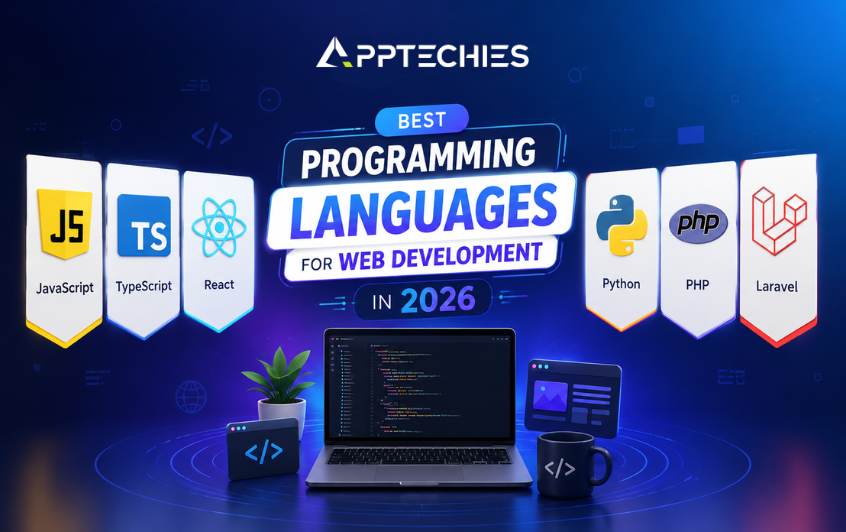
Best Programming Languages for Web Development in 2026
Picking the wrong programming language for a web project is one of the most expensive mistakes a business can make. It slows development. It raises hiring costs. It creates technical debt that can take years to untangle.
The global web development market is expected to exceed $89 billion by 2027. Every business, from a two-person startup to a Fortune 500 company, needs a web presence. And behind every great website is a language choice that either helps or hurts the team building it.
Here is the reality: there is no single best language for every project. JavaScript powers the world’s most visited sites. Python runs the backend of some of the smartest applications. PHP still serves over 77% of all websites. Java handles millions of daily banking transactions without breaking a sweat.
What matters is matching the language to your goals. That means thinking about:
- Development Speed: How fast can your team ship features?
- Scalability: Can the codebase handle 10x growth?
- Security: How well does the language protect user data?
- Hiring: How easy is it to find skilled developers?
- Cost: What does long-term maintenance actually look like?
- AI Compatibility: Does the language support modern AI tooling?
This guide covers all of it. Whether you are a business owner evaluating a technology partner, a startup founder scoping your MVP, or a developer wanting to sharpen your stack knowledge, this is built for you.
At Apptechies, we have built web applications across dozens of industries using multiple languages and frameworks. This guide reflects what we have seen work and what we have seen fail.
What is a Web Development Programming Language?
A programming language is a formal set of instructions that tells computers what to do. In web development, these languages control everything you see on a website: the layout, the buttons, the data, the logic behind login systems, checkout flows, and search results.
There are two environments where web languages operate:
Client-side (frontend): Code that runs inside the user’s browser. It determines what you see and engage with.. HTML structures the content. CSS styles it. JavaScript makes it move and respond.
Server-Side (backend): Code that runs on a server. It handles databases, user authentication, business logic, and data processing before sending results to the browser.
Real World Examples
Netflix uses Node.js on the backend for its streaming engine and React on the frontend for the user interface.
Amazon uses Java and C++ for its core infrastructure and React for the customer-facing web experience.
Facebook (Meta) built its own PHP framework (Hack) and React, a JavaScript library now used by millions of developers worldwide.
Airbnb relies on Ruby on Rails for its backend and React for the frontend, handling millions of bookings daily.
Understanding this distinction helps you make better decisions when choosing your tech stack.
Frontend vs Backend vs Full-Stack Development
Before choosing a language, you need to understand where it fits in the development ecosystem.
Frontend development focuses on user experience. Every pixel, animation, and button click is driven by frontend code. Backend development is the engine underneath, invisible to users but critical to everything working correctly.
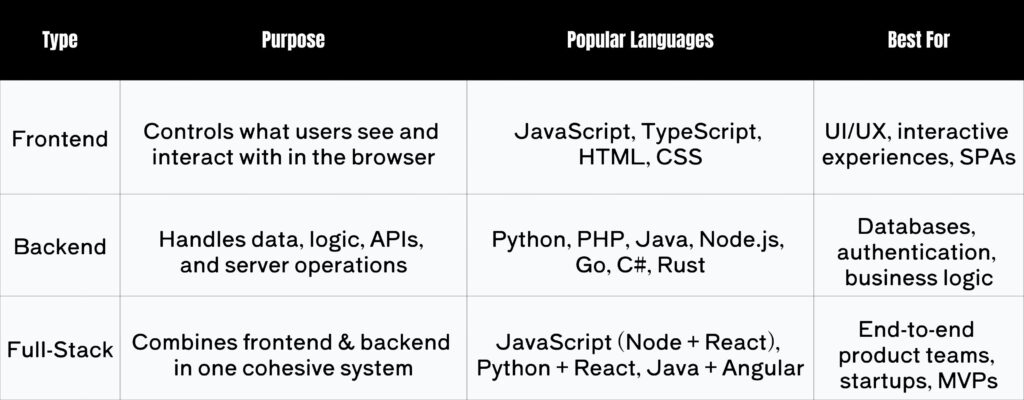
Businesses building complete digital solutions often partner with teams that handle both layers. Our web development services cover the full stack, from pixel-perfect interfaces to robust backend architecture.
How to Choose the Best Programming Language for Web Development
No language wins every category. The best option depends on your specific circumstances. Here is the decision-making framework we use at Apptechies when advising clients.
Business Goals
- Startups: Speed matters. Choose JavaScript (MERN stack) or Python. Both have large talent pools and fast development cycles.
- Enterprise: Stability and security matter most. Java, C#, and Python have scaled successfully.
- SaaS Platforms: Scalability is the priority. Node.js, Go, or Python with React on the frontend handle rapid user growth well.
- Marketplaces: Complex logic and real-time features need proven stacks like MERN or Python + Django.
Scalability
Some languages handle 1,000 concurrent users easily. Others handle 10 million. Go and Java are built for extreme scale. PHP and Ruby work well at medium scale with proper architecture. Node.js scales horizontally with minimal cost.
Budget
PHP and Python developers are generally more affordable to hire. Java and .NET specialists command higher salaries. Open-source frameworks (Django, Laravel, React) reduce licensing costs significantly compared to proprietary solutions.
Security
All major languages offer strong security when used correctly. Java and .NET have mature enterprise-grade security features. Python has extensive libraries for encryption and secure coding. Rust is gaining traction for security-critical systems due to its memory-safe design.
Hiring Availability
JavaScript developers are the most available globally. Python is close behind. Java has a large talent pool concentrated in enterprise sectors. Go and Rust are newer — fewer developers, but growing fast.
AI Compatibility
If your product roadmap includes AI features, Python is the dominant choice. Its ecosystem — TensorFlow, PyTorch, scikit-learn — is unmatched. JavaScript also has AI libraries, but they are less mature for production AI workloads.
Top Frontend Programming Languages
JavaScript
The only programming language that is compatible with all web browsers is JavaScript. It is the foundation of frontend web development. Nothing else comes close in terms of ecosystem size and adoption.
Advantages
- Runs in every browser — no installation required for end users
- More than two million npm packages make up this vast ecosystem.
- Huge developer community — easiest language to hire for
- Handles both frontend and backend (via Node.js)
- Real-time features like live chat and notifications are straightforward
Disadvantages
- Dynamic typing can lead to bugs in large codebases
- Inconsistent browser behavior requires testing across environments
- Security vulnerabilities if developers are not careful (XSS, injection attacks)
Top Frameworks
- React: Component-based UI library by Meta. Used by Facebook, Instagram, Airbnb, Netflix.
- Vue.js: Lightweight and beginner-friendly. Popular for smaller teams.
- Angular: Full-featured framework by Google. Preferred for large enterprise applications.
Best Use Cases
- Single-page applications (SPAs)
- Real-time dashboards and web apps
- Progressive Web Apps (PWAs)
- Full-stack development with Node.js
TypeScript
TypeScript is JavaScript with types. It adds static type-checking to catch errors before they reach production. Microsoft built it, and it has become the default choice for serious JavaScript projects.
Why Enterprises Prefer TypeScript:
- Catches errors at compile time, not at runtime — fewer bugs in production
- Better tooling and code editor support (autocomplete, refactoring)
- Scales better in large teams where multiple developers touch the same codebase
- Seamlessly integrates with React — most new React projects are TypeScript-first
Stack Overflow’s 2024 developer survey ranked TypeScript as one of the most loved and most used languages for the fourth consecutive year. Its adoption is only accelerating in 2026.
HTML & CSS
HTML and CSS are not traditional programming languages but they are the foundation of every website on the internet. HTML provides structure. CSS provides style.
No matter which JavaScript framework or backend language you use, the output eventually becomes HTML and CSS that browsers render. Understanding both is non-negotiable for any frontend developer.
CSS has evolved significantly. Modern CSS features like Grid, Flexbox, and Custom Properties allow developers to build complex layouts without heavy JavaScript. CSS frameworks like Tailwind CSS have changed how teams approach styling at scale.
Responsive web design, built with HTML, CSS, and JavaScript, is the foundation for consistent experiences across devices. A specialized mobile app is another way that many companies expand this. Our mobile app development services help teams build cohesive digital experiences across web and mobile.
Top Backend Programming Languages
Python
Python is the most versatile backend language available today. It reads almost like plain English, which makes it fast to write and easy to maintain. But its real superpower is its ecosystem.
Key Frameworks
- Django: A full-featured framework that handles authentication, ORM, admin panels, and more out of the box. Used by Instagram, Pinterest, and Disqus.
- Flask: A lightweight micro-framework for teams that want more control and less abstraction. Popular for APIs and microservices.
- FastAPI: A contemporary, quick framework for creating APIs is called FastAPI. Growing rapidly in 2025-2026 for its performance and automatic documentation.
Advantages
- Fastest development speed for most web applications
- Dominant in data science, machine learning, and AI integration
- Large library of third-party packages (PyPI has over 500,000 packages)
- Clean syntax reduces bugs and improves code readability
Disadvantages
- Slower raw performance compared to Go, Java, or C++
- Not ideal for CPU-intensive tasks without optimization
- The Global Interpreter Lock (GIL) may be a multi-threading bottleneck.
Python is the language of choice for teams building AI-powered web applications. Its integration with machine learning frameworks is unmatched. If your product roadmap includes intelligent features, explore our AI development services to see how we help businesses build smarter systems.
PHP
PHP powers over 77% of all websites on the internet — including WordPress, which alone runs about 43% of the web. It is mature, widely supported, and extremely cost-effective to deploy and maintain.
Key Frameworks & Platforms
- Laravel: Modern PHP framework with elegant syntax, built-in authentication, and a rich ecosystem. A top choice for custom web applications in 2026.
- WordPress: The world’s most popular CMS. Ideal for blogs, business sites, and content-heavy platforms.
- Symfony: Enterprise-grade PHP framework used by large organizations needing robust, modular architecture.
Best For
- Content-heavy websites and blogs
- e-commerce platforms (WooCommerce, Magento)
- Cost-effective custom web applications
- Teams with existing PHP expertise
Java
Java is one of the oldest and most reliable programming languages in existence. It has been the backbone of enterprise software for over 25 years. Although it is not the most preferred option in 2026, nothing compares to it for the proper projects.
Key Frameworks
- Spring Boot: The dominant Java web framework for building enterprise-grade APIs and microservices.
- Hibernate: ORM framework for database operations, widely used in Java enterprise apps.
Best For
- Banking and fintech applications requiring high reliability
- Large enterprise systems with long maintenance cycles
- Android mobile backends
- High-traffic applications needing horizontal scalability
C# and .NET
C# is Microsoft’s flagship programming language. Combined with the .NET ecosystem, it is a top choice for businesses already invested in Microsoft infrastructure — Azure, Windows Server, and Office 365.
- Excellent performance — comparable to Java for most enterprise workloads
- Strong typing and mature tooling with Visual Studio
- Azure cloud integration is seamless
- ASP.NET Core is a fast, modern web framework for APIs and web apps
- Popular in gaming (Unity), desktop software, and enterprise web development
Go (Golang)
Go was built by Google to solve real-world problems: fast compilation, efficient execution, and simple concurrency. It has become the language of choice for teams building high-performance microservices and APIs.
- Compiles to a single binary — simple to deploy anywhere
- Built-in concurrency makes handling thousands of simultaneous requests straightforward
- Fast execution speed — significantly faster than Python and PHP
- Used by Google, Uber, Dropbox, Docker, and Kubernetes
- Best for microservices, API gateways, and real-time systems
Rust
Rust is the most exciting systems language of the decade. It offers C++-level performance with a memory safety model that eliminates entire categories of bugs — null pointer errors, buffer overflows, and data races.
- Ranked the most loved language in Stack Overflow’s survey for 9 consecutive years
- Growing adoption in WebAssembly, embedded systems, and security-critical infrastructure
- Mozilla, Microsoft, Amazon, and the Linux kernel have all adopted Rust
- Steeper learning curve than most languages — not ideal for rapid MVP development
- Best for security-critical systems, performance-intensive backends, and WebAssembly apps
Best Full-Stack Languages and Frameworks
Using comparable front-end and back-end technologies is known as a full-stack approach. The right combination reduces context-switching for developers and simplifies communication across the team.
MERN Stack (MongoDB + Express + React + Node.js)
JavaScript runs everything in MERN — frontend, backend, and database queries. This is the most popular full-stack choice for startups and modern web applications.
Advantages
Single language across the entire stack, massive community, fast development speed, great for real-time apps.
Disadvantages
JavaScript’s flexibility can become a liability in very large teams without strict TypeScript enforcement.
Best For
Startups, MVPs, SaaS platforms, social apps, real-time dashboards.
MEAN Stack (MongoDB + Express + Angular + Node.js)
Like MERN, except using Angular in place of React. Angular’s opinionated structure makes it a better fit for teams that prefer clear conventions over flexibility.
Advantages
TypeScript by default with Angular, strong structure for large teams.
Disadvantages
Compared to React, Angular has a more difficult learning curve.
Best For
Enterprise web applications, teams coming from Java or .NET backgrounds.
Python + React
Python on the backend (Django or FastAPI) paired with React on the frontend. A powerful combination for data-heavy applications, dashboards, and platforms requiring AI integration.
Advantages
Python’s data science ecosystem + React’s UI flexibility = a strong product stack.
Disadvantages
Requires separate frontend and backend expertise.
Best For
Data platforms, analytics dashboards, and AI-powered web apps.
Java + Angular
A proven enterprise combination. Java Spring Boot on the backend with Angular on the frontend. Highly structured, type-safe across the full stack, and trusted by large organizations.
Best For
Banking, insurance, government, and enterprise software.
.NET + React
C# with ASP.NET Core on the backend and React on the frontend. A top choice for businesses in the Microsoft ecosystem wanting modern, performant web applications.
Best For
Microsoft-centric enterprises, Azure-hosted applications, internal business tools.
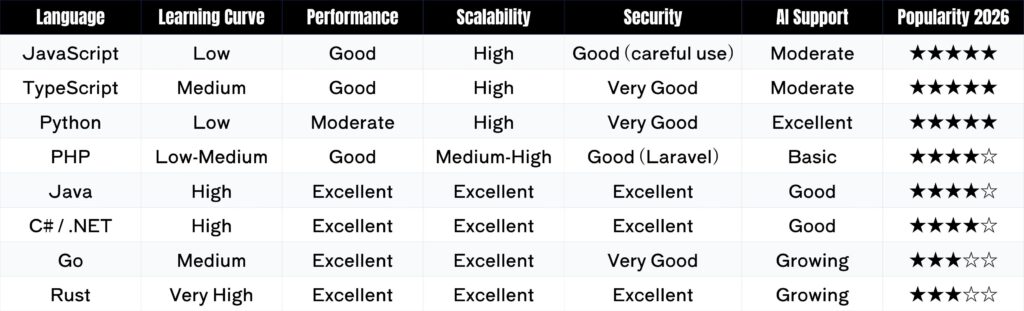
Comprehensive Language Comparison Table
Best Programming Languages by Project Type
Startup Websites
Speed to market is the priority. You need a stack your small team can move fast with, and that investors and early users will find reliable.
Recommended Stack
MERN (MongoDB + Express + React + Node.js) or Python + React with FastAPI
Why
Large talent pools, rapid development, strong open-source ecosystems, and easy to scale when traction comes.
SaaS Platforms
SaaS products need to handle growing user bases, recurring billing, multi-tenancy, and complex business logic.
Recommended Stack
Python (Django/FastAPI) + React, or Node.js + React with PostgreSQL
Why
Both handle complex logic and scale horizontally. Django offers built-in admin tools that accelerate internal operations management.
eCommerce Websites
eCommerce demands performance, security, and reliability. One second of load delay costs conversion rates.
Recommended Stack
PHP (Laravel/WooCommerce) for mid-market, Node.js or Java for high-traffic stores
Why
PHP powers the majority of e-commerce platforms. Laravel offers excellent security features for handling payments and user data.
Enterprise Solutions
Enterprise software requires long-term maintainability, security audits, and integration with existing infrastructure.
Recommended Stack
Java (Spring Boot) + Angular, or C# (.NET) + React
Why
Strong type systems, mature tooling, enterprise support contracts, and decades of proven stability.
AI-Powered Applications
Products that include machine learning models, intelligent recommendations, or natural language processing need a backend built for it.
Recommended Stack
Python (FastAPI or Django) + React, with TensorFlow or PyTorch for model serving
Why
Python’s machine learning ecosystem has no equal. Deploying models as API endpoints with FastAPI is fast and production-ready. We build AI-integrated web applications for businesses across industries. See how our AI development services can make your product smarter.
How AI Is Transforming Web Development
Two years ago, AI in web development meant adding a chatbot. Today, it means fundamentally changing how applications are built, tested, and personalized.
AI Coding Assistants
Tools like GitHub Copilot and Cursor have changed daily development workflows. Developers now write code faster, catch bugs earlier, and spend more time on architecture decisions than repetitive syntax. Studies show developers using AI coding tools complete tasks up to 55% faster in certain scenarios.
AI-Generated and AI-Reviewed Code
AI can now generate boilerplate code, write unit tests, review pull requests for security issues, and suggest performance improvements. This is not replacing developers — it is amplifying their output.
AI-Powered Testing
Manual QA is time-consuming. AI testing tools automatically generate test cases, identify regression issues, and simulate user behavior at scale. Products ship with fewer bugs and faster release cycles.
AI Chatbots and Virtual Assistants
Embedding large language model-powered chatbots into web applications has become standard for customer support, onboarding flows, and lead qualification. Businesses that deploy conversational experiences report measurable improvements in user engagement.
AI Personalization Engines
From eCommerce product recommendations to news feed curation, personalization algorithms are now accessible to mid-market companies, not just tech giants. Python-backed recommendation engines can be deployed as APIs and integrated into any web application.
AI-Enhanced Search
Semantic search powered by vector databases and embedding models is replacing keyword-only search. Users find what they are looking for faster. This lowers bounce rates and increases retention.
Our AI development services help businesses integrate intelligent features into existing web applications and build new products with AI at the core.
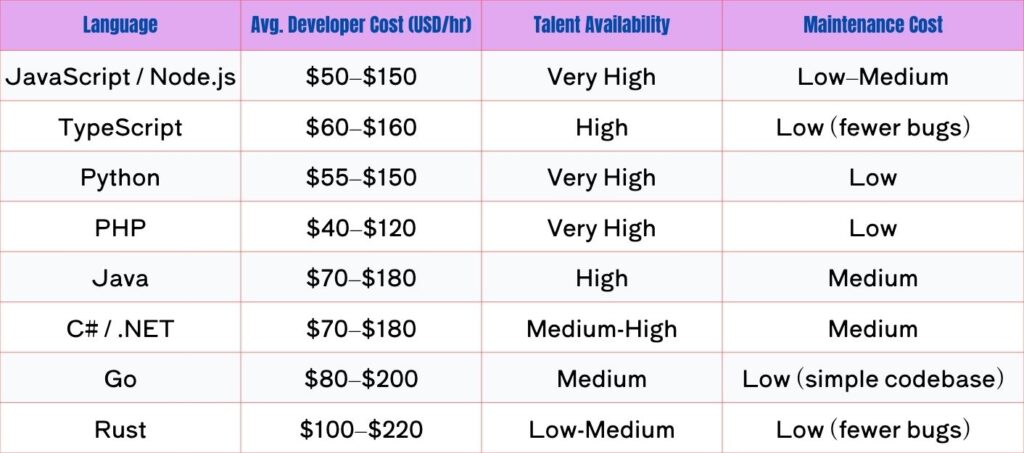
Development Cost Comparison by Language
Language choice directly affects your development budget — both upfront and over time.
Why Some Languages Cost More
- Talent scarcity: Go and Rust developers are rarer. Scarcity drives rates higher regardless of project complexity.
- Framework complexity: Java and .NET enterprise projects often require senior developers with deep domain knowledge.
- Long-term maintenance: Because bugs are discovered early, strongly typed languages (such as TypeScript, Java, C#, and Rust) often have lower maintenance costs.
- PHP and JavaScript: The largest talent pools in the world. Easier and faster to hire, which reduces project risk.
It’s not always the case that the lowest hourly rate equals the lowest overall cost. A PHP project built by experienced developers with clean architecture can cost far less over 5 years than a Go project built by a team learning the language as they go.
Emerging Languages and Technologies to Watch in 2026
Rust — Security-First Performance
Rust is moving from systems programming into web backends. Whole types of vulnerabilities are eliminated by its memory safety paradigm. The US government’s CISA has formally recommended Rust (and similar memory-safe languages) for new software projects. Expect enterprise adoption to accelerate.
TypeScript — The Default JavaScript
TypeScript is no longer an alternative to JavaScript, it is becoming the default. New React projects, Next.js apps, and Node.js backends are TypeScript-first. Any team still writing plain JavaScript in a large codebase will migrate.
WebAssembly (Wasm) — Native Performance in Browsers
WebAssembly allows languages like Rust, C++, and Go to run inside browsers at near-native speed. Video editors, CAD tools, and gaming engines are among the applications that are migrating to the browser from desktop software. Figma, Google Earth, and Autodesk CAD web tools all use WebAssembly.
Edge Computing and Serverless
Running backend code at the network edge, closer to users — reduces latency dramatically. Cloudflare Workers, Vercel Edge Functions, and AWS Lambda at Edge support JavaScript, TypeScript, and WebAssembly. Teams building low-latency applications are moving logic closer to users rather than centralized servers.
Bun — JavaScript Runtime Challenger
Bun is a new JavaScript runtime that claims to be significantly faster than Node.js in benchmarks. It is still maturing, but its performance characteristics are attracting serious attention from the JavaScript community.
Common Mistakes Businesses Make When Choosing a Language
Following Trends Blindly
Rust is impressive. Go is fast. But if your team knows Python and your project is a standard web application, rewriting in Rust because it is trendy adds risk and cost with minimal benefit.
Ignoring Scalability Until It Is Too Late
A language that works perfectly at 1,000 users may struggle at 100,000. Plan for scale upfront, it is far cheaper to architect correctly from the beginning than to refactor under user pressure.
Underestimating Hiring Challenges
Choosing a niche language because one senior developer loves it is a risk. If that developer leaves, you may struggle to find replacement talent. Prioritize languages with large, active communities.
Accumulating Technical Debt Through Poor Framework Choices
The language matters, but the framework matters just as much. Choosing an outdated or abandoned framework creates long-term maintenance costs that dwarf the original development budget.
Choosing Unfamiliar Frameworks Under Time Pressure
When deadlines are tight, teams sometimes pick frameworks they have seen in job postings rather than ones they actually know. This slows development exactly when speed is most critical. Work with what your team knows deeply, then expand.
Not Thinking About Security From the Start
Security is not a post-launch addition. The language, framework, and architectural choices you make at the start determine how easy it is to secure your application later. Languages with strong typing and secure default configurations reduce exposure significantly.
Why Businesses Choose Apptechies for Web Development
We have helped startups validate ideas in weeks, enterprise teams modernize legacy systems, and growing businesses scale their digital infrastructure without technical disruption.
We contribute the following to each project:
Multi-Language Expertise
JavaScript, TypeScript, Python, PHP, Java, C#, and Go are all used by our team.We recommend the right language for your specific project — not the one we happen to know best or find easiest to staff.
Full-Stack and Cross-Platform Delivery
We build web applications, mobile apps, APIs, and cloud infrastructure as connected systems. Your web application and mobile app share consistent data, design, and user experience.
Need a mobile companion to your web application? Our mobile app development services cover iOS and Android native and cross-platform builds.
AI-Ready Architecture
We design backends that can accommodate AI features from day one, even if you are not ready to build them yet. This means your architecture scales into intelligence without requiring a full rebuild.
Explore our AI development services to see how we integrate intelligent capabilities into web products.
Dedicated Development Teams
We offer dedicated team engagements for businesses that need ongoing development capacity. Your team works exclusively on your product, maintaining deep context over time.
Scalable Architecture by Default
We build systems designed to scale from day one. Clean APIs, modular codebases, cloud-native deployments, and CI/CD pipelines are standard, not premium add-ons.
Ongoing Support and Maintenance
We support products we build. Post-launch maintenance, performance monitoring, security updates, and feature development are available through flexible engagement models.
Ready to discuss your project? Visit our web development services page to learn more about how we work.
Building for iOS? Our iOS app development services are a natural extension of our web development capabilities.
Conclusion
Choosing a programming language is not just a technical decision. It is a business decision. The language you build on shapes your hiring strategy, your development speed, your security posture, and your long-term maintenance costs.
Here is what to take away from this guide:
- There is no single best language, match the language to your project goals and team capabilities.
- JavaScript and Python dominate modern web development for good reason, versatility, community, and ecosystem depth.
- TypeScript is the direction JavaScript is heading. Starting new projects with TypeScript is smart in 2026.
- PHP remains viable and cost-effective for content sites and e-commerce.
- Java and C# are still the gold standard for enterprise applications requiring long-term stability.
- Go and Rust are growing rapidly and are worth investing in for performance-critical or security-critical systems.
- AI is not optional anymore, Python’s ecosystem makes it the natural backend choice for any product with an AI roadmap.
The most important factor is not the language itself, it is the team building with it. Experienced developers make any good language work. Inexperienced developers struggle with even the best tools.
Frequently Asked Questions
Q. What Is The Best Programming Language For Web Development In 2026?
Ans: There is no single best language. JavaScript is the most versatile — it works on frontend and backend, has the largest ecosystem, and is easiest to hire for. Python leads for data-heavy or AI-powered applications. PHP is the most cost-effective for content sites. The right choice depends on your project goals, team, and budget.
Q. Is Python Better Than JavaScript For Web Development?
Ans: It depends on the use case.Python is superior for data processing, AI integration, and backend services. JavaScript is better for interactive frontends and full-stack applications where a single language across the stack is valuable. Many modern stacks use both: React (JavaScript) on the frontend and Python on the backend.
Q. Which Language Is Best For AI-powered Web Applications?
Ans: Python. Its machine learning ecosystem — TensorFlow, PyTorch, scikit-learn, Hugging Face — is unmatched. For serving AI models as web APIs, FastAPI is the current best-practice framework in the Python world.
Q. What Language Do Enterprise Websites Use?
Ans: Enterprise web development is dominated by C# (.NET) and Java. Both offer exceptional performance, strong typing, enterprise-grade security, and long-term vendor support. The two most widely used enterprise web frameworks are Spring Boot (Java) and ASP.NET Core (C#).
Q. Is PHP Still Relevant In 2026?
Ans: Yes. PHP powers over 77% of websites globally, including WordPress which runs about 43% of the internet. Laravel has modernized PHP development significantly. For content-heavy sites, eCommerce, and cost-sensitive projects, PHP remains a strong and practical choice.
Q. Is TypeScript Replacing JavaScript?
Ans: Not replacing — evolving. TypeScript compiles to JavaScript and runs everywhere JavaScript runs. But TypeScript adoption is accelerating to the point where new JavaScript projects — especially production applications — increasingly start as TypeScript projects. The transition is gradual but directional.
Q. What Is The Most Scalable Web Development Language?
Ans: Go and Java offer the highest scalability for concurrent workloads. Node.js scales well horizontally with minimal infrastructure cost. For most businesses, the architecture and infrastructure decisions matter more than the language choice when planning for scale.
Q. For Web Development, Which Language Is The Simplest To Learn?
Ans: JavaScript is the most accessible starting point because it runs in the browser with no setup required. Python comes close — its clean syntax is designed to be readable. HTML and CSS are not programming languages in the traditional sense but are the first things every web developer learns.
Q. What Is The Mern Stack?
Ans: MERN stands for MongoDB (database), Express (backend framework), React (frontend library), and Node.js (JavaScript runtime). It is a popular full-stack JavaScript approach where one language — JavaScript — runs across every layer of the application.
Q. What Is The Duration Required To Develop A Web Application?
Ans: It varies significantly based on complexity. A simple informational website can take 2–4 weeks. A custom web application with user authentication, dashboards, and integrations typically takes 3–6 months. Enterprise platforms with complex workflows can take 6–18 months. The language and framework chosen affect development speed significantly.
Q. What Is WebAssembly And Why Does It Matter For Web Development?
Ans: WebAssembly (Wasm) is a binary instruction format that allows code written in Rust, C++, or Go to run in web browsers at near-native speed. It enables applications that were previously impossible in browsers — complex graphics, real-time video processing, and game engines. Its adoption is growing steadily in 2026.
Q. Should I Choose A Popular Language Or The Technically Best One?
Ans: Popularity matters practically. A technically superior but obscure language creates hiring risk, smaller communities, fewer libraries, and potential abandonment. For production web applications, choose languages with active communities, regular releases, and large talent pools. You can always optimize later.
Q. How Do I Know If My Current Tech Stack Is Outdated?
Ans: Signs include: difficulty hiring developers who know your language, dependencies that are no longer maintained, performance bottlenecks that cannot be resolved within the framework, and security vulnerabilities with no patches available. A technical audit by an experienced team can identify these risks early.
Q. Can One Web Application Use Multiple Programming Languages?
Ans: Yes, and many do. Microservices architectures commonly use different languages for different services — Python for data processing, Go for a high-throughput API, and Node.js for real-time features. The frontend is almost always JavaScript or TypeScript regardless of what the backend uses.