
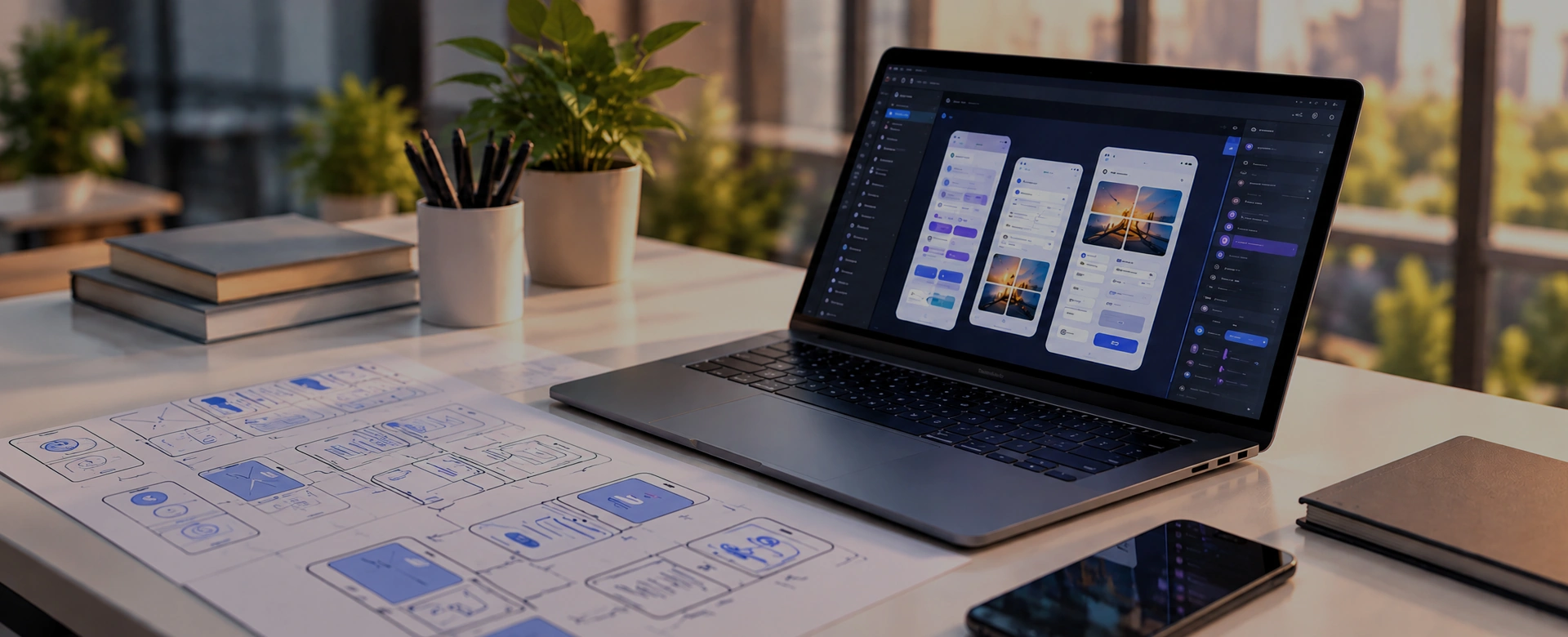
UI/UX Design Services Grounded in Real User Data
Quick answer: Apptechies is a UI/UX design company that studies how people actually use your product, then designs around what that research shows instead of a mood board. We design web and mobile app interfaces, dashboards, and SaaS products for teams that want every screen to earn its place, with each decision tied back to a number: conversion, retention, or task completion.
Trusted by ambitious teams










Keeping Your Users at the Center of Every Design Decision
Our UX design practice runs on a three-phase methodology, and each phase produces something your team can act on.

Supercharging UI/UX Design with Predictive & Generative Intelligence
We blend human-centered design craft with deep learning telemetry and generative systems to build interfaces that convert higher, test faster, and adapt dynamically.
Predictive Eye-Tracking & Heatmaps
Neural attention models simulate gaze fixations across candidate UI layouts before code is written, ensuring critical CTAs receive 94% immediate focal capture.
Generative Design Token Synthesis
Autonomous sync bridges design variables in Figma with semantic CSS custom properties and React component props, eliminating manual token translation.
Cognitive Persona Simulations
Autonomous AI user agents navigate interactive prototypes, stress-testing complex workflows, edge-case fallbacks, and microcopy clarity.
Adaptive Multi-Variant UI Generation
Generative design algorithms generate contextual layout variations tuned for specific user segments and accessibility profiles.
Think Broad, Act Deep With Our Design Sprint Workshops
A focused, time-boxed workshop that aligns stakeholders and validates a product direction with real users in days, not months. It is a useful step before committing budget to a full design engagement or a larger SaaS product build.
Products We've Built
FreshHook
Food Delivery
Challenge
FreshHook is a fresh-fish delivery marketplace connecting buyers directly with fishmongers and suppliers.
Approach
We built real-time catalog browsing, ordering and doorstep delivery.
Result
FreshHook runs on iOS, Android and the web as an on-demand delivery marketplace.
What Our Design Clients Say
They cleared all my doubts and turned my idea into a powerful app.
Recognized by the Best
Top App Development Company, USA
Best Web App Development Agency

Top 10 App Development Firm

Best Software Development Agency

Best AI Development Agency

Frequently Asked Questions
Common questions about UI/UX design services. Can't find yours? Ask us directly on the right.
A full engagement covers user research, information architecture, wireframes, high-fidelity UI design, an interactive prototype, and a developer-ready design system. Smaller engagements can focus on a single flow, such as checkout or onboarding, rather than a full product.
UX (user experience) design is the research and structure behind a product: how it flows, what users need, and why. UI (user interface) design is the visual layer, meaning colors, typography, spacing, and components. Strong UX with weak UI still confuses people, and polished UI on broken UX just looks good while failing to work, so most projects need both.
A focused design sprint for a single product flow typically runs $8,000 to $20,000. A full end-to-end engagement, covering research, information architecture, wireframes, high-fidelity UI, and a design system, usually runs $30,000 to $80,000, depending on product complexity and the number of user roles involved.
The number of user roles and screens, how much original research is needed, how many rounds of usability testing you want before development starts, and how quickly stakeholders review and approve work all affect the schedule. A single-flow redesign can move in a few weeks; a full product design system takes longer.
Look at their actual case studies and ask what changed after the redesign, not just how it looks. Ask how they test with real users, what a typical deliverable set looks like, and how design work hands off to engineering. Much of the same evaluation criteria we cover in our guide to choosing a software development company applies here too.
Typically: user research findings, personas and journey maps, information architecture and flow diagrams, wireframes, high-fidelity mockups, an interactive prototype, and a developer-ready design system or component library, rather than just a folder of static screens.
Yes. Most engagements are redesigns of specific flows inside a live product rather than greenfield work, so we start by reviewing your current interface, component library, and any technical constraints. Where the redesign touches backend workflows or third-party tools, that usually runs alongside our software integration services.
An incremental redesign of the flows causing the most friction, such as checkout or onboarding, is usually faster to ship and easier to measure than a full rebuild. A full redesign makes more sense when the underlying information architecture no longer matches how the product is actually used. Usability testing on what is already live tells us which one applies.
Because friction in a user flow costs money directly: every extra step in checkout or onboarding loses people who would otherwise have converted. Good UX design is measurable through usability testing scores, task completion rates, and conversion lift, not just subjective taste.
Yes. Our design sprint workshops are a focused, time-boxed way to align stakeholders and validate a product direction with real users in days rather than months, which is useful before committing budget to a full design engagement.
Yes, a designer or small design team can work inside your existing product roadmap rather than as a one-off project. We staff this in a similar way to how we arrange dedicated software developers for an existing team, adapted for design roles and design tooling.
We work with product teams and businesses across the United States, United Kingdom, India, Australia, and the UAE, along with international clients outside those markets. Time zone overlap, review cadence, and handoff format are agreed at the start of the engagement.
You own the final designs, prototypes, and design system files delivered under the engagement. We are happy to sign an NDA before any detailed discussion of your product; mention it when you reach out and we will send one over before the first call.
Handoff includes the design system, component specs, and prototype your engineering team builds from. Many clients bring us back for a review pass once the build is in staging, to check the implementation against the original design intent before launch.
Get Expert Guidance on Your Design Strategy
Book a free 45-minute consultation with our senior UX designers.