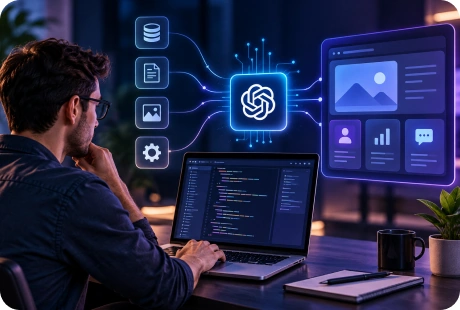
Build AI software that answers customer questions, automates repetitive work, and helps your team make better use of data. Apptechies develops custom AI applications, agents, and machine learning solutions, from the first prototype to production support.
Trusted by industry leaders worldwide
Trusted partnerships built on technology, expertise and results.




Quick answer: Apptechies is a custom AI development company building AI applications, intelligent agents, and predictive systems. Our artificial intelligence development services cover consulting, data preparation, model development, integration, and ongoing support for startups and enterprises in the USA, UK, and India.
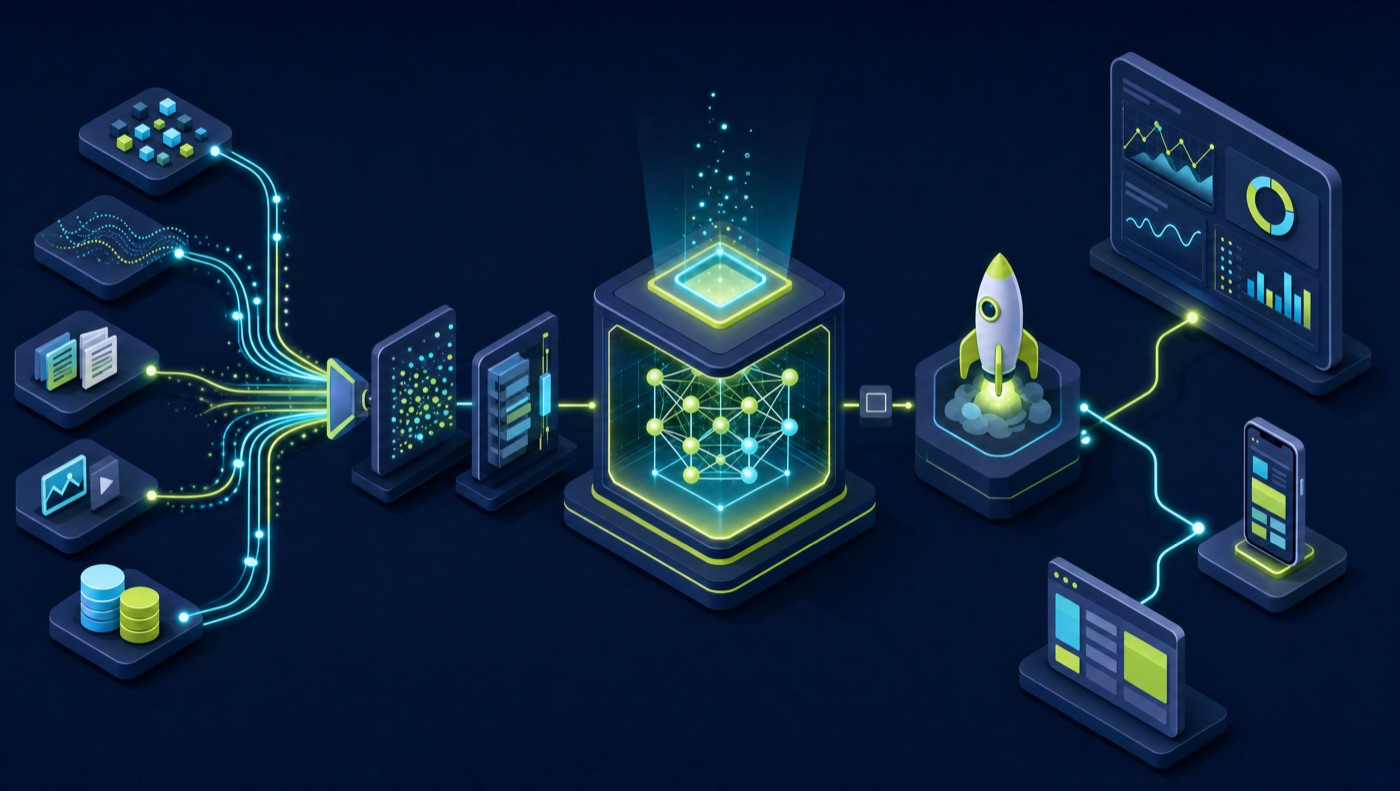
Explore our work across generative AI, mobile experiences, and business platforms. Each case study explains the product and delivery scope.
Built the native iOS and Android apps and AI generation backend for MyMood AI. The product turns selfies into portraits and avatars, bringing generative AI into a mobile experience with a wide choice of visual styles.

Our work and expertise have earned recognition from respected organisations across technology and business.

Clutch
GoodFirms
DesignRush
Manifest

UpCity

Clutch
Techreviewer
TopDevelopers
From AI consulting and custom software development to generative AI, machine learning, and automation, choose the expertise your project needs. We build around your data, existing systems, and business goals.
Our AI consulting services help you decide what to build, whether your data is ready, and how to measure the result. We assess use cases, compare technical approaches, and define the scope, costs, and risks before development begins.
Our AI consulting services help you decide what to build, whether your data is ready, and how to measure the result. We assess use cases, compare technical approaches, and define the scope, costs, and risks before development begins.
AI development cost depends on your data, features, integrations, and evaluation needs. We help you scope a practical first build and separate development costs from ongoing model and hosting costs. Explore our AI development cost guide before planning your budget.
Genuine client relationships across AI, SaaS, mobile, and web applications.
“They cleared all my doubts and turned my idea into a powerful app.”
Founder, PlayHuman
“The AI-powered fitness platform Apptechies developed integrates personalized workout plans, nutrition tracking, and real-time progress monitoring in one beautiful app. Their technical execution has been exceptional.”
Owner, Ultravoom
“Flawless execution, smooth communication, and on-time delivery.”
Owner, GenieChat
Explore AI use cases for healthcare, finance, retail, logistics, and other industries. We match the workflow to your data and define where evaluation and human review are needed.
Client Satisfaction, average across all projects.
“The AI-powered fitness platform Apptechies developed integrates personalized workout plans, nutrition tracking, and real-time progress monitoring in one beautiful app. Their technical execution has been exceptional.”
“Flawless execution, smooth communication, and on-time delivery.”
“The MSK performance platform Apptechies built has changed how our clinicians track patient outcomes. The data-driven insights have significantly improved rehabilitation decisions, and the team understood our clinical domain deeply from day one.”
Start with one business problem and examples of the data involved. Our AI readiness assessment helps identify gaps before a prototype. From discovery and data preparation to testing, deployment, and monitoring, our development process sets out what needs to happen next.

Data access, deployment choices, and human review belong in the project plan. We assess which of these regulations, standards, and frameworks are relevant to your AI system and agree the required controls.
Understand how your data will be used, where it will be processed, and how outputs will be reviewed. Explore our security practices and compliance approach to discuss the controls your project needs.

Our enterprise AI development services support businesses in the USA, UK, and India. Explore our work for AI development in Texas, AI development in California, and AI development for Dubai businesses, or hire AI developers to work with your team. We agree delivery, communication, and deployment needs around your project.
Technology Ecosystem
Building reliable AI solutions with the technologies trusted by modern engineering teams.


Compare the technologies used in AI software development, from predictive models and RAG to voice agents. The right approach depends on the task, available data, and how the output will be used.
Use historical data to forecast demand, rank recommendations, or identify unusual activity. Our machine learning development services compare model performance with an agreed business baseline.
Build tools that draft, summarize, and create content from business inputs. Our generative AI development services combine model capabilities with task-specific evaluation and review.
AI agents can use tools and carry out multi-step tasks across connected systems. Our AI integration services define permissions, action limits, human approvals, and recovery when something goes wrong.
RAG retrieves relevant business information before a language model answers. Our RAG development services connect approved sources, preserve permissions, and test answer quality and citations.
Automate predictable tasks such as data entry, reconciliation, and document routing. Our RPA development services combine rules-based steps with AI where information needs interpreting.
Extract useful information from images and video. Our computer vision development services support inspection, object tracking, classification, and visual search on cloud or edge devices.
NLP helps software classify text, extract entities, understand intent, and summarize documents. Use it to organize records, improve search, and make large volumes of information easier to review.
Prepare business data for modeling, reporting, and experimentation. Our data analytics services help teams investigate patterns and measure the effect of an AI feature after release.
Run suitable AI models on a device when connectivity, response time, or data handling makes local processing useful. We compare model quality and resource use on the target hardware.
Help reviewers understand the factors behind model outputs. We choose explanation methods for the model and use case, document their limits, and add human review where the workflow requires it.
Build voice assistants that understand spoken requests and connect conversations to business workflows. Our AI agent development services cover speech processing, integrations, and handover.
Control the running cost of AI with model selection, caching, quantization, and workload routing where appropriate. We test the tradeoffs between response quality, speed, and resource use.
AI Models
We compare model quality, response time, running cost, and deployment options using representative tasks. Model versions are selected for the project. Read our guide to choosing an AI model for the key tradeoffs.
Our AI development stack connects application code, data pipelines, models, and monitoring. We select frameworks and cloud services that fit your existing systems and the team that will operate them.
Find the right support for your next step: AI strategy, generative AI, machine learning, RAG, chatbots, or voice agents.
Straight answers about AI development costs, timelines, model choices, data security, and working with our team.
AI development services cover designing, building, integrating, and maintaining software that uses artificial intelligence. Projects can include AI chatbots, generative AI applications, prediction models, computer vision, and workflow automation. Apptechies supports the application, data connections, model evaluation, and deployment work around each use case.
Custom AI development cost depends on data preparation, application features, model choice, integrations, and testing. A focused prototype has a smaller scope than an enterprise application with several workflows. We estimate the build separately from ongoing model usage, hosting, monitoring, and support after reviewing your requirements.
A focused AI proof of concept typically takes 4–8 weeks. A production system with integrations and monitoring usually takes 12–24 weeks. These are planning ranges: data access, evaluation requirements, and project scope affect the schedule. We confirm milestones after discovery.
Look for relevant project experience, a clear explanation of the proposed approach, and an evaluation plan using representative data. Ask who will build the application, how integrations and security are handled, what affects cost, and what support is included after launch. Compare the evidence and scope behind each proposal.
We start with discovery and success measures, then assess and prepare the data. Next comes a focused prototype, model evaluation, application development, and integration. Before launch, we test realistic usage and failure cases. Monitoring, documentation, and agreed support follow deployment.
Yes. We assess your APIs, data access, permissions, and business workflows before planning the integration. AI can support search, document processing, customer service, or task automation within existing CRMs, ERPs, and applications. The technical assessment identifies what can be reused and what needs changing.
An existing tool or foundation-model API can be a practical choice for standard tasks. Custom development is useful when your workflow, data, permissions, or user experience needs a closer fit. We compare options before recommending model training, fine-tuning, retrieval, or a simpler integration.
Retrieval-augmented generation, or RAG, supplies relevant source information when a model answers. Fine-tuning uses training examples to adjust model behavior for a task. RAG is often useful for changing business knowledge; fine-tuning can help with consistent task behavior. Some applications use both, based on evaluation results.
Yes. We develop AI agents that retrieve information and use approved tools to complete defined tasks. We specify the systems they can access, the actions they can take, and the steps that require human approval. Testing covers task completion, mistakes, and recovery when an integration fails.
We assess sensitive data, user permissions, hosting requirements, and model-provider settings during discovery. Depending on the project, controls can include restricted access, encryption, retention settings, audit records, and human review. Applicable requirements and responsibilities are agreed with your team before deployment.
RAG can reduce unsupported answers by grounding responses in relevant source material, but it does not eliminate hallucinations. Retrieval quality, missing information, and model behavior still affect results. We evaluate citations and answers, add checks, and define when the system should decline or hand over a request.
We work with suitable hosted and open models, including GPT, Claude, Gemini, and Llama, alongside frameworks such as PyTorch and tools for retrieval and orchestration. Selection depends on evaluation results, latency, cost, licensing, and data requirements. We confirm exact versions during architecture planning.
Yes. Apptechies works with businesses in the USA, UK, and India, and supports projects for international clients. We agree working-hour overlap, communication, and deployment needs at the start. Our US regional pages cover Texas, California, New York, Florida, and Illinois; a separate page covers AI development for Dubai businesses.
Yes. You can discuss dedicated AI developers for your existing team or a project engagement covering the application and AI workflow. The right arrangement depends on your internal skills, management capacity, and delivery needs. Roles, availability, and responsibilities are agreed in the engagement scope.
Support can include monitoring answer quality, response times, costs, and model drift, along with planned provider or model updates. We agree review frequency, response responsibilities, and maintenance scope before launch. Changes are evaluated before release so updates can be compared with the current system.
We can arrange an NDA before a detailed project discussion. The agreement defines ownership of custom deliverables, access to data, and the handover. Third-party models, libraries, and hosted services remain subject to their own terms, which should be documented before development starts.
Tell us your use case, data sources, and existing systems. Let’s discuss scope, timing, and the next step.