How Much Does It Cost to Build An AI-Powered App in Singapore in 2026?
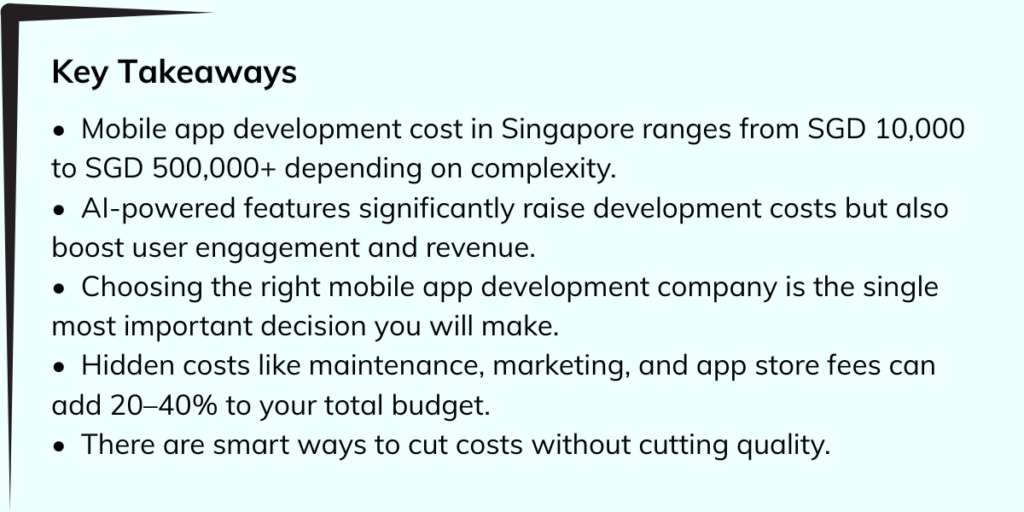
Imagine spending months planning your app, hiring a team, and investing your savings, only to discover halfway through that you had no idea what the real costs looked like. It happens more often than you think.
If you are a startup founder, a business owner, or someone with a great app idea, one of the first questions on your mind is probably: how much will this actually cost?
In Singapore, the mobile app development scene is booming. With one of the most tech-forward economies in Southeast Asia, Singapore is home to world-class developers, cutting-edge AI tools, and a thriving digital ecosystem. But all of that comes with a price tag, and understanding that price tag before you start is what separates successful app launches from expensive missteps.
Everything is explained in simple terms in this guide. No confusing tech jargon, no vague estimates. Just clear, practical numbers and the reasoning behind them.
Cost to Build an AI-Powered App in Singapore in 2026?
There is no one-size-fits-all answer. The cost of building a mobile app depends on what you want the app to do, how polished you want it to look, which platforms you want it on, and who builds it for you. Let us break it down properly.
App Type & Features
The features you include are the biggest driver of cost. More features equal more development time, and more development time means higher cost. Here is a general breakdown:
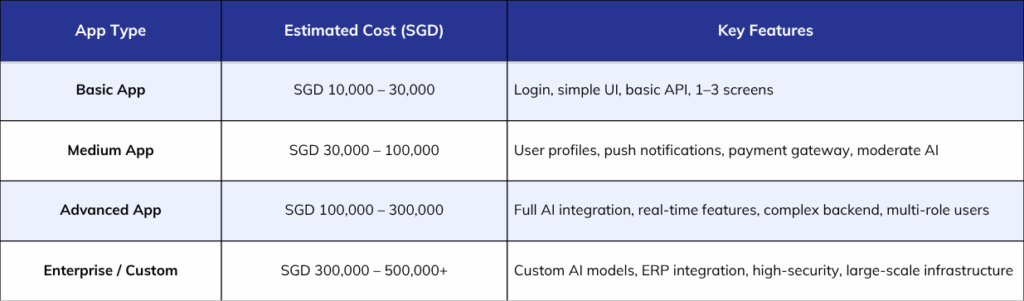
A basic app might be a simple tool with a few screens and minimal logic. A medium app adds layers, user accounts, third-party integrations, and maybe a chatbot. Advanced and enterprise-level apps are full platforms with machine learning, real-time processing, and robust security architectures.
Platform: iOS, Android, or Both?
iOS only: Roughly SGD 10,000 – 80,000 depending on complexity
Android only: Similar pricing to iOS
Both platforms (native): Roughly 1.5x to 2x the single-platform cost
Cross-platform (React Native, Flutter): Can reduce costs by 30–40% while covering both platforms
For most startups and businesses targeting Singapore and Southeast Asia, building for both iOS and Android makes sense. Cross-platform frameworks like Flutter or React Native are a popular way to do that without doubling the budget. The right iOS app development company will guide you toward the most cost-effective approach for your specific goals.
UI/UX Design Complexity
Good design is not decoration — it is how users experience your app. The more polished and custom the design, the higher the cost.
- Basic UI (template-based): SGD 2,000 – 8,000
- Custom UI with branding: SGD 8,000 – 25,000
- Premium, animated UI with custom illustrations: SGD 25,000 – 60,000+
Cutting corners on design often backfires. Users judge an app in the first few seconds. A clunky interface drives them away permanently. Investing in good UI/UX upfront saves you money on redesigns later.
Backend Infrastructure and APIs
Most apps need a backend — a server that stores data, handles logic, and connects to third-party services.
- Simple backend (basic database, REST API): SGD 5,000 – 20,000
- Medium backend (real-time sync, cloud functions): SGD 20,000 – 60,000
- AI/ML backend (model training, inference pipelines): SGD 60,000 – 200,000+
AI features like personalized recommendations, voice recognition, image analysis, or intelligent search all require specialized backend infrastructure. Working with a proper AI development company ensures that these systems are built to scale and perform reliably.
Development Team: Freelancers vs. Agencies vs. In-House
Who you hire makes a big difference in cost, quality, and reliability.
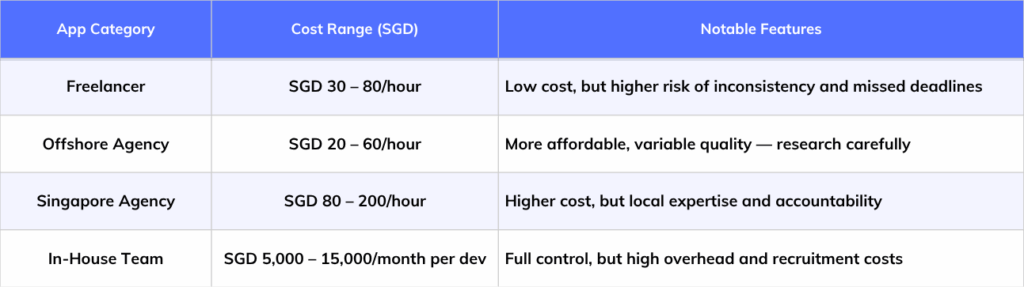
For most businesses, partnering with a reputable mobile app development company in Singapore offers the best balance of quality, communication, and results. You get a full team, designers, developers, project managers, and QA testers, without the overhead of building one yourself.
Ongoing Maintenance and Updates
Your app does not stop needing attention after launch. Operating systems update. Security vulnerabilities emerge. Users request new features. Maintenance is a real and recurring cost.
- Basic maintenance: SGD 500 – 2,000/month
- Regular updates and new features: SGD 2,000 – 10,000/month
- Enterprise-level support and SLA: SGD 10,000 – 30,000+/month
Budget for at least 15–20% of your development cost annually for maintenance. Ignoring this leads to apps that break, frustrate users, and fall behind competitors.
Hidden Costs to Keep in Mind
- App Store fees: Apple charges SGD 148/year. Google charges a one-time SGD 34.
- Third-party API fees: Payment gateways, maps, SMS, AI services, these all have usage fees.
- Cloud hosting: AWS, Google Cloud, or Azure costs can range from SGD 100/month to several thousand, depending on traffic.
- Legal and compliance: PDPA (Personal Data Protection Act) compliance in Singapore is mandatory and may require legal consultation.
- Marketing: No one downloads an app that they do not know exists. Budget at least SGD 5,000 – 20,000 for initial marketing.
What Factors Affect App Development Cost in Singapore?
Beyond the basics, several factors specifically affect how much you will pay in Singapore.
Talent Costs Are High
Singapore developers are among the best-paid in Southeast Asia. The average software developer in Singapore earns SGD 70,000 – 110,000 annually. This expertise comes at a premium, but it also means higher-quality code, better security practices, and more reliable delivery timelines.
Regulatory Requirements
Singapore has strict data privacy laws. If your app handles personal data, which most do, you must comply with the PDPA. Apps in finance, healthcare, and education face additional regulations. Compliance costs can add SGD 5,000 – 30,000 to your project.
Integration Complexity
The more external systems your app needs to connect with — ERP software, CRM tools, payment processors, logistics APIs — the more complex and expensive the development becomes. Each integration point is another potential failure point that needs careful engineering.
AI and Machine Learning Features
AI is not just a buzzword anymore. It is a genuine competitive advantage. But AI development requires specialists. Training custom models, building recommendation engines, or implementing natural language processing can cost two to three times what standard feature development costs. For many businesses, working with a dedicated AI development company is the most efficient route.
Security Requirements
Apps that handle financial data, medical records, or sensitive user information require enterprise-grade security. Penetration testing, end-to-end encryption, and secure coding practices all add to the cost — but skimping here can be catastrophic.
Timeline Pressure
Need your app done fast? Rush jobs cost more. A development timeline of 3–6 months for a medium app is realistic. Compressing that to 6–8 weeks often requires bringing in extra developers, which increases cost significantly.
How a Well-Built App Drives Revenue and Growth
It is easy to focus only on what an app costs. But the smarter question is: what can it earn?
Direct Revenue Streams
Apps can generate money through subscriptions, one-time purchases, in-app purchases, transaction fees, and advertising. A well-monetized app can recoup its development cost within 12–24 months.
Customer Retention
An app keeps your brand on your customer’s phone. Push notifications, loyalty programs, and personalized experiences drive repeat business in ways that websites simply cannot.
Operational Efficiency
Apps can automate tasks, reduce manual errors, and speed up workflows. Businesses that build internal apps often see productivity gains worth 5–10x their development investment.
Data and Insights
Every tap, swipe, and purchase in your app generates data. This data tells you what your customers want, when they want it, and how they want to receive it. That intelligence is invaluable for growth.
Competitive Differentiation
In Singapore’s competitive market, an innovative app can set you apart. Businesses that invest in quality mobile experiences consistently outperform those that do not.
The key is building smart, not just building fast. An app that launches buggy, slow, or confusing will not generate any of these benefits. It will just generate negative reviews and lose customers.
Build Smart, Scalable AI-Powered Apps with Apptechies
At Apptechies, we have spent years helping businesses across Singapore and Southeast Asia turn their app ideas into profitable realities. We are not just a development shop, we are a strategic partner that thinks about your business goals first.
Whether you need a sleek consumer app, a complex enterprise platform, or a custom AI solution, our team brings together designers, engineers, AI specialists, and project managers to deliver apps that work beautifully and perform reliably.
What Makes Apptechies Different?
- We build for scale from day one, your app will not crumble when traffic spikes.
- We are specialists in AI integration, from recommendation engines to intelligent automation.
- We have deep experience across industries — fintech, healthcare, retail, taxi, grocery, education, and more.
- We are transparent about costs, no surprise invoices, no hidden fees.
- We provide end-to-end service, from idea to launch to ongoing maintenance.
- Explore our full range of services, from mobile app development to AI-powered solutions, and find out how we can bring your vision to life.
How Much Does Each Type of App Really Cost?
Let us get specific. Different app categories come with different complexity levels, regulatory requirements, and user expectations. Here is what you can realistically expect to pay in Singapore in 2026.
Social Media Apps
Social media apps are deceptively complex. Real-time feeds, user-generated content, media uploads, notifications, messaging, and content moderation all add up fast.
- Basic social features: SGD 50,000 – 100,000
- Full-featured platform (Stories, Reels, Live): SGD 150,000 – 400,000+
AI-powered features like content recommendations, spam detection, and sentiment analysis are increasingly expected and add another SGD 30,000 – 80,000 to the budget.
Medical and Telemedicine Apps
Healthcare apps in Singapore must comply with strict regulations from the Ministry of Health. HIPAA-equivalent data protection, encrypted communications, and accurate medical record handling are non-negotiable.
- Appointment booking app: SGD 20,000 – 60,000
- Telemedicine platform with video consultations: SGD 80,000 – 200,000
- AI diagnostics or symptom checker: SGD 150,000 – 350,000+
The regulatory compliance and security requirements make healthcare one of the more expensive app categories to build correctly.
Logistics and Delivery Apps
Logistics apps need real-time GPS tracking, route optimization, driver-rider matching, and payment processing. Think apps like Lalamove, Grab Delivery, or a custom solution for your own fleet.
- Basic delivery tracking app: SGD 30,000 – 70,000
- Full logistics platform with route optimization: SGD 80,000 – 200,000
- AI-powered demand forecasting and fleet management: SGD 150,000 – 300,000+
For businesses building a grocery app or a local delivery service, logistics infrastructure is the foundation on which everything else rests.
M-Commerce, Live Stream, and Shopping Apps
Mobile commerce is exploding in Southeast Asia. Building a competitive shopping app means delivering a seamless browsing experience, fast checkout, secure payments, and increasingly, live-stream selling features.
- Basic m-commerce app: SGD 25,000 – 70,000
- Full shopping platform with search and recommendations: SGD 70,000 – 180,000
- Live stream commerce (like TikTok Shop): SGD 120,000 – 300,000+
AI-powered product discovery and personalized recommendations are now a baseline expectation for competitive shopping apps.
Restaurant Apps
From table reservations to mobile ordering to loyalty rewards, restaurant apps have evolved significantly. Contactless dining accelerated adoption, and now customers expect smooth digital experiences.
- Basic menu and reservation app: SGD 15,000 – 40,000
- Full ordering, payment, and loyalty platform: SGD 40,000 – 100,000
- Multi-location chain with AI upselling: SGD 80,000 – 180,000
Banking, Payment, and E-Wallet Apps
Financial apps are the most heavily regulated category. MAS (Monetary Authority of Singapore) licensing, strong authentication, fraud detection, and real-time transaction processing are all mandatory, not optional.
- Basic payment app or e-wallet: SGD 80,000 – 150,000
- Full neobank or digital banking platform: SGD 200,000 – 600,000+
- AI-powered fraud detection and credit scoring: Adds SGD 50,000 – 150,000
Cutting corners on financial apps is not just risky for business — it can lead to regulatory penalties and loss of operating licenses.
Fitness Apps
Fitness apps combine wearable integrations, workout tracking, nutrition logging, video content, and increasingly AI-powered coaching. It is a competitive market, but there is still room for differentiated products.
- Basic workout tracker: SGD 15,000 – 40,000
- Full fitness platform with video and AI coaching: SGD 60,000 – 150,000
- Wearable integration (Apple Watch, Garmin): Adds SGD 10,000 – 30,000
Educational Apps
EdTech in Singapore is booming. From tuition supplements to corporate training platforms, educational apps require engaging content, assessment tools, progress tracking, and often AI-powered personalized learning paths.
- Basic course delivery app: SGD 20,000 – 60,000
- Interactive learning platform with assessments: SGD 60,000 – 150,000
- AI-powered adaptive learning system: SGD 120,000 – 300,000+
Singapore’s strong emphasis on education makes this one of the most promising app markets in the region.
Fintech Apps
Fintech sits at the intersection of finance and technology, covering everything from investment apps to insurance platforms to blockchain solutions. Singapore is Asia’s fintech hub, and the standards here are high.
- Robo-advisor or investment app: SGD 100,000 – 250,000
- Insurance platform with instant quotes: SGD 80,000 – 200,000
- Blockchain or DeFi application: SGD 150,000 – 400,000+
Building a fintech app in Singapore requires close coordination with MAS guidelines and often involves ongoing legal consultation throughout development.
Why Singapore Stands Out in the App Development Space
Singapore is not just a place to build an app — it is one of the best places in the world to do it.
- World-Class Talent Pool: Singapore attracts top engineering talent from across Asia and beyond. Universities like NUS and NTU produce graduates who are globally competitive.
- Government Support: The Singapore government actively supports tech businesses through grants like the Enterprise Development Grant (EDG) and Productivity Solutions Grant (PSG), which can offset app development costs by up to 50% for eligible businesses.
- Strong IP Protection: Singapore has robust intellectual property laws, meaning the app you build is protected.
- Regional Hub: An app built in Singapore is well-positioned to expand across ASEAN, a market of over 680 million people.
- Advanced Digital Infrastructure: With one of the world’s fastest internet speeds and a population that is among the most smartphone-savvy on the planet, Singapore is the ideal testing ground for digital products.
For businesses serious about building something that lasts and scales, Singapore is not just a good choice, it is a strategic one.
Beyond the Basics: Hidden Costs of App Development in Singapore
Many first-time app builders underestimate the total cost because they only think about development. Here’s what else you should budget for. .
App Store Fees
To publish your app, you must enrol in the relevant developer programs:
- Apple App Store: SGD 148/year for the Apple Developer Program
- Google Play Store: One-time fee of approximately SGD 34
If your app handles payments, both Apple and Google take a 15–30% cut of in-app purchases and subscriptions. This can significantly impact your revenue model if not planned for in advance.
Marketing & Promotion Costs
The build is just the beginning. Getting people to download and use your app is a separate challenge entirely.
- App Store Optimization (ASO): SGD 2,000 – 10,000 initially
- Social media advertising: SGD 3,000 – 20,000/month for early traction
- Influencer partnerships or PR: SGD 5,000 – 50,000 depending on scale
- User acquisition campaigns: SGD 10,000 – 100,000+ for meaningful scale
For apps in competitive categories — fitness, food delivery, fintech — expect to spend significantly on marketing before organic growth kicks in.
Ongoing Maintenance and Update Costs
Mobile operating systems update regularly. Each iOS or Android update can break existing features, require new permissions, or introduce new capabilities that users expect you to adopt.
- Bug fixes and OS compatibility updates: SGD 1,000 – 5,000/month
- Feature updates: SGD 3,000 – 20,000 per update cycle
- Security patches: Critical and cannot be deferred without risking user data
Plan for maintenance from day one. A good maintenance retainer with your mobile app development company is far cheaper than emergency fixes.
Potential Return on Investment (ROI)
Despite these costs, a well-built app is one of the best investments a modern business can make.
- Subscription apps can generate 3–5x their development cost in the first two years with the right user base.
- Enterprise apps that automate internal processes often deliver ROI within 6–12 months through labour savings alone.
- E-commerce apps consistently outperform mobile websites in conversion rates by 3x or more.
The key is not whether to build an app, but how to build it smartly enough that the returns justify the investment.
How to Cut App Development Costs Without Cutting Quality
Budget constraints are real. Here are proven strategies to get more for your money without compromising on what matters.
Prioritize Features
Not every feature you want needs to be in version 1.0. In fact, launching with fewer features is often smarter. Here is how to approach it:
- List every feature you want in the app.
- Sort them by impact — which ones do users absolutely need on day one?
- Label them as Must Have, Should Have, or Nice to Have.
- Build only the Must Haves first. Ship. Learn. Then add the rest.
This approach, often called an MVP (Minimum Viable Product) strategy, lets you launch faster, spend less, and use real user feedback to decide what to build next. It is the approach that most successful apps follow. For instance, apps like a free offline music app started as simple players before expanding into full-featured platforms.
Consider Open-Source Solutions
You don’t have to start from scratch with everything. Open-source libraries, frameworks, and tools can dramatically reduce development time:
- Authentication systems: Firebase Auth, Auth0 — free or low-cost and battle-tested
- Payment processing: Stripe or Braintree SDKs handle the complex payment logic for you
- Maps and location: Google Maps SDK or OpenStreetMap for geolocation features
- Chat and notifications: Twilio, Firebase Cloud Messaging — no need to build from scratch
- Analytics: Mixpanel, Amplitude, or Firebase Analytics — free tiers cover most early-stage needs
A good development team knows which open-source tools to use and which ones to avoid. The goal is to spend development time on what makes your app unique, not on reinventing infrastructure that already exists.
Final Thoughts
Building an AI-powered app in Singapore in 2026 is a significant investment — but it is also one of the most powerful moves a business can make. The mobile app development landscape here is mature, competitive, and full of talented people who can turn your vision into reality.
The key is to enter with clear eyes. Understand the costs, plan for the hidden ones, choose the right team, and build smart rather than just building fast. The businesses that thrive in the app economy are not necessarily the ones that spend the most — they are the ones who plan the most carefully.
Whether you are building a startup app, upgrading an existing digital product, or exploring AI-powered solutions for your business, the right mobile app development company in Singapore will make all the difference.
Frequently Asked Questions
Q. Should I Use The Same Provider For Both Design And Development Services?
Ans: Yes, in most cases. When design and development happen in the same team, communication is smoother, handoffs are cleaner, and the final product is more cohesive. Designers and developers who work together regularly understand each other’s constraints and capabilities. Splitting the work between two vendors often leads to mismatches, delays, and additional costs in rework. There are exceptions — if you already have a trusted design partner — but for most businesses starting fresh, keeping both under one roof is the practical choice.
Q. Are Mobile Apps And Mobile Web Apps The Same?
Ans: No, they are quite different. A mobile web app runs in a browser and does not need to be downloaded. It is built with web technologies and works across devices, but has limited access to device hardware. A native mobile app is downloaded from the App Store or Google Play and is built specifically for iOS or Android. It can access the camera, GPS, push notifications, and biometric sensors. Native apps are generally faster, more secure, and offer a better user experience — but they cost more to build and maintain. A progressive web app (PWA) is a middle ground — a web app that behaves more like a native app.
Q. What Factors Should You Consider Before Hiring A Development Company?
Ans: Before signing with any mobile app development company, evaluate the following:
- Portfolio: Has the company built apps similar to what you need? Ask for case studies and live app links.
- Technical expertise: Do they have specialists in the technologies your app requires — AI, payment systems, real-time data?
- Communication: Are they responsive? Do they communicate in plain language or drown you in jargon?
- Process: Do they follow an agile development process with regular updates and checkpoints?
- References: Can they provide client references you can speak with directly?
- Post-launch support: Will they maintain the app after launch, or do they disappear once the project is delivered?
- Transparency on costs: Do they give detailed, itemized quotes, or vague estimates that balloon later?
Q. How To Find The Best Development Company In Singapore?
Here is a Practical Approach:
- Search on review platforms like Clutch, GoodFirms, and Google — look for companies with verified reviews and consistent ratings above 4.5.
- Ask your network — personal referrals from trusted business contacts are often the most reliable.
- Request proposals from 3–5 shortlisted companies for your project, and compare not just the price but the thoroughness and clarity of their thinking.
- Look at their own website and social media — a development company that cannot maintain its own digital presence is a warning sign.
- Arrange a discovery call and pay attention to how they listen and ask questions, good companies are curious about your business, not just your features list.
- Prioritize cultural fit, you will be working with this team for months. You need people you can communicate with honestly.