How Much Does It Really Cost to Make a Music App Like Spotify in 2026?
Key Takeaways Before You Dive In
Before we get into the full breakdown, here is what you need to know upfront:
- Building a music streaming app like Spotify costs anywhere from $30,000 for a basic MVP to $300,000+ for a full-featured platform.
- Music licensing is one of the most underestimated costs — and it can make or break your launch strategy.
- AI-powered personalization is no longer optional. It directly influences user retention and market share.
- The global music streaming market generated $53.7 billion in revenue in 2024 and is still growing fast.
- Choosing the right development partner and platform scope from Day 1 will save you months of costly rebuilding.
- 2026 is genuinely a smart time to enter this space — the market is growing but still has room for niche players.
Spotify changed everything. Before it existed, music was something you downloaded, stored, and owned. Today, over 640 million people stream music directly from their phones. No storage. No waiting. No clutter.
That shift created a business opportunity that is still wide open. And more founders, startups, and enterprises are now asking the same question: how much does it actually cost to build a music streaming app like Spotify?
The honest answer is — it depends. But not in the ambiguous, ineffective manner that phrase is typically employed. It depends on very specific choices: what features you build, which platforms you target, how seriously you take audio infrastructure, and whether you invest in personalization from Day 1.
In this guide, we have done the research so you do not have to. We have broken down every cost driver, every development phase, every hidden expense, and every money-saving strategy. Whether you are a startup founder exploring an MVP or a business leader planning a full-scale platform, this guide gives you a clear picture of what it takes to build a competitive streaming app in 2026.
Music Streaming App Market Statistics
Numbers tell a story. And the story of the music streaming market in 2026 is one of consistent, undeniable growth.
Music streaming platforms generated $53.7 billion in global revenue in 2024, a 12.5% jump from the year before. The global market is projected to reach $46.81 billion by the end of 2026, with steady annual growth of around 5% through 2030. If current trajectories hold, the market could hit $77 billion by 2030.
Spotify alone crossed 640 million monthly active users in Q3 2024, with over 250 million paying subscribers. That is a platform built on years of refinement, but it proves the model works at scale.
Today, streaming accounts for roughly 80% of all recorded music revenue. The average listener spends about 104 minutes daily on music streaming apps. Subscriber numbers jumped from 616 million in 2022 to over 818 million by late 2024.
What does this mean for you? It means the market has momentum. New users are coming in, existing users are spending more time on apps, and businesses that build the right product for the right audience can carve out a profitable space — even against giants like Spotify and Apple Music.
What Makes a Music App Special?
Building a music streaming app is not like building an e-commerce platform or a fitness tracker. The technical complexity, the legal landscape, and the infrastructure requirements are in a completely different league.
The Technical Challenges
Streaming audio in real time across millions of devices simultaneously is hard. Your backend must handle massive concurrent loads without buffering. Your CDN (Content Delivery Network) needs to serve audio files from locations close to the user. Your app must intelligently switch audio quality based on the listener’s connection speed — a feature called adaptive bitrate streaming.
Then there is offline mode. Letting users download and play tracks without internet is a premium feature that requires DRM (Digital Rights Management) to ensure downloaded files cannot be shared or used outside your app. You need to implement Apple’s FairPlay for iOS, Google’s Widevine for Android, and PlayReady for web browsers — all separately.
Cross-platform compatibility adds another layer. iOS, Android, CarPlay, Android Auto, and web each have their own audio handling requirements. What works seamlessly on one platform may break on another.
Legal and Licensing Complexity
But not in the ambiguous, ineffective manner that phrase is typically employed. You cannot simply build an app and start streaming music. You need licenses — and securing them involves negotiating with record labels, music publishers, and rights organizations.
There are two main types of licenses. Public Performance Rights (from organizations like ASCAP, BMI, and SESAC) allow you to stream music to the public. Mechanical Licenses (from publishers or agencies like the Harry Fox Agency) allow you to reproduce compositions digitally.
The cost and complexity of licensing varies enormously by region. Launching globally means separate negotiations in each market. Getting this wrong does not just cost money — it can shut your platform down entirely.
Why 2026 Is the Right Year to Build Your Music Streaming App?
The Market Gap Is Still Realstic
Spotify and Apple Music dominate the mainstream. But billions of listeners exist outside the mainstream. Regional music markets, niche genres, and underserved communities represent enormous white space. A platform built specifically for Latin indie artists, South Asian pop, or a specific cultural community can gain serious traction without competing head-to-head with the giants.
The Technology Is Mature
AI recommendation systems, adaptive streaming, and cloud infrastructure have all reached a level of maturity where you can implement Spotify-grade features at a fraction of what it cost five years ago. Cross-platform frameworks like React Native and Flutter have made it possible to build for iOS and Android simultaneously — cutting development time and cost significantly.
Independent Artists Are Looking for Better Homes
Many artists are frustrated with the royalty structures and algorithm opacity of existing platforms. A platform that treats artists as partners — offering real-time analytics, transparent royalty tracking, and direct fan engagement tools — has a genuine acquisition advantage. Independent artists bring their audiences with them.
AI Has Changed Personalization
Research shows that strong personalization can boost market share by nearly 23%. In 2026, AI-powered recommendation engines are accessible to smaller teams and lower budgets than ever before. A startup can now build discovery features that feel genuinely intelligent — not just algorithmic noise.
Basic & Advanced Features Every Music Streaming App Should Have in 2026
Features are where budgets balloon fast. Knowing which ones are essential versus which ones are nice-to-have is one of the most valuable decisions you will make in planning your build.
Basic Features
User Accounts and Music Discovery
- User Registration & Login: Sign-up via email, phone number, or social accounts. Profile customization and usage history tracking.
- Smart Search: Users should find songs by title, artist, album, genre, or mood. Include autocomplete and fuzzy matching for a polished experience.
- Playlists: Allow users to create, save, edit, and share playlists. This is core engagement. It is how users build habits around your app.
- Basic Recommendations: Even a simple ‘You May Also Like’ section, built on listening history, dramatically improves session length.
- Playback Controls: Play, pause, skip, shuffle, repeat, and volume control. These seem obvious but must be rock-solid before anything else.
- Music Library: A well-organized library where users can save albums, artists, and playlists for quick access.
Technical Foundations
- Audio Streaming Engine: The core of your app. Must handle adaptive bitrate switching, low latency, and smooth buffering transitions.
- Push Notifications: Alert users about new releases, playlist suggestions, or friend activity. Keep them short, relevant, and non-intrusive.
- Social Sharing: Let users share what they are listening to on WhatsApp, Instagram, or X. This is word-of-mouth marketing built into the product.
Advanced Features
Smart Features That Keep Users Coming Back
- AI-Powered Recommendations: Machine learning models that analyze listening behavior, time of day, and activity context to serve hyper-relevant suggestions. This is the single biggest retention lever after content quality.
- Contextual & Mood-Based Playlists: Dynamically generated playlists for working out, studying, or relaxing. These recalculate automatically, keeping content fresh without editorial work.
- Lyrics Display: Real-time synced lyrics turn passive listening into an interactive experience. Users who engage with lyrics stay longer per session.
- Voice Search & Assistant Integration: Hands-free control via Siri, Google Assistant, or Alexa. Essential for commuter and gym audiences.
- Podcast Integration: Adding podcasts broadens your content offering and opens additional monetization lanes.
Premium Features Worth the Investment
- Offline Mode with DRM: The number one reason users upgrade from free to paid tiers. Requires implementing DRM across platforms — complex but high-value.
- High-Resolution Audio: Lossless and spatial audio formats for audiophiles. Tidal built an entire brand around this. If your target user cares about sound quality, this matters.
- Artist Dashboard: Real-time streaming analytics, geographic audience data, and royalty tracking for artists. Attracts independent artists who bring their fanbase.
- Live Streaming Events: Artists can host live performances, Q&As, or listening parties. Builds community and creates event-driven engagement spikes.
- Social Features: Follow friends, see what they are listening to, and collaborate on playlists. Turns a solo activity into a shared experience.
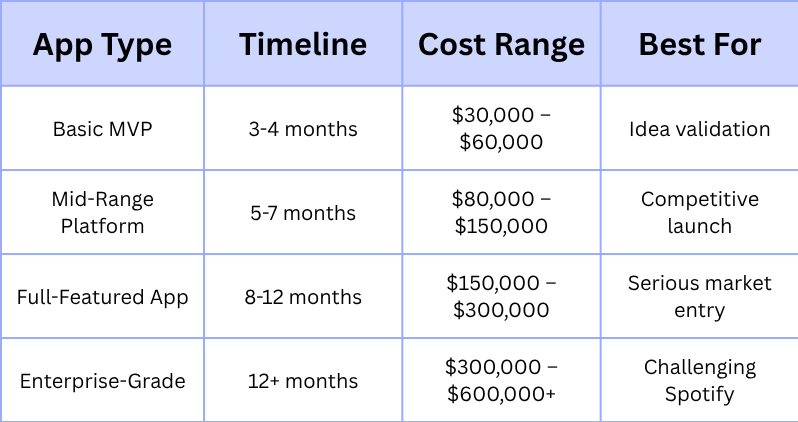
How Much Does Music Streaming App Development Cost?
Here is the honest breakdown. There is no single number — but there is a clear range based on what you are building.
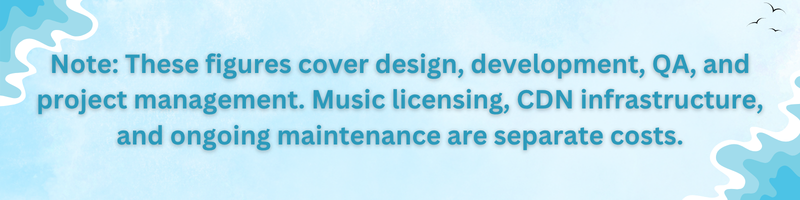
Cost of Every Feature One by One
How Many Types of Music Apps Can You Build?
Not every music app is built the same way — and the type you build directly shapes your features, licensing needs, and development cost.
On-Demand Streaming
Users pick exactly what they want to play. This is the Spotify model. It requires the most robust licensing and the deepest music catalog. Cost range: $80,000 – $300,000+.
Internet Radio / Algorithmically Curated
Continuous streams based on genre, mood, or artist. Think Pandora. Less catalog complexity, but you lose user control. Cost range: $40,000 – $120,000.
Cloud Music Locker
Users upload their own music and stream it from the cloud. Fewer licensing headaches since users own the content. Cost range: $30,000 – $80,000.
Social Music Platforms
Community-driven apps where users share playlists, follow friends, and discover music through social connections. Cost range: $60,000 – $180,000.
Hi-Fi / Audiophile Platforms
Apps focused on lossless, high-resolution, or spatial audio. Premium positioning with a niche audience. Think Tidal HiFi. Cost range: $100,000 – $250,000.
Podcast + Music Hybrid
Combines streaming music with exclusive or licensed podcast content. Broader engagement but more content licensing complexity. Cost range: $120,000 – $350,000.
What Decides the Cost of Building a Music App?
Music Licensing
Licensing is the cost most founders underestimate. You are not just paying for development, you are paying for the right to play music. Public performance rights, mechanical licenses, and sync licenses each apply to different use cases.
In the US alone, you will likely negotiate with ASCAP, BMI, and SESAC for performance rights. Anticipate separate agreements or through sub-licensees for every country you grow into. Smaller platforms often start with aggregator services (like DistroKid or CD Baby) that offer pre-negotiated licensing deals, which reduces upfront cost but limits catalog depth.
Budget roughly $5,000 – $50,000 for initial licensing setup, depending on your target market and catalog size.
Audio Quality, Infrastructure & CDN Costs
Audio quality is not just a listener feature — it is an infrastructure decision. Higher quality audio means larger files, more bandwidth, and higher CDN costs.
CDN delivery typically costs $0.015 – $0.03 per GB of data transferred. If your platform serves 100 million song plays a month (with an average file size of 4MB per song), you are looking at $6,000 – $12,000 monthly just in CDN costs. Cloud infrastructure on AWS, Google Cloud, or Azure adds another $10,000 – $30,000 monthly for a mid-size platform.
This is why understanding your expected listener volume matters before you sign infrastructure contracts.
Platform Scope
Every platform you add increases cost. An iOS-only MVP is the cheapest starting point. Adding Android adds roughly 30-40% more development cost if building natively. Adding web, CarPlay, Android Auto, or smart TV apps each bring their own requirements.
Cross-platform frameworks like React Native or Flutter can reduce this cost significantly — often 25-35% cheaper than native development for dual-platform builds, but they come with trade-offs in performance for audio-heavy applications.
AI & Personalization System Depth
Basic recommendations (collaborative filtering based on listening history) are achievable at modest cost. Deep personalization — context-aware playlists that shift based on time, activity, location, and mood, requires a proper machine learning infrastructure: data pipelines, model training, real-time inference, and continuous retraining.
A lightweight recommendation system adds $18,000 – $35,000 to development. A full AI personalization engine that rivals Spotify’s Discover Weekly can push $50,000 – $100,000 — but it pays back in retention and conversion from free to paid.
How to Build a Music App on a Low Budget?
Smart Development Choices
- Start with an MVP. Validate your audience and core experience before building everything. A focused MVP lets you learn from real users before spending on advanced features.
- Use cross-platform frameworks for the initial build. React Native or Flutter can serve both iOS and Android with one codebase — significantly cutting your first-year development spend.
- Leverage existing audio APIs. Platforms like Spotify for Developers, Apple MusicKit, or third-party audio SDKs can accelerate certain features without building from scratch.
- Prioritize backend scalability early. A well-designed backend from Day 1 is cheaper than rebuilding a fragile one after you hit scale problems.
- Use cloud-native infrastructure. Pay-as-you-go cloud pricing means you only pay for what you actually use during early growth stages.
Where to Cut Costs Safely
- Reduce scope on social features in V1. Social tools are nice-to-have, not must-have, for early traction. Add them once core retention is solid.
- Start with one region. Global licensing is expensive. Launching in one market first reduces legal complexity and lets you perfect the product.
- Use open-source for back-end services where possible. PostgreSQL, Redis, and Elasticsearch power production-grade apps for free.
- Hire a development partner in Eastern Europe or South/Southeast Asia. The quality gap versus North American teams has narrowed considerably, and the cost gap is still significant.
What Affects the Final Price of Your Music App?
The Biggest Cost Factors
If you want to know where the money really goes, here are the factors that have the highest impact on your final budget:
Feature Complexity
Every advanced feature — offline mode, AI personalization, artist dashboards, multiplies development hours. Choose features based on what your target user actually needs, not what Spotify has.
Platform Count
Each additional platform (iOS, Android, web, CarPlay) adds real cost. Start narrow and expand.
Team Location
A full build in North America can cost 2-3x the same build in Eastern Europe, and 4-5x the same build in South Asia. Quality vetting matters more than geography.
Music Licensing
Especially for on-demand streaming. This is a recurring cost, not a one-time expense.
Infrastructure Scale
Your CDN and cloud costs grow with your user base. Plan this before you launch, not after.
Post-Launch Maintenance
Budget 15-20% of your initial build cost annually for updates, security patches, and feature additions.
What Hidden Costs Come With Building a Music App?
Most cost guides stop at development. The real cost picture includes several factors that rarely make it into the first budget conversation.
DRM Implementation
Digital Rights Management is legally required for any platform offering downloadable or offline content. Implementing Apple FairPlay, Google Widevine, and Microsoft PlayReady across platforms adds significant development time and ongoing licensing fees.
Content Moderation
If your platform allows user-generated content (covers, remixes, podcast uploads), you need moderation tools — both automated and human-reviewed. This is both a cost and a legal necessity.
GDPR and Privacy Compliance
If you launch in Europe or handle EU users’ data, GDPR compliance requires specific data architecture, consent management, and audit capabilities. Expect $20,000 – $50,000 in additional development cost to do this properly.
Royalty Tracking and Payments
You are legally obligated to track every stream and pay the corresponding royalty to rights holders. Building a reliable royalty calculation and disbursement system is an engineering challenge most people do not see coming.
App Store Fees
Apple takes a 30% cut (15% for smaller developers) of subscription revenue from iOS users. Factor this into your pricing and revenue model.
Customer Support Infrastructure
Payment disputes, account issues, and licensing questions require a support system. Underinvesting here destroys user trust fast.
Third-Party Integrations
Payment gateways, analytics tools, social media APIs, and music licensing platforms all come with integration costs and recurring fees.
Security Audits
A platform handling payment data and personal user information needs periodic security auditing. Not optional. Not cheap.
Recommended Tech Stack for Your Music Streaming App in 2026
Technology choices affect performance, scalability, and long-term maintenance cost. Here is what modern production-grade music streaming apps use:
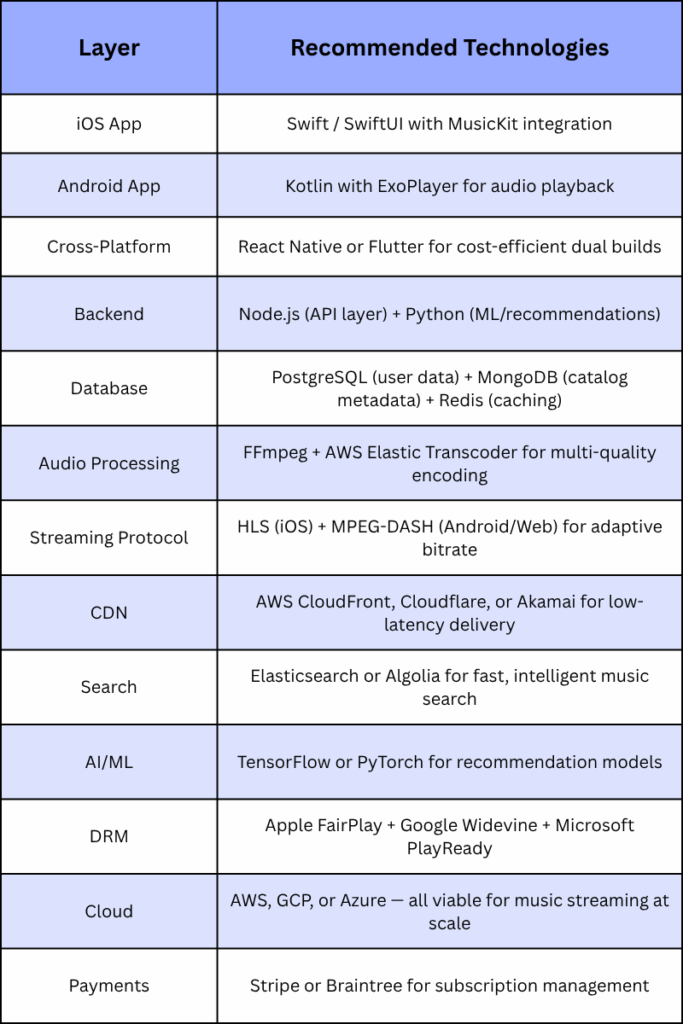
Steps to Build Your Music App From Start to Finish
Here is a realistic phase-by-phase timeline for a mid-range music streaming app build:
Phase 1 — Discovery & Planning (Weeks 1-3)
Define your target audience, feature set, monetization strategy, and licensing approach. This phase determines every decision that follows. Cutting it short is the most expensive mistake you can make.
Phase 2 — UI/UX Design (Weeks 4-7)
Wireframes, user flows, visual design, and interactive prototypes. Good design reduces development rework and improves conversion from the first launch.
Phase 3 — Core Development (Weeks 8-20)
Backend architecture, audio streaming engine, user authentication, playlists, search, and admin panel. The longest and most costly stage is this one.
Phase 4 — Advanced Features (Weeks 18-28)
AI recommendations, offline mode, social features, DRM implementation, and payment integration. Runs parallel to late-stage core development.
Phase 5: QA & Testing (Weeks 26–30)
Security audits, cross-device compatibility checks, functional testing, and performance testing. Don’t miss this. Particularly vulnerable to platform-specific flaws are audio apps.
Phase 6: Launch and After-Launch (Week 30+)
App Store submission, setting up a CDN, setting up monitoring, and gathering comments within the first week. Aim for close post-launch assistance for at least three months.
Total Timeline: 6-9 months for a mid-tier platform. 3-4 months for a focused MVP. 12+ months for enterprise-grade.
Ways to Earn Money From Your Music Streaming App
How you make money matters as much as how much it costs to build. Here are the revenue models that work in today’s streaming landscape:
Freemium + Subscription
Offer basic listening for free (with ads) and charge for premium features, offline mode, and higher audio quality, no ads. This is Spotify’s core model and remains the most effective for large-scale user acquisition.
Subscription Only
No free tier. Higher quality commitment but slower growth. Works for niche platforms where the audience is already primed to pay.
Ad-Supported Free
Monetize purely through audio and display advertising. Lower ARPU (average revenue per user) but strong for high-volume, emerging markets.
Artist Partnerships & Promotion
Charge artists or labels for promoted placement, playlist features, or early access to analytics. A meaningful secondary revenue stream for platforms with strong catalog relationships.
Live Events & Ticketing
Monetize live streaming sessions, exclusive performances, or fan meetups. Growing fast as artists look for direct-to-fan revenue channels.
Merchandise & Fan Commerce
Allow artists to sell merchandise through your platform. Takes a commission. Builds deeper artist-fan engagement.
How Long Before You Get Your Money Back From Your App?
Profitability in music streaming is not instant. It follows a predictable curve, and knowing the curve helps you plan your runway.
In year one, most platforms are cash-negative. You are covering licensing, infrastructure, and team costs while building your user base. User acquisition cost is highest at launch, and conversion from free to paid is lowest when your product is newest.
By year two, platforms with strong retention (daily active users above 40% of monthly actives) start seeing subscription revenue outpace operational costs at a meaningful scale. AI personalization plays a critical role here, users who receive accurate recommendations churn at a significantly lower rate.
Break-even typically comes at 12-18 months for niche platforms with controlled licensing costs, and 24-36 months for broader on-demand platforms competing in major markets.
The long-term math is strong. Subscription-based music platforms have high LTV (lifetime value) per user, low marginal cost per additional stream, and a flywheel effect where growing catalogs attract more artists who attract more listeners. Once that loop starts working, it returns compound.
What Decides the Cost of Building an App Like Spotify?
Planning
Before a single line of code is written, your planning decisions lock in the majority of your cost. Scope creep — the slow addition of features beyond the original plan, is the leading cause of budget overruns in app development. A disciplined discovery phase with a clearly documented feature list and technical requirements is genuinely worth its cost.
At Apptechies, we have seen firsthand how projects that invest properly in the discovery and planning phase finish closer to budget and on time. Those that skip it almost always end up rebuilding significant portions of the product.
Finding the Mobile App Developers
Your team composition affects both cost and quality. Here is what typical hourly rates look like in 2026:
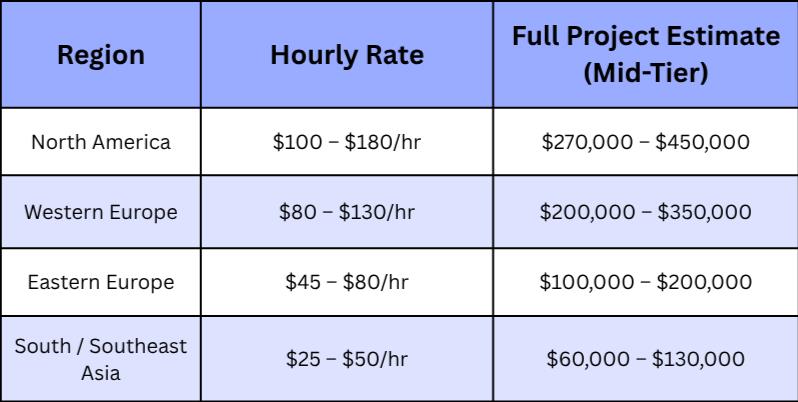
The best approach is not always the cheapest team. Look for developers with proven audio streaming experience, a portfolio of similar projects, and a clear QA process.
Designing the App Like Spotify
UI/UX design for music apps is deceptively complex. The interface needs to work in the dark (night listening), during workouts (sweaty hands, glancing interactions), and while commuting (one thumb, divided attention). Spotify’s design language, dark backgrounds, high-contrast text, large tap targets, is not an aesthetic preference. It is a functional design built around real listening contexts.
Design cost for a mid-tier music app typically runs $8,000 – $25,000. Enterprise-grade design with extensive user research, accessibility audits, and design system creation can reach $40,000 – $80,000.
Deciding on a Platform
iOS-first is common for apps targeting premium markets (US, UK, Australia) where iOS users have higher purchasing power and conversion rates. Android-first makes more sense for emerging markets with high smartphone adoption. Cross-platform from the start (using React Native or Flutter) suits startups looking to validate in both markets simultaneously with a controlled budget.
For a music streaming app, native development still has performance advantages, especially around audio focus handling, background playback, and CarPlay/Android Auto integration. But cross-platform has caught up significantly and is a legitimate choice for most non-enterprise builds.
Getting a License to Play the Music
You cannot launch a public music streaming service without proper licensing. Here is a simplified roadmap:
- Identify which license types you need: performance rights, mechanical rights, and synchronization rights (for video).
- In the US, approach ASCAP, BMI, and SESAC for performance rights. Each represents a different catalog.
- For mechanical rights, use the Harry Fox Agency or a licensing aggregator.
- For international markets, engage with local PROs (Performing Rights Organizations) in each territory.
- Consider licensing aggregator services (DistroKid for Developers, Musickit, etc.) for faster catalog access at lower upfront cost.
- Budget for ongoing royalty reporting and payment infrastructure, this is legally required, not optional.
Features You Need to Build in Your Music App
Authentication
Authentication in a music app goes beyond username and password. Users expect social sign-in (Google, Apple, Facebook), biometric login (Face ID, fingerprint), and seamless session persistence across devices. Security matters too, you are storing payment information and personal listening data.
Build this with OAuth 2.0 and JWT tokens. Add multi-factor authentication for account security. Estimated cost: $4,000 – $12,000 depending on platform count and security requirements.
Music Streaming
The streaming engine is the heart of your application. It must handle real-time playback initiation (under 2 seconds from tap to first sound), adaptive bitrate switching based on connection quality, background playback when the phone is locked, and seamless transitions between tracks.
HLS (HTTP Live Streaming) is the standard for iOS. MPEG-DASH handles Android and web. Both require pre-encoded audio in multiple quality levels (96kbps, 160kbps, 320kbps) stored on your CDN and served based on the listener’s bandwidth.
This is the component where cheap shortcuts cost you users. Buffering, skipping, and audio quality drops are the top reasons users abandon music apps. Build this properly from Day 1. Estimated cost: $15,000 – $55,000.
Search
Search in a music app needs to be fast (under 300ms for results to appear), fuzzy (handling misspellings), and contextual (understanding that ‘weekend’ might mean The Weeknd). Autocomplete suggestions, recent search history, and trending searches all improve the experience.
Elasticsearch or Algolia power most production-grade music search implementations. Estimated cost: $6,000 – $20,000.
Playlists
Playlists are the primary engagement mechanism in music streaming. Users who build playlists have dramatically higher retention rates. Your playlist feature needs to support creation, editing, collaborative playlists (multiple users adding tracks), sharing to social media, and smart suggestions for what to add next.
On the backend, playlists are surprisingly complex, especially when handling large collaborative playlists with concurrent edits. Estimated cost: $5,000 – $18,000.
Offline Mode
Offline mode is the single highest-value premium feature in music streaming. Users who listen offline are far less likely to cancel their subscription — they depend on it. But implementing it properly requires DRM integration across all three major systems (FairPlay, Widevine, PlayReady), local storage management, license expiry handling, and sync logic when the user comes back online.
Do not offer offline without DRM. It exposes you to significant legal liability. Estimated cost: $15,000 – $60,000 depending on platform scope.
Conclusion
Building a music streaming app like Spotify is one of the more ambitious and rewarding digital product investments you can make in 2026. The market is large and still growing. The technology is mature enough to build competitive features at reasonable cost. And the audience, both listeners and independent artists — is actively looking for alternatives to the platforms that currently dominate.
The cost to develop a music streaming app ranges from $30,000 for a tightly scoped MVP to $300,000+ for a full-featured competitive platform. But the number that matters most is not the build cost — it is the combination of licensing strategy, infrastructure investment, and user experience quality that determines whether your platform survives its first year.
Start focused. Build core streaming and personalization well. Learn from real listeners. Then expand.
At Apptechies, we work with founders and businesses to plan, design, and build streaming platforms that are engineered for the real world, not just the pitch deck. Whether you are starting from scratch or scaling an existing product, the right strategy from the beginning makes every dollar count.
Frequently Asked Questions
Q: How much does it cost to build a music streaming app in 2026?
Ans: The cost ranges from $30,000 – $60,000 for a basic MVP, $80,000 – $150,000 for a mid-tier competitive app, and $300,000+ for an enterprise-grade platform. Music licensing, CDN infrastructure, and ongoing maintenance costs are additional.
Q: How long does it take to develop a music streaming app?
Ans: A focused MVP takes 3-4 months. A full-featured mid-tier app takes 6-9 months. Enterprise-grade platforms typically take 12+ months, with ongoing development after launch.
Q: Do I need music licensing before I launch?
Ans: Yes. You cannot legally stream copyrighted music to users without proper licensing agreements. Secure performance rights and mechanical licenses before your public launch.
Q: Can I build a music streaming app cheaper using cross-platform frameworks?
Ans: Yes. React Native or Flutter can reduce development cost by 25-35% compared to native builds for iOS and Android separately. There are performance trade-offs, but for most non-enterprise builds, cross-platform is a legitimate and cost-effective choice.
Q: What is the most important feature to get right first?
Ans: The audio streaming engine. Buffering, lag, and quality drops are the primary reasons users abandon music apps. No amount of great design compensates for unreliable playback.
Q: When does a music streaming app start making money?
Ans: Most platforms break even between 12-36 months depending on licensing costs, market focus, and conversion from free to paid. Niche platforms with controlled licensing costs tend to reach profitability faster.
Q: Is AI personalization worth the investment?
Ans: Yes, especially for retention. Research shows strong personalization can boost market share by nearly 23%. Users who receive relevant recommendations listen longer and churn at significantly lower rates.
Q: What hidden costs should I plan for?
Ans: DRM implementation, royalty tracking systems, GDPR/privacy compliance, app store fees (Apple takes up to 30% of subscription revenue), content moderation, and ongoing security audits are the most commonly missed budget items.