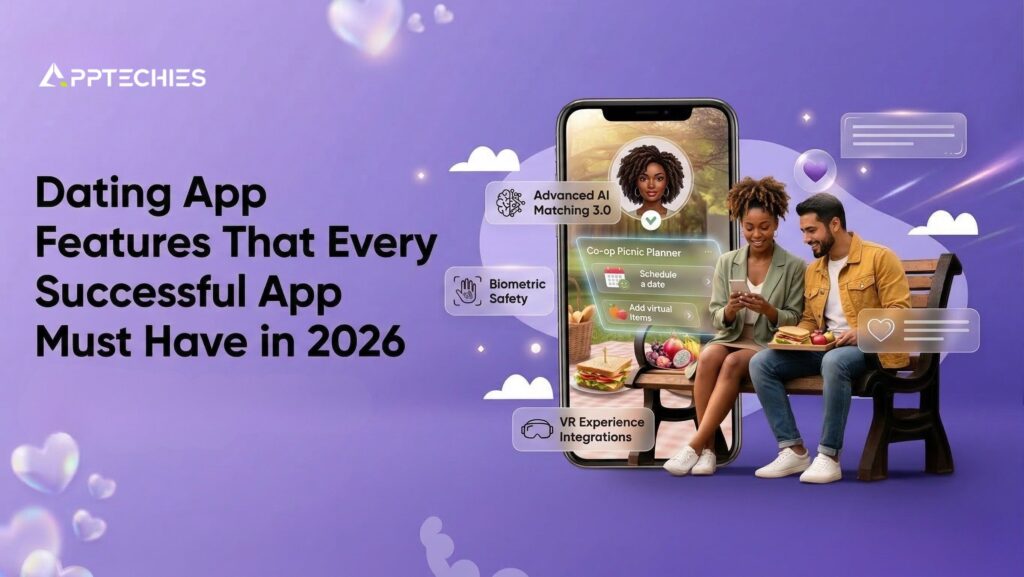
Dating App Features That Every Successful App Must Have in 2026
Do you remember the last time you deleted an app from your phone?
Maybe it wasn’t because it looked bad. It was because it didn’t seem useful. Dating apps are no different. A 2024 Forbes study found that more than three-quarters of dating app users reported swiping fatigue, and the apps losing users aren’t the ones with the worst designs. They’re the ones that have stopped developing.
The global dating app market generated revenue between $10.89 billion and $11.61 billion in 2025. According the global market data 350 million people using dating apps worldwide. That is a massive opportunity. But here is the catch, global dating app installs and sessions declined in both 2024 and 2025. Users have more choices than ever, and they are becoming far more selective. They select apps actually deserve space on their phone.
So if you’re a developer, founder, or entrepreneur thinking about building a dating app in 2026, this blog is exactly what you need. We’ve detailed every feature that’s essential, why it’s important, and what your app really needs to compete.
Let us get into it.
Who Actually Uses Dating Apps in 2026?
Before building an app, you need to know who you are building it for.
Nearly half of people aged 18-29 and 30-49 have used online dating apps, while only 20% of people aged 50 or older have. Your main audience is 18-45 years old. They’re mobile-first, impatient, and have zero tolerance for slow or confusing dating apps.
In 2026, users are prioritising intentional dating, being upfront about relationship goals, values, and timelines from the very beginning. They do not want to swipe through hundreds of profiles. They want fewer, better matches. Your features need to reflect that shift.
The Core Dating App Features You Cannot Skip
These are the non-negotiables. Every dating app, big or small, needs these working perfectly before anything else.
Fast and Simple Onboarding
Your user decides whether to stay or leave within the first 60 seconds. If your signup process is long, confusing, or asks for too much information upfront, most people will never get past it.
Keep it simple. Allow user to login via their Google or Apple ID. Let users build their profile gradually rather than filling in everything before they can see a single match. Ask for the essentials first, photos, age, and location, then prompt for more detail later.
A profile should also support more than just photos. Voice clips, short video introductions, and interest tags all help users show personality beyond a headshot. In 2026, users are moving away from highly curated, filtered personas and toward authentic self-presentation and your onboarding needs to make that easy.
AI-Powered Matching
Basic swiping is no longer enough on its own. Hinge introduced an AI recommendation feature that drove a 15% increase in matches and contact exchanges after it went live. That is a meaningful result that came directly from smarter matching — not more users or a redesigned interface.
A good matching algorithm looks at more than location and age. It considers behavior — who a user actually engages with, what profiles they spend time on, who they message first. Over time, it gets smarter. The more a user interacts, the more accurate the suggestions become.
Only 21% of Americans believe that dating app algorithms can accurately predict compatibility, which means there is still a huge trust gap to close. Build a matching that actually works and communicate clearly to users how it operates. Transparency builds confidence.
Real-Time Chat and Messaging
Once two people match, the conversation needs to flow naturally. Your messaging system should feel as smooth as texting — fast, clean, and reliable.
Include read receipts, photo sharing, voice messages, and the ability to react to messages. Give users control over who can message them and easy tools to block or report someone without friction.
Hinge found that 72% of users are more likely to engage with a match when it arrives with a message already attached. This led to their AI Convo Starters feature, which generates opening lines based on the other person’s profile. Users can send it as is or edit it before sending. It removes the most common friction point in online dating: not knowing what to say first.
Location-Based Discovery
People want to meet people nearby. GPS-based matching with adjustable distance filters is a foundational feature that has been around since Tinder launched — and it still matters in 2026.
Give users control over their location radius, let them search by neighborhood or city, and allow them to hide their exact location while still being discoverable. Location precision without privacy compromise is the goal.
Push Notifications Done Right
Notifications keep users coming back. A new match, a reply, a profile like, these are moments that pull someone back into the app. But notifications that feel spammy or irrelevant do the opposite.
Build smart notification logic. Send alerts when something really interesting happens. Give users the opportunity to choose what they want to be notified about. Timing also matters a notification at 2 a.m. is more likely to be ignored than acted upon.
Photo and Identity Verification
Fake profiles destroy trust faster than any other problem. Build a verification system that checks profile photos against a live selfie. It does not need to be invasive, just enough to confirm the person is real and looks like their pictures.
Tinder’s FaceCheck safety feature reduced interactions with bad actors significantly after it launched and it became a genuine selling point for users who had previously lost trust in the platform.
Block, Report, and Moderation Tools
Every user needs to feel that they can quickly and easily remove someone from their experience. Your report flow should take no more than three taps. Your moderation team or AI moderation system should respond quickly, within hours, not days.
More than 50% of female dating app users under 50 have received unwanted explicit messages. This is not a small edge case. Build moderation tools that take this seriously and let users control their experience.
End-to-End Encryption
Every message, photo, and piece of personal data shared inside your app needs to be protected. End-to-end encryption, two-factor authentication, and secure data storage are the baseline in 2026 — not extras.
Users are increasingly aware of data privacy. An app that clearly communicates how it protects user data will earn more trust than one that stays silent on the topic.
Safety Check-In for In-Person Dates
This is one of the most underused features in dating apps, and one of the most genuinely useful ones. Allow users to share their live location with a trusted friend or family member before going on a date. Add an optional check-in reminder so someone is notified if the user does not confirm they are safe after a set time.
This feature alone can significantly improve how safe users feel using your app, and that feeling translates directly into better reviews, longer retention, and word-of-mouth growth.
Video Profiles and Voice Prompts
A static photo tells you very little about someone. A 30-second video or a short voice clip tells you everything, their energy, their humour, how they actually sound. By 2024, 40% of dating app users had already tried video-based features and that number has only grown.
Give users the option to record a short video introduction or answer a prompt with their voice. Make it optional, not every user will want to do it, but for the ones who do, it creates a significantly richer profile.
In-App Video Calling
Meeting on a video call before meeting in person has become a completely normal step in modern dating. Build this directly into your app so users never have to share a personal phone number to make it happen.
Keep the feature simple. One-tap calling, no account setup, clean interface. The goal is to make it as easy as possible for two people to have a real conversation before committing to an in-person meeting.
Niche and Values-Based Matching Filters
When asked what matters most in finding a match, 51% of dating app users cited sharing similar family values as very important, followed by similar political beliefs at 33% and religious or spiritual beliefs at 31%.
People want to filter by what actually matters to them not just age and distance. Build filters for values, lifestyle, religion, dietary preferences, relationship goals, and communication style. The more precisely someone can describe what they are looking for, the more likely your app is to deliver it.
Gamification and Engagement Loops
The apps that keep users coming back daily have one thing in common, they make the experience feel engaging, not like a chore.
Daily matches, icebreaker games, streak rewards, and time-limited boosts all create reasons to open the app even when there is nothing urgent waiting. Tinder’s Double Date feature — which lets pairs of friends match up with other pairs for a shared experience — was a major success, particularly with women under 30. It turned solo swiping into a social activity.
Think about what makes your app enjoyable to use, not just functional.
Inclusivity by Design
63% of LGBTQIA+ adults have used dating apps more than any other demographic group. Your app needs to reflect the full range of how people identify.
Expanded gender identity options, pronoun display, relationship style filters, and orientation settings are not edge-case features. They are expected by a large and loyal user base. Build them in from the beginning rather than adding them as an afterthought.
AR and VR Dating Experiences
Virtual reality dates immersive experiences where two people can explore a virtual environment together are among the most anticipated developments in dating app technology for 2026 and beyond.
This is still early-stage for most apps. But if you are building a product designed to stand out in a crowded market, exploring AR-powered profile experiences or virtual shared activities puts you years ahead of competitors still relying on photos and text.
Blockchain for Trust and Payments
Blockchain-powered identity verification and data transparency are emerging as a solution to the trust problem that has long plagued dating apps. When a user knows their identity has been cryptographically verified, and that their data is not stored in a centralised server waiting to be breached, the entire experience feels safer.
How to Monetise These Features
Building great features is only half the work. Receiving payment for them is the other part.
The most effective monetisation model in 2026 combines a free tier that is genuinely useful with a premium subscription that makes the experience significantly better. Put the right things behind the paywall — unlimited likes, advanced filters, profile boosts, read receipts, and the ability to see who liked you first.
Around 35% of dating app users have paid for premium features, with higher-income users at 45% much more likely to pay. That means your free experience needs to be good enough to attract users — and your premium tier needs to be good enough to convert them.
Avoid locking basic safety features or core messaging behind a paywall. Users will not forgive that.
What the Top Dating Apps in USA Are Getting Right
The top dating apps in USA, Tinder, Hinge, Bumble, and Match — are all investing heavily in the same direction: AI-powered personalisation, safety infrastructure, and reducing the friction that causes users to give up and delete the app.
Match Group committed $60 million toward AI and product development at Tinder alone. Bumble is rebuilding its entire platform from scratch as a cloud-native, AI-first system. These are not small bets — they are signals about where the entire industry is heading.
You do not need a $60 million budget to compete. But you do need to understand what these apps are building and why — then find your own angle within that direction.
Build Your Dating App With Apptechies
You now know exactly what features a successful dating app needs in 2026. The harder question is, who do you trust to build it?
Apptechies is a mobile app development company that has spent over 10 years building apps that actually launch, actually perform, and actually grow. Our team covers everything from UI/UX design and AI integration to backend architecture and App Store deployment.
As an iOS app development company and full-stack Android and cross-platform development team, we handle the complete build — customer app, driver app, admin panel, and everything in between — so you can focus on your business while we focus on your product.
Whether you are a first-time founder with a dating app idea or an established business looking to enter the space, we will help you build something people actually want to use.
Talk to our team today and get a free consultation on your dating app project.
Frequently Asked Questions
Q. What Are The Must-have Features Of A Dating App In 2026?
Ans: The core features every dating app needs are smart onboarding, AI-powered matching, real-time chat, location-based discovery, photo verification, block and report tools, and push notifications. Advanced features like video calling, AI conversation starters, and values-based filters are what separate good apps from great ones.
Q. How Much Does It Cost To Build A Dating App In 2026?
Ans: A basic dating app with core features typically starts around $15,000–$30,000. A full-featured app with AI matching, video calling, and admin dashboard usually falls between $40,000–$80,000. The final cost depends on the platform, feature complexity, and the team you work with.
Q. How Long Does It Take To Create A Dating Application?
Ans: A simple dating app takes roughly 3–4 months from design to launch. A fully featured app with AI, video, and custom matching logic typically takes 6–9 months. Rushing the timeline almost always creates problems after launch.
Q. What Makes A Dating App Safe For Users?
Ans: Safety comes from combining photo verification, end-to-end encryption, fast block and report tools, AI content moderation, and optional safety check-in features for in-person dates. Users need to feel protected before they feel comfortable using your app.
Q. Should I Create A Native App Or Go Cross-platform?
Ans: Cross-platform frameworks like Flutter or React Native work well for most dating apps, especially at launch. They let you reach iOS and Android users without doubling your development budget. If your app relies heavily on device-specific hardware, native development gives you more control.
Q. What AI Features Should A Dating App Have?
Ans: The most impactful AI features right now are smart matching algorithms that learn from user behavior, AI-generated conversation starters, and content moderation systems that flag inappropriate messages automatically. These three alone can significantly improve both retention and user safety.