
"AI agent" and "agentic AI" get used interchangeably in vendor pitches, but they describe two genuinely different levels of autonomy, and mixing them up leads to either underbuilding (a chatbot that can't actually do anything) or overbuilding (a system with far more decision-making power than the task needed, and far more ways to go wrong).
This article works through the real distinction, where each one actually fits, and the specific risks that show up once a system starts acting instead of just answering.
What Is an AI Agent, Actually?
An AI agent is a single system built around one language model, given a defined set of tools, and scoped to one bounded task. It reads a request, decides which of its available tools to call, calls them, and returns a result. A support-ticket triage agent is a good example: it reads an incoming ticket, checks it against a knowledge base, and either drafts a reply or routes it to a human, using a narrow, specific tool set to do it.
The defining trait isn't the model underneath it, it's the scope. An agent has a clear start, a clear end, and a small number of steps in between. Most production deployments we build through AI development services start here, because a well-scoped agent is easier to test, easier to secure, and easier to explain to the person who has to sign off on it.
What Is Agentic AI, and How Is It Different?
Agentic AI describes a system where multiple steps, and often multiple specialized agents, work together toward a broader goal without a human deciding each intermediate step. Instead of "read this ticket, draft a reply," an agentic system might be told "resolve this customer's billing dispute," and it decides on its own which records to pull, which policies apply, whether to issue a refund, and when to escalate.
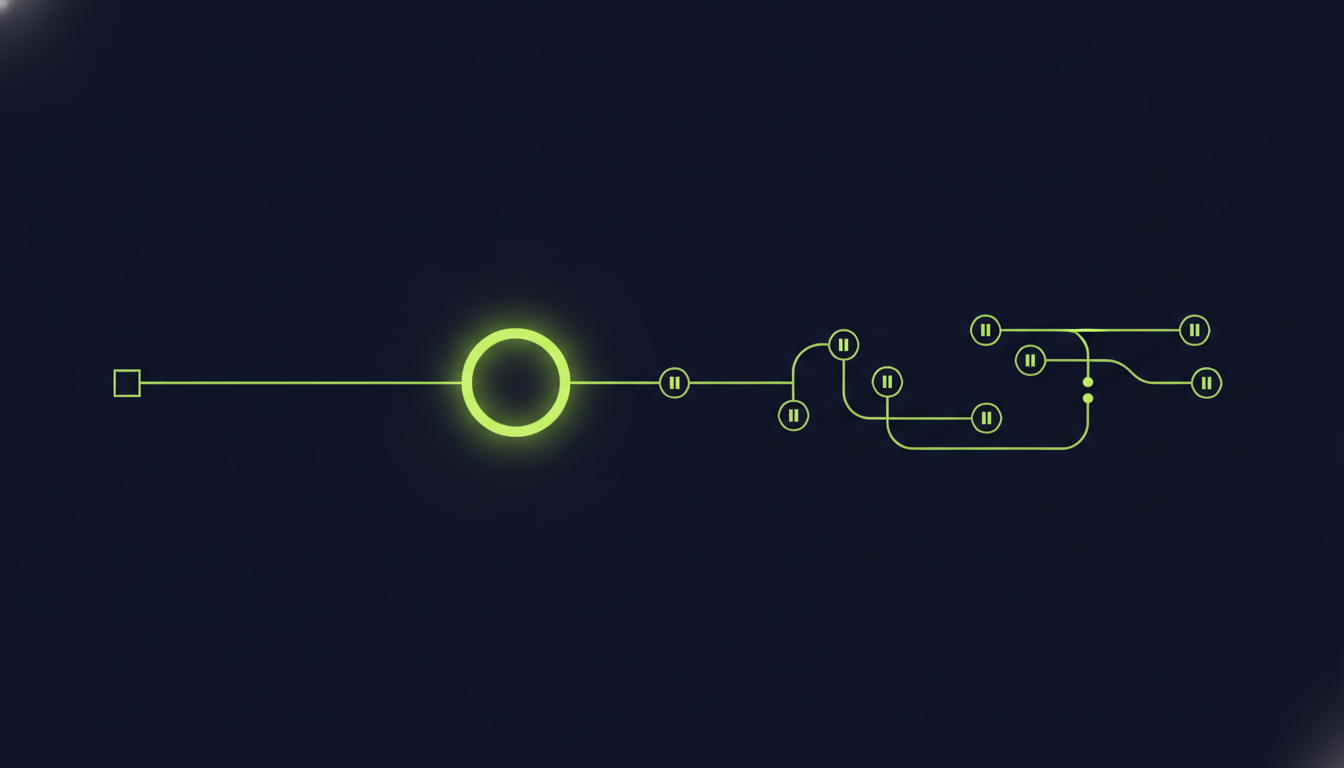
The system plans a sequence of actions, executes them, checks its own progress against the goal, and adjusts course if something didn't work the way it expected. That loop, plan, act, observe, replan, is the actual technical difference. A single agent doesn't replan; it does its one job and stops. An agentic system keeps going until the broader goal is met or it hits a limit someone built in.
The industry term for this loop is often ReAct-style reasoning (reason, then act, then observe the result), though the specific pattern varies by framework. What matters for a buyer isn't the pattern's name, it's how many of those loop iterations run before a person sees what happened.
AI Agent vs. Agentic AI: A Direct Comparison
Comparing scope, autonomy, and risk across both approaches
| Dimension | AI Agent | Agentic AI |
|---|---|---|
| Scope | One defined task | A broader goal spanning several tasks |
| Planning | None; follows a fixed flow | Plans and re-plans its own steps |
| Tool use | A small, fixed tool set | Multiple tools, often chosen dynamically |
| Typical review point | One, at the end | Several, at defined checkpoints |
| Failure mode | Wrong single output | Compounding errors across steps |
| Build complexity | Lower | Meaningfully higher |
| Good fit for | Well-defined, repeatable work | Multi-step work with real judgment calls |
Neither side of this table is automatically the better choice. It depends entirely on the actual task, and specifically on how bad it is if the system gets a step wrong before anyone notices.
The Architecture Behind an Agentic System
Once a system starts planning its own steps, a few architectural pieces become mandatory, not optional. Skipping any of them is how a demo that worked fine turns into a production incident.
- State and memory: the system needs to know what it already tried in this run, so it doesn't repeat a failed step in a loop.
- Tool permission boundaries: each tool call should only be able to do what that specific step actually needs, not everything the underlying account can do.
- A loop limit: a hard cap on how many planning iterations a run can take before it stops and asks for help, rather than running indefinitely.
- Human-in-the-loop checkpoints: specific points where an irreversible action (a payment, a deletion, an external email) pauses for approval instead of executing automatically.
- Observability: a real log of what the system decided and why at each step, not just the final output, since debugging an agentic failure means reconstructing its reasoning.
This is also where RAG development services and retrieval quality matter more than people expect: an agentic system that plans several steps based on bad or outdated retrieved information doesn't just get one answer wrong, it can build several wrong decisions on top of each other before anyone catches it.
When a Single AI Agent Is the Right Choice
Most business problems that people describe as needing "an AI agent" are actually well served by exactly that, a single, well-scoped agent, and don't need the added complexity of a full agentic system.
A single agent is the right call when the task is repeatable and well-defined, when the cost of a wrong output is low or easily caught (a draft that a human reviews, not an action that already happened), and when the value of speed comes from doing one thing reliably rather than from replacing a whole workflow. Document classification, a first-pass support reply, structured data extraction from a form, these are agent-shaped problems, not agentic ones.
If your team is exploring this route, hire AI developers who can scope the actual task narrowly first. A surprising amount of agentic-AI spend goes toward autonomy the business never actually needed.
When Agentic AI Is Worth the Added Complexity
Agentic AI earns its complexity when a task genuinely spans multiple steps that depend on each other's outcomes, and doing it as separate single-purpose agents would just move the coordination problem onto a human instead of solving it. Multi-step research synthesis, an internal operations workflow that has to check several systems and reconcile them, or a customer-service resolution that might need three or four different lookups depending on what the first one finds, are realistic candidates.
It's also the right call when the business genuinely wants fewer human touchpoints in the loop, not just faster individual steps, and is prepared to build the permission boundaries and checkpoints that decision actually requires. Teams already running AI consulting services engagements with us usually reach this stage after a single agent has proven the individual steps work; agentic orchestration is rarely the right starting point.
For genuinely conversational, multi-turn use cases specifically, this is also where AI chatbot development services and generative AI development services intersect: a chatbot that only answers questions is an agent; one that actually resolves an issue across several turns and systems is edging into agentic territory, and should be scoped and secured accordingly.
What Actually Goes Wrong With Agentic Systems
The failure modes are specific, not hypothetical, and they're the reason agentic AI needs more engineering discipline than a single agent, not less.
- Permission creep: a tool integration gets broader access than the current task needs "to save time later," and a planning error uses that access somewhere it shouldn't.
- Compounding errors: a wrong intermediate decision becomes the input to the next step, so a small mistake early in the loop can produce a confidently wrong final result.
- Cost and loop runaway: without a hard iteration limit, a system that keeps trying to satisfy a goal it can't actually complete will keep calling tools and models until someone notices the bill.
- Data exposure: an agent with broad retrieval access can surface information in an output that the requester wasn't supposed to see, especially across multi-tenant systems.
- Silent scope creep: a system built for one goal gets reused for a slightly different one without re-checking whether its permission boundaries and checkpoints still make sense for the new task.
None of these are solved by using a more capable model. They're solved by architecture: explicit permission scoping, iteration limits, and real human checkpoints at the points where a mistake would actually matter.
This is also squarely a security and compliance question, not just an engineering one, particularly for any workflow touching payments, health data, or customer records. If your process already has an established quality assurance practice for regular software releases, an agentic AI system needs at least that level of scrutiny before it goes live, since its outputs are harder to predict than a deterministic feature.
How to Evaluate Whether Your Business Is Ready
Skip the question of which approach sounds more advanced, and ask three practical things about the actual task instead.
- Is the action reversible? If a mistake can be undone by a human afterward, a single agent with a review step is usually enough. If it can't (money moved, an email sent, a record deleted), you need a human checkpoint before that specific step, regardless of how the rest of the system is built.
- Does the task actually require multiple dependent decisions? If a human could complete it correctly by following one fixed checklist, it's an agent, not an agentic system. If the right next step genuinely depends on what the previous step found, it's a real candidate for agentic orchestration.
- Can you afford to build the guardrails properly? Permission scoping, loop limits, and real checkpoints take genuine engineering time. An agentic system without them isn't a leaner version of the same thing, it's an unfinished one.
If the answer points toward agentic orchestration, plan for it as its own project phase rather than an add-on to an existing single-agent build. Teams building this on an existing product often bring in full-stack developers alongside AI engineers specifically because the guardrails (audit logging, permission systems, approval UI) are regular application engineering, not AI work, and software integration services matter just as much as the model choice once several internal systems are in the loop. For how those agents actually reach their tools and each other, our guide to MCP, A2A and the other agent protocols covers which layer a multi-agent build needs and which it can skip.
For a closer look at picking the underlying model itself once you know which architecture you need, see our guide on how to choose an AI model for production, and for a realistic sense of what either build actually costs, AI development cost in 2026 breaks down the real cost drivers rather than a single number.
Real Examples: Agent-Shaped Work vs. Agentic-Shaped Work
Our MyMood AI build is a good example of agent-shaped work done well: a defined task (mood-based content and avatar generation) with a bounded tool set, not an open-ended autonomous loop, which kept it fast to ship and easy to reason about.
GenieChat, by contrast, sits closer to the agentic end: a conversational system that has to maintain context across a longer interaction and decide how to respond based on more than a single fixed lookup. The engineering difference between the two projects wasn't the underlying model, it was how much decision-making authority each system needed before a person saw the result.
If you're weighing this for your own roadmap, teams working in machine learning development services and AI integration services can scope which category your actual use case falls into before any architecture gets built, which is a much cheaper mistake to catch on paper than after a system is already in production.