
Top 10 Best Taxi App Development Companies in the USA for 2026
Every Missed Ride Is a Missed Revenue Opportunity
Picture this. A passenger opens three taxi apps at once. Yours takes four seconds to load. The other two give a quote in one. They pick a competitor before your splash screen even disappears.
That’s the market you’re entering in 2026. Speed is expected. Reliability is the baseline. And the app behind your fleet is either your biggest asset, or your biggest liability.
The ride-hailing industry in the US is projected to cross $75 billion in revenue this year. Yet, according to published data, 62% of new taxi apps still fail to gain meaningful traction within their first year. The reasons aren’t complicated: wrong tech partner, underestimated costs, and apps built without a clear understanding of what American riders actually expect.
This guide cuts through the noise. We’ve reviewed the landscape of taxi app development companies in the USA and shortlisted ten that have a real track record, not just polished marketing pages. Whether you’re a startup testing a niche market or an established fleet operator ready to go digital, you’ll find a clear path forward here.

What Should You Look for Before Hiring a Taxi App Development Company in the USA in 2026?
Most businesses get this part wrong. They compare price quotes first and capabilities second. Here’s what actually matters when shortlisting a mobile app development company for your taxi platform.
Domain Experience Matters More Than General Capability
A company that has built 500 generic apps isn’t necessarily equipped to build a ride-hailing platform. Taxi apps require real-time GPS matching, surge pricing logic, three interconnected panels (rider, driver, admin), and state-specific compliance handling. Ask directly: how many taxi or ride-hailing apps have they shipped? Can they name the platforms and show what happened after launch?
White-Label vs. Custom Build Is a Foundational Decision
This choice affects your timeline, budget, and long-term flexibility. A white-label solution lets you launch in 30–60 days and costs significantly less upfront, often under $30,000. A custom build gives you full ownership over every feature and UX decision, but expect a 6–12 month timeline and a budget that reflects it.
Neither option is universally better. If you’re validating a new market, white-label gets you data fast. If you’re building a product with a unique model, say, fleet-specific corporate transport, a custom build is worth the investment. Companies like Apptechies offer both paths, so you don’t have to pick a vendor based solely on what they prefer to build.
Post-Launch Support Is Often Overlooked
Most development agreements focus on the build phase. But the months after launch, when real users expose unexpected bugs, app store updates break integrations, and traffic spikes stress your backend, that’s when the partnership actually matters. Before signing, ask what post-launch SLA they offer, how bugs are triaged, and who your point of contact is after go-live.
US Market Fit Requires Specific Capabilities
Operating in the United States isn’t just a geography — it’s a regulatory environment. Payment processors like Stripe and Braintree must be integrated correctly. ADA accessibility requirements apply to your app UI. State-by-state insurance compliance and driver background check rules vary significantly. The right company will already understand these requirements, not learn them on your project’s dime.
- Ask for verifiable taxi or mobility app portfolio examples
- Confirm whether they offer white-label, custom, or both
- Clarify post-launch maintenance terms in writing
- Check for US-specific payment and compliance experience
- Review their tech stack for real-time capability (WebSockets, live GPS)
Top 10 Taxi App Development Companies in the USA (2026)
Each company below was evaluated on domain experience, tech capability, post-launch support, and real client outcomes, not just website claims.
Apptechies
HQ: USA & UAE
Best For: Startups, SMBs & Enterprise Fleets
Clutch Rating: 4.9 / 5
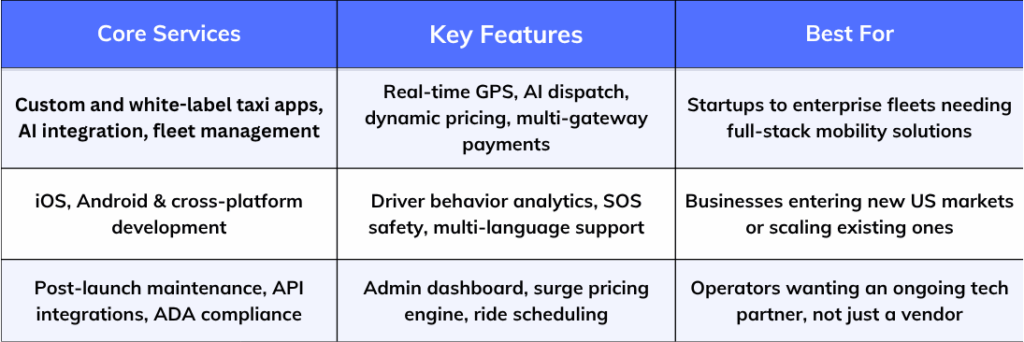
Apptechies sits at the intersection of deep mobility expertise and practical business thinking. They don’t just build apps, they consult on the business model first, which saves clients from costly architecture decisions down the road. Their team has delivered taxi and ride-hailing platforms for markets across the US, UAE, and beyond, with hands-on experience in AI features in taxi apps, real-time dispatch systems, and multi-city scaling.
What makes them stand out is the post-launch commitment. Their support model includes dedicated SLAs, live monitoring dashboards, and proactive update cycles, not just a ticketing queue. For entrepreneurs exploring how to start a taxi business, Apptechies also provides market entry consultation alongside the technical build.
Mobisoft Infotech
HQ: Houston, USA & India
Best For: IoT-Integrated Fleet Operations
Clutch Rating: 4.8 / 5
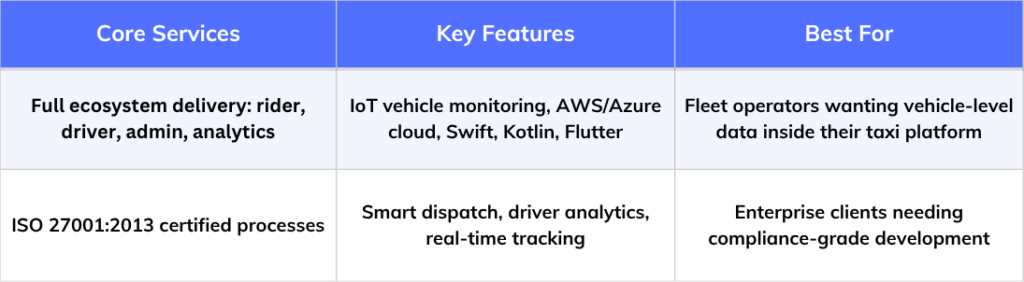
One of the few companies with a genuine US headquarters, Mobisoft offers local engagement advantages for clients who prefer in-person collaboration or US-entity contracts. Their standout capability is IoT integration, layering vehicle-level data such as fuel monitoring, driver behavior tracking, and predictive maintenance onto standard booking infrastructure.
Space-O Technologies
HQ: USA & India
Best For: Startups & SMBs
Clutch Rating: 4.8 / 5
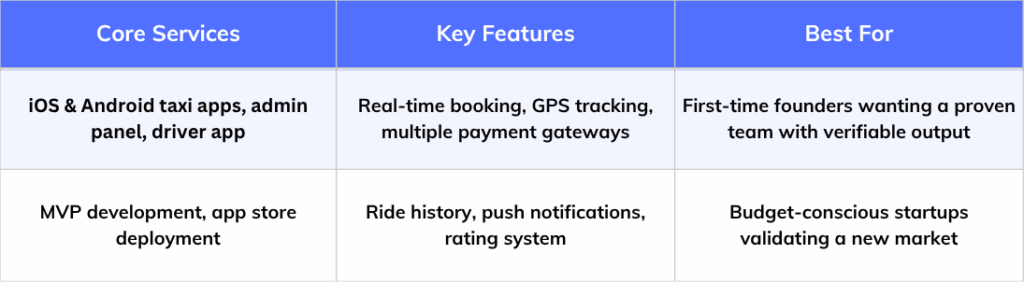
Space-O Technologies has delivered more than 50 taxi booking apps, including publicly verifiable platforms, a meaningful proof point in an industry full of unverifiable claims. Their track record with named platforms like Braxi and Venuxx shows they can handle production environments, not just demo builds.
Hyperlink InfoSystem
HQ: USA, India & UAE
Best For: Advanced Tech Integrations
Clutch Rating: 4.7 / 5
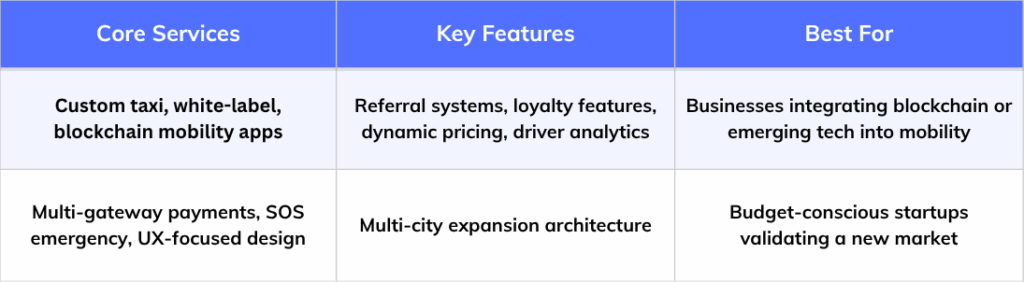
Founded in 2011, Hyperlink InfoSystem has a large development bench, 450+ developers, which matters when you need specialized skills across AI, blockchain, and IoT within a single project. Their volume of taxi app work means they’ve encountered and solved edge cases that smaller teams simply haven’t faced.
Suffescom Solutions
HQ: USA & India
Best For: On-Demand App Specialists
Clutch Rating: 4.7 / 5
Suffescom specializes in on-demand platforms, which means taxi apps aren’t an occasional project for them, it’s their primary domain. Their backend systems are built for high-frequency transactions, which is critical when you’re managing hundreds of concurrent bookings during peak hours.

Elluminati Inc.
HQ: USA & India
Best For: Multi-Service Mobility Platforms
Clutch Rating: 4.6 / 5
Elluminati’s modular architecture is their real differentiator. Operators can configure the platform across service types, city taxis, bike taxis, corporate transport, or car rentals, without rebuilding from scratch per vertical. This flexibility is rare and genuinely valuable for startups with multi-service ambitions.

AppScript
HQ: Global (US, Europe, LATAM, Middle East)
Best For: Fast Market Entry
Clutch Rating: 4.6 / 5
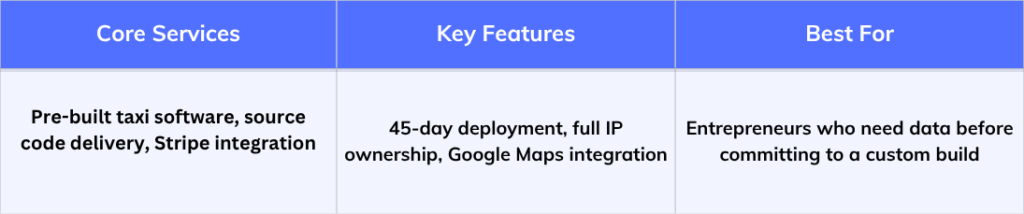
Appscrip’s pre-built taxi software is designed for deployment within 45 days, a real advantage for businesses that need to validate demand before 2committing to a full custom build. Full source code ownership means no SaaS lock-in, which matters during fundraising or multi-city expansion, where IP ownership is material.
Octal Software
HQ: USA & India
Best For: End-to-End Mobility Solutions
Clutch Rating: 4.5 / 5
Octal Software brings a structured approach to taxi app delivery—from discovery and UX design through to backend infrastructure and app store submission. Their process includes dedicated QA cycles, which reduces post-launch defect rates, a detail that matters more than most founders realize until they’re managing a live platform.

Techcronus
HQ: USA, Australia & India
Best For: Enterprise & Agile Delivery
Clutch Rating: 4.5 / 5
Techcronus combines enterprise-grade delivery discipline with an agile structure that keeps projects from stalling. They’ve completed 800+ projects across industries, and their taxi app works benefits from that cross-industry experience, especially when integrations like ERP systems, corporate billing, or third-party logistics APIs are required.

Kody Technolab
HQ: USA & India
Best For: Performance-Focused Builds
Clutch Rating: 4.4 / 5
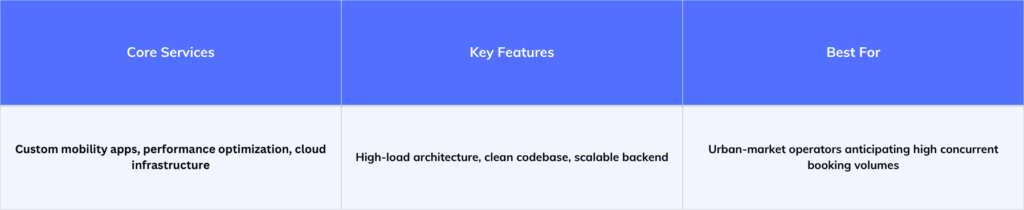
Kody Technolab focuses on clean architecture and performance optimization from day one. Their taxi app builds are designed to handle high concurrent load without backend degradation, an issue that surfaces quickly in dense urban markets where hundreds of ride requests can hit simultaneously.
How to Choose the Right App Development Company for Your Taxi Platform
The right partner depends entirely on where you are in your journey. Here’s a practical, honest framework, not a generic checklist.
If you’re validating a new market
Go with a white-label solution from companies like Apptechies, Elluminati, or Appscrip. Launch fast, collect real data, and iterate. Don’t build custom infrastructure for a hypothesis.
If you’re building a differentiated product
Custom is the right call. Work with companies like Apptechies or Mobisoft who can build from scratch with your specific business logic, unique pricing model, or niche market requirements.
If you’re budget-conscious without cutting corners
Choose a hybrid approach, US-based product design and strategy with offshore engineering execution. This balances quality and cost without sacrificing communication or output.
One more thing worth noting: the cheapest quote is almost never the cheapest outcome. A poorly built taxi app will cost more in bug fixes, user churn, and rebuilds than a well-scoped project done right the first time. For founders exploring a taxi business idea for startups, the development partner you choose is a founding-team-level decision, treat it that way.
Cost Breakdown of Taxi App Development in the USA
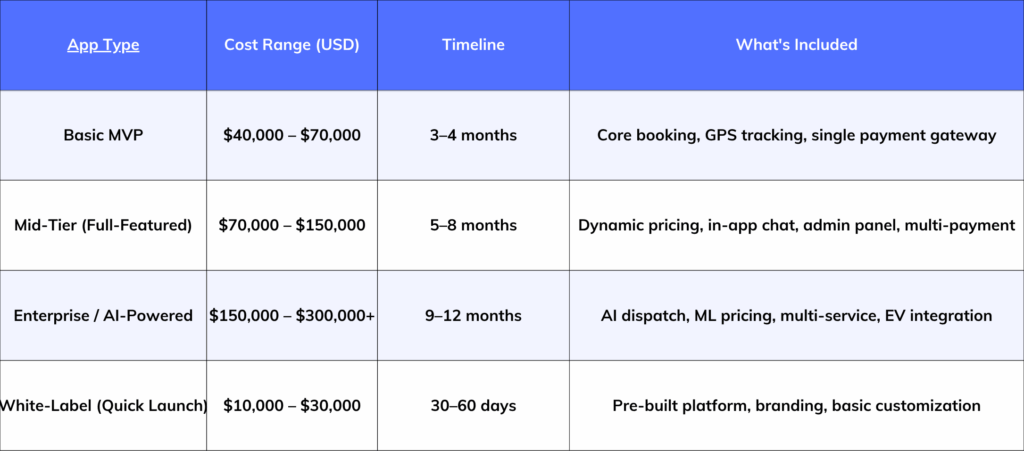
The most honest answer to “How much does it cost?” is: it depends on what you’re building. But here’s what the real numbers look like, based on current market data.
Key Factors That Drive the Final Number
- Team location: US-based developers average $150/hour. Offshore teams run $40–$60/hour. Hybrid models balance both.
- AI features: Adding AI and ML capabilities increases development cost by 20–40%, but can improve revenue per ride by 18–25%.
- Platform choice: Building separate native iOS and Android apps adds roughly 50% to the cost. Cross-platform frameworks like Flutter reduce this by up to 30%.
- EV integration: Charging station locators, battery monitoring, and carbon tracking add 15–30% in additional scope.
- Annual maintenance: Budget 15–20% of your initial development cost per year for updates, bug fixes, and OS compatibility.
One cost most founders miss: post-launch server infrastructure. As your user base grows, cloud costs on platforms like AWS or Azure scale with it. Budget for auto-scaling architecture from day one—it’s cheaper to architect it correctly upfront than to retrofit it under production load. For a full picture of the cost to develop a taxi app, always factor in the 12-month post-launch runway, not just the build.
How AI-Based Taxi Platforms Make US Taxi Operations Easier
Running a taxi operation without AI in 2026 means making decisions based on incomplete information. AI doesn’t replace your team, it gives them better data to act on.
Here’s where AI makes a measurable operational difference:
- Instant Smart Dispatch: AI automatically connects passengers with the nearest, most suitable driver, eliminating manual juggling and reducing average wait times significantly.
- Dynamic Pricing: Machine learning models adjust fares in real time based on demand, traffic, and supply. This directly protects revenue during peak hours without requiring manual overrides.
- Predictive Maintenance: AI can flag vehicles approaching mechanical issues before they break down, reducing downtime and unexpected repair costs.
- Demand Forecasting: By analyzing historical trip data alongside local event schedules and weather, AI helps fleet managers position drivers proactively rather than reactively.
- AI-Powered Customer Support: Conversational AI handles 80% of common rider queries instantly, refunds, cancellations, payment issues, freeing your human team for complex escalations.
Platforms using AI dispatch have reported up to 27% more completed rides per day and up to 35% shorter wait times. For companies building or scaling a taxi app like Uber or Lyft, these aren’t optional features anymore, they’re the competitive baseline. Explore how AI features in taxi apps shape modern platform performance.
How AI Mobility Solutions Help Increase Rider Safety and Confidence
Safety isn’t just a legal requirement, it’s a user retention factor. Riders who trust your platform return. Those who don’t, leave a one-star review and never open the app again.
AI brings several meaningful safety improvements to modern taxi platforms:
- Driver Behavior Monitoring: Sensors and AI models detect harsh braking, sharp turns, or speeding in real time, and flag patterns for fleet review without waiting for rider complaints.
- Route Deviation Alerts: If a driver takes an unexpected detour, the system can automatically notify both the rider and a monitoring team.
- In-App SOS: One-tap emergency alerts with live location sharing give riders an immediate safety net, which also builds trust before any incident occurs.
- Identity Verification: AI-powered facial recognition at driver check-in ensures the registered driver is operating the vehicle, not someone else.
- Trip Sharing: Automated real-time trip links sent to trusted contacts, a small feature that significantly raises rider confidence, especially for solo travelers.
When evaluating a taxi app development company, ask specifically about their safety feature architecture. It’s a strong signal of how seriously they take production environments versus demo apps.
Grow Your Taxi Platform Faster with Multi-Currency and Language Support
The US is not a monolingual, monocultural market. Cities like Miami, Los Angeles, New York, and Houston have massive Spanish, Mandarin, French Creole, and Arabic-speaking populations. A taxi app that only works in English is leaving a significant portion of potential users on the table.
Multi-language support isn’t technically complex, but it has to be built into the architecture from day one. It is costly and painful to retrofit it later. Similarly, multi-currency support matters if you’re operating across state lines or planning international expansion from a US base.
Practical considerations for your build:
- RTL (right-to-left) language support for Arabic-speaking markets
- Localized date, time, and distance formats
- Currency conversion with real-time exchange rate feeds
- Localized push notification content, not just translated text, but culturally appropriate phrasing
If your platform is designed to eventually start a taxi business in Dubai or other international markets alongside US operations, these capabilities are non-negotiable from the architecture phase.
Save Money on Customer Acquisition with AI Automation
Most taxi startups overspend on paid acquisition because they don’t have systems in place to retain the riders they already have. AI helps on both fronts.
Retention-First Thinking
Acquiring a new rider costs 5–7x more than keeping an existing one. AI-powered personalization, showing riders relevant promotions based on their ride history, preferred times, and locations — increases return booking rates without additional ad spend.
Smart Referral and Loyalty Mechanics
AI can identify your highest-value riders and trigger referral incentives at the right moment—after a completed long-distance trip, for example—rather than blanket promotions that dilute margin.
Churn Prediction
If a rider hasn’t booked in 14 days and their usage was previously consistent, AI flags them for a targeted re-engagement campaign. Knowing who’s at risk of churning before they leave is worth more than any paid ad campaign.
For taxi businesses working with tighter margins, AI-driven retention is one of the highest-ROI investments in the platform. A good mobile app development company will build these mechanics into the platform rather than treating them as afterthought integrations.
How Electric and Autonomous Vehicles Are Changing Taxi Services
The EV shift is no longer a future consideration. California already mandates EV reporting for ride-hailing operators, and similar policies are expanding across other states. Building a platform without EV capability today means retrofitting it under regulatory pressure tomorrow.
What EV Integration Looks Like in Practice
- Charging station locators integrated into the driver app
- Battery level display and range estimation for driver route planning
- Carbon savings tracking for rider-facing transparency (which Gen Z riders respond to positively)
- Predictive charging reminders based on scheduled trips
The Autonomous Vehicle Question
Tesla and Waymo are already piloting autonomous taxis in select US cities. Full autonomous deployment at scale isn’t here yet — regulatory uncertainty and public trust remain real barriers. But the platform architecture decisions you make today should account for autonomous vehicle integration as a future layer, not a rebuild.
Developing a full autonomous taxi system can cost $250,000 to $500,000+, with LiDAR hardware alone running up to $70,000 per vehicle. For most operators in 2026, the practical play is building an EV-ready, AI-optimized platform now, and leaving the architecture door open for autonomous integration as the regulatory landscape matures
Why Businesses Trust Taxi App Developers in the USA
Working with a US-based or US-experienced development team carries real, practical advantages, not just the “quality” marketing claim you’ll see on every agency website.
- Regulatory alignment: US developers understand ADA accessibility requirements, state-by-state insurance compliance, and data privacy regulations like CCPA without needing education on your project’s timeline.
- Payment integration familiarity: Stripe, Braintree, and Square integrations are familiar territory — not learning exercises.
- Time zone coordination: For US operators, working across a 12-hour time difference creates real project delays. US-aligned teams remove this friction.
- App store compliance: Apple and Google have specific requirements for on-demand platforms. Experienced US teams know these cold.
- Liability clarity: US-entity contracts provide clearer legal recourse if deliverables don’t match agreements.
These aren’t reasons to avoid offshore teams entirely — hybrid models often make the most financial sense. But they are reasons to ensure your project lead and product ownership sit with a team that understands the US operating environment firsthand. Companies like Apptechies operate across both contexts, which is part of why they’re well-positioned for US market builds.
Latest Trends in Taxi Booking App Development in the USA
AI Is Moving from Optional to Standard
AI adoption in taxi apps was at 67% in 2025. Projections put it at 85% by mid-2027. Platforms without AI dispatch, dynamic pricing, or predictive analytics will struggle to compete on efficiency alone.
Cross-Platform Development Is Now the Default
Flutter and React Native have matured to the point where most new taxi app builds use them instead of native-only development. The cost savings (30–40%) are real, and performance gaps have largely closed for standard ride-hailing interactions.
Hyperlocal Niche Models Are Gaining Ground
Uber and Lyft dominate 65% of the US market. New entrants are winning by going narrow: airport-only shuttles, eco-friendly fleets, corporate transport with billing integrations, and accessibility-focused rides. A focused niche beats a generic clone every time.
White-Label First, Then Custom
65% of 2025 ride-hailing startups launched with white-label solutions. The strategy makes sense: validate market demand with a live product, then invest in custom development based on real data not assumptions.
Sustainability Features Are Becoming a Differentiator
Carbon tracking, EV-first routing, and sustainability dashboards for riders are showing up in new platform launches. For Gen Z riders especially, these features influence platform choice, and retention.
Final Words
The taxi app market in the USA is large, growing, and crowded in equal measure. The opportunity is real, but so is the cost of getting the foundation wrong.
The companies listed in this guide have earned their positions through delivery, not just marketing. Each brings something specific: some are built for speed, some for enterprise complexity, some for niche AI capabilities. The right match depends on your budget, your market, and your stage.
If you’re still in the early stages of figuring out your taxi business idea for a startup, the most valuable thing you can do is talk to two or three companies before committing, not to collect quotes, but to understand how they think about your problem. The quality of those early conversations tells you more than any portfolio page.
And if you’re ready to move past the research phase, Apptechies is a natural starting point. Their team works across white-label, custom builds, and AI integration, and they’ll give you a straight answer on what your project actually requires, not just what you want to hear.
Frequently Asked Questions
Q. What are the key benefits of hiring a taxi booking app development company in the USA?
Ans: US-experienced companies understand local regulatory requirements (ADA, CCPA, state insurance rules) without needing to learn them on your project. They’re familiar with payment integrations like Stripe and Braintree, app store compliance for ride-hailing platforms, and the operational realities of the US ride-hailing market. Beyond compliance, working with a US-aligned team reduces communication delays, legal ambiguity, and the risk of deliverables that don’t reflect how American riders actually behave.
Q. Who Is the Best Taxi App Developer in the USA?
Ans: There’s no single “best” — the right company depends on your stage and needs. For startups wanting a full-service partner with both white-label and custom build capability, Apptechies is consistently well-regarded. For IoT-heavy fleet operations, Mobisoft Infotech is a strong match. For fast market entry with minimal upfront investment, Appscrip or Elluminati make sense. The real question is which company’s strengths align with your specific requirements, not which one has the most awards on their homepage.
Q. How Much Does It Cost to Build a Taxi App in the USA?
Costs range from $40,000–$70,000 for a basic MVP, $70,000–$150,000 for a full-featured platform with dynamic pricing and AI capabilities, and $150,000–$300,000+ for enterprise-grade systems with autonomous or EV integrations. White-label solutions start under $30,000 for faster market entry. US-based development teams charge $150+/hour versus $40–$60/hour offshore. Most founders underestimate ongoing maintenance, which typically runs 15–20% of the initial build cost annually. See our detailed taxi app cost guide for a full breakdown.
Q. What Is the Timeline to Develop a Taxi App?
Ans: A basic MVP takes 3–4 months. A mid-tier, full-featured platform runs 5–8 months. Enterprise-level builds with AI, EV integration, and complex backend systems take 9–12 months. White-label solutions can launch in 30–60 days. These timelines assume an active, responsive client — delays in feedback, design approvals, or content delivery extend every estimate.
Q. What Features Make a Taxi App Successful?
Ans: The baseline: real-time GPS tracking, seamless ride booking, multi-payment gateway support, driver and rider apps, and an admin dashboard. The competitive differentiators in 2026: AI-powered dispatch and dynamic pricing, in-app safety features (SOS, trip sharing, identity verification), driver behavior analytics, and multi-language support. EV readiness and sustainability tracking are becoming standard expectations, not premium additions.
Q. Should I Build a Custom Taxi App or Use White-Label Software?
Ans: If you’re validating a market — go white-label. Launch fast, get real usage data, and let that guide your custom build investment. If you have a proven market, a unique business model, or specific technical requirements that off-the-shelf solutions can’t accommodate, custom development is the right move. The most common mistake is building custom before validating demand. The second most common is staying on white-label past the point where it’s limiting growth. Know which stage you’re in and choose accordingly. Read more about how to start a taxi business to align your tech choice with your business model.