
How to Start a Taxi Business in Dubai? Complete UAE Guide for 2026
Dubai is one of the most vibrant and dynamic cities in the world. Millions of tourists visit every year. Thousands of businesses launch here. And transportation remains one of the most in-demand services across the emirate.
If you wish to start a cab business in Dubai, you’ll be entering a growing market. Airports are too busy throughout the year in Dubai. Hotels are packed. Corporate professionals need reliable rides. And residents depend on taxis and ride-hailing services constantly.
This guide covers everything you need to know, from the legal structure and licensing steps to real cost figures, revenue potential, and technology requirements. Whether you are a UAE local, an investor, or an entrepreneur exploring options. Here, we’ll provide a detailed picture of what it takes to start and run a taxi business in Dubai by 2026.
Is It Worth Starting a Taxi Business in Dubai?
The short answer is yes — but only if you go in with the right plan.
Dubai’s transportation sector is growing steadily. The UAE taxi and limousine market was valued at over AED 2.5 billion and continues to expand. With more than 17 million tourists visiting annually and a resident population of over 3.6 million, the demand for reliable transport is consistent and high.
What makes Dubai particularly attractive for a taxi business is that it is not seasonal. Unlike many markets, demand stays strong all year. Formula 1, Expo events, major conferences, holiday travel, and daily corporate commuting all keep the market active.

That said, this is not a low-effort business. The setup costs are real. The competition includes major players like DTC (Dubai Taxi Corporation), Careem, and Uber. You need to be properly licensed and compliant with RTA regulations. But for entrepreneurs who are serious, structured, and ready to invest, the returns can be very rewarding.
Why Entrepreneurs Choose Dubai for Taxi Businesses
There are strong reasons why business owners — both local and international — choose Dubai when starting a transportation company. Here are the key ones:
High Demand
Dubai never truly sleeps. Airports, malls, hotels, business districts, and entertainment venues create consistent demand for taxi services across all hours of the day and night.
Government Support
The UAE government actively supports business growth through streamlined licensing, dedicated authorities like the RTA, and a regulatory framework that protects both operators and passengers.
Diverse Customer Base
Dubai serves tourists from over 180 countries, a massive expat community, and UAE nationals — all with different transportation needs. This diversity keeps demand wide and stable.
Advanced Technology
Dubai has one of the most advanced transport technology ecosystems in the region. From smart dispatch systems to app-based bookings, the infrastructure is already in place for modern taxi operations.
Regulated Environment
The RTA creates a structured and fair marketplace. While compliance is required, the regulations also protect your business from unregulated competition and set clear quality standards that build customer trust.
Flexible Operation
You can operate a single taxi, a small fleet, or a large franchise. You can focus on standard metered rides, luxury transfers, or app-based services. The business model is flexible enough to match your budget and goals.
Profitability Potential
A well-managed taxi in Dubai can generate AED 1,500 to AED 3,000+ in monthly net profit per vehicle. With a fleet of 10 or more vehicles, the business becomes significantly more profitable.
Networking Opportunities
Dubai’s business community is highly connected. Hotel partnerships, corporate accounts, and event-based contracts can give your taxi business a reliable source of steady revenue beyond individual street hails.
Cultural Appeal
Dubai values quality service, punctuality, and professionalism. Taxi businesses that deliver consistently high standards build strong reputations quickly in this market.
Scalability
Once your first fleet is operational and profitable, scaling is straightforward. You can add more vehicles, expand into new service categories like luxury or women-only taxis, or apply for a larger RTA franchise.
Dubai Taxi Market Explained in Simple Terms
Market Performance and Demand Drivers
The Dubai taxi market operates under a clear structure. The Roads and Transport Authority (RTA) oversees all licensed taxi and transport operations. The market includes RTA-affiliated franchise operators, independent licensed operators, and app-based platforms like Careem and Uber — all working within RTA-approved frameworks.
Key demand drivers include:
- Tourism — Dubai welcomes over 17 million visitors annually, all needing ground transport
- Corporate Travel — thousands of businesses and free zones generate daily employee transport needs
- Residential Demand — Dubai’s 3.6 million residents use taxis regularly for daily commuting
- Airport Traffic — Dubai International Airport (DXB) is one of the busiest in the world, generating massive taxi demand daily
- Events and Entertainment — global conferences, sports events, and exhibitions create seasonal spikes in demand
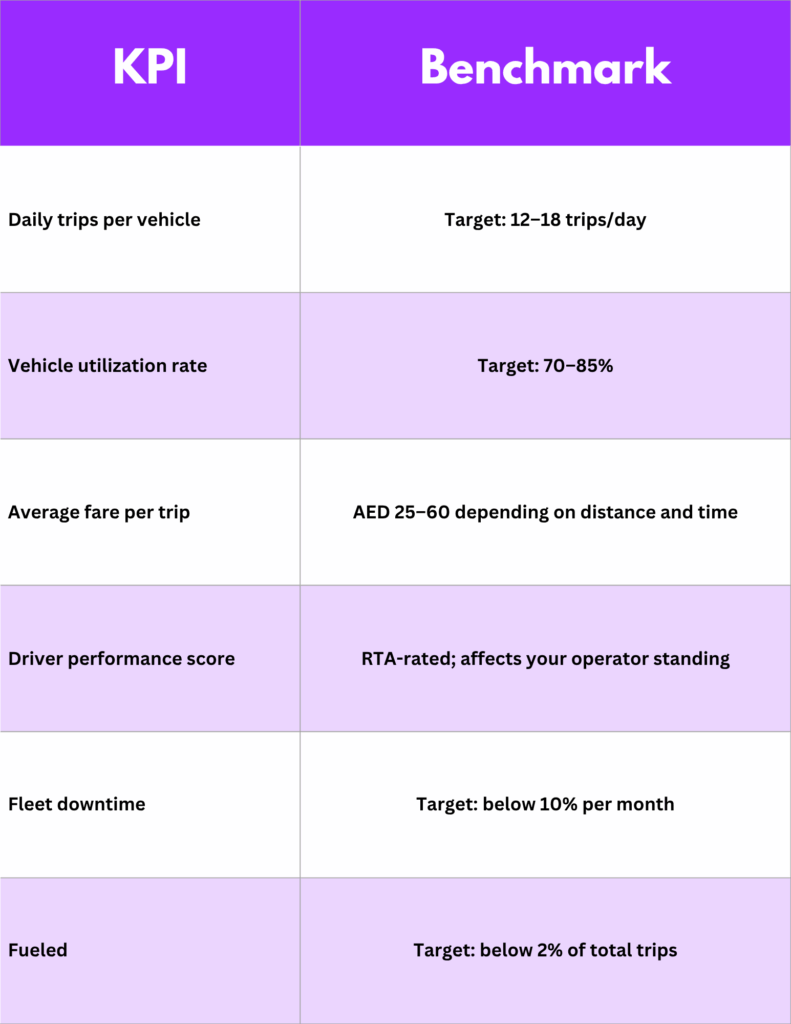
The average daily trips per licensed taxi in Dubai range between 12 and 18 trips during peak periods. With the right location strategy and dispatch technology, operators can consistently hit the higher end of this range.
Understanding the Taxi Operating Model in Dubai
Core Functions and Processes
Running a taxi business in Dubai involves several interconnected functions. Understanding these from day one helps you plan better and avoid costly operational mistakes.
- Fleet Management — maintaining, scheduling, and tracking all vehicles
- Driver Management — hiring, training, scheduling, and performance monitoring
- Dispatch Operations — managing ride requests through apps, call centers, or both
- Compliance Management — ensuring all vehicles, drivers, and operations meet RTA standards
- Revenue Collection — processing metered fares, app payments, and corporate billing
- Customer Service — handling complaints, feedback, and service quality control
Operating KPIs to Track
Requirements to Start a Taxi Business in Dubai
There are two main regulatory bodies you need to work with when setting up a taxi business in Dubai.
Roads and Transport Authority (RTA)
The RTA is the government body that regulates all transport operations in Dubai. For taxi businesses, the RTA issues the taxi permit that allows you to legally operate passenger transport services. Without an RTA permit, you cannot legally run a taxi business, regardless of your trade license.
Key RTA requirements include:
- Minimum fleet of 30 vehicles to qualify for a franchise taxi permit
- Vehicles must meet RTA specifications, age, condition, and equipment
- Operators must provide a dedicated shelter and parking facility in Dubai
- All drivers must complete RTA-approved training and hold valid UAE licenses
- Technology systems, including GPS tracking and approved taximeters, must be installed
Dubai Department of Economic Development (DED)
The DED issues your trade license, which is the legal foundation for your business. Before the RTA processes your taxi permit, you need to have your DED trade license in place. The DED registers your business, assigns your activities (passenger transport), and ensures you are operating as a legitimate commercial entity.
Business Structure Options
Limited Liability Company (LLC)
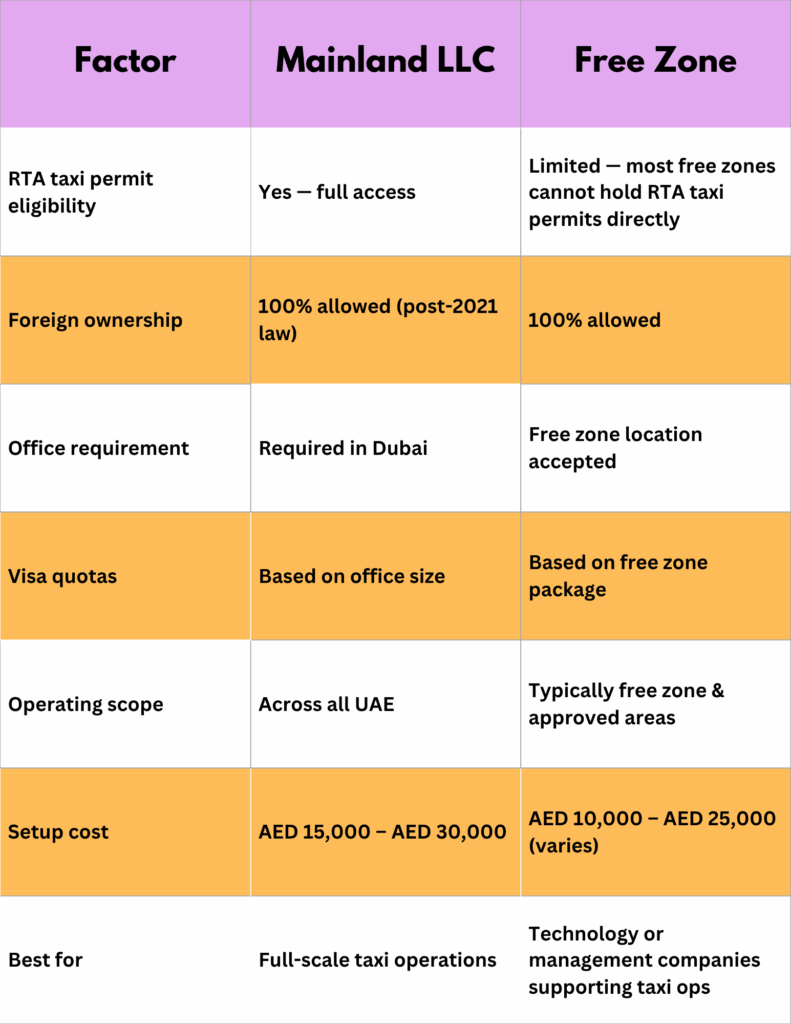
An LLC is the most popular structure for taxi businesses in Dubai. It allows up to 50 shareholders, provides personal liability protection, and is fully recognized by both the DED and RTA. As of 2021, UAE law allows 100% foreign ownership in many business categories, including transport services, meaning you no longer need a local sponsor in most cases.
Sole Proprietorship
A sole proprietorship is simpler to set up, but it limits your business to a single owner. It works well for small operators with one or two vehicles, but it carries personal liability risk and may face limitations when applying for larger RTA permits.
Partnership
A partnership allows two or more individuals to co-own the business. This is useful when you want to pool capital to meet the RTA’s minimum fleet requirement. Each partner’s share and responsibilities should be clearly documented in the Memorandum of Association (MOA).
Easy Steps to Start a Taxi Business in Dubai
Here is a clear, step-by-step breakdown of how to launch your taxi business the right way in Dubai.
Step 1: Build Your Business Plan and Strategy
Before applying for any license, you need a clear business plan. This helps you choose the right structure, calculate costs accurately, and present a serious application to both the DED and RTA.
Choose your taxi service type:
Traditional Taxi Services
Standard metered taxis are operating across Dubai under RTA fare structures. This is the most common model and the one most customers recognize.
App-Based Ride-Hailing
Partnering with platforms like Careem or Uber, or building your own ride-hailing application. This model offers flexible booking and a wider customer reach.
Luxury Limousine Services
Premium vehicles catering to corporate clients, tourists, and high-end events. Higher fares and better margins, but require premium fleet investment.
Specialized Services
Ladies-only taxis, airport transfer services, school transport, or medical transport. These niche models often face less direct competition and can build loyal client bases.
Step 2: Obtain Trade License from DED
Required Documentation
- Passport copies of all shareholders
- Emirates ID (for UAE residents)
- Proposed company name (must comply with DED naming rules)
- Business activity description
- Memorandum of Association (MOA)
- Tenancy contract for office space (Ejari registered)
- Initial approval certificate from DED
License Categories
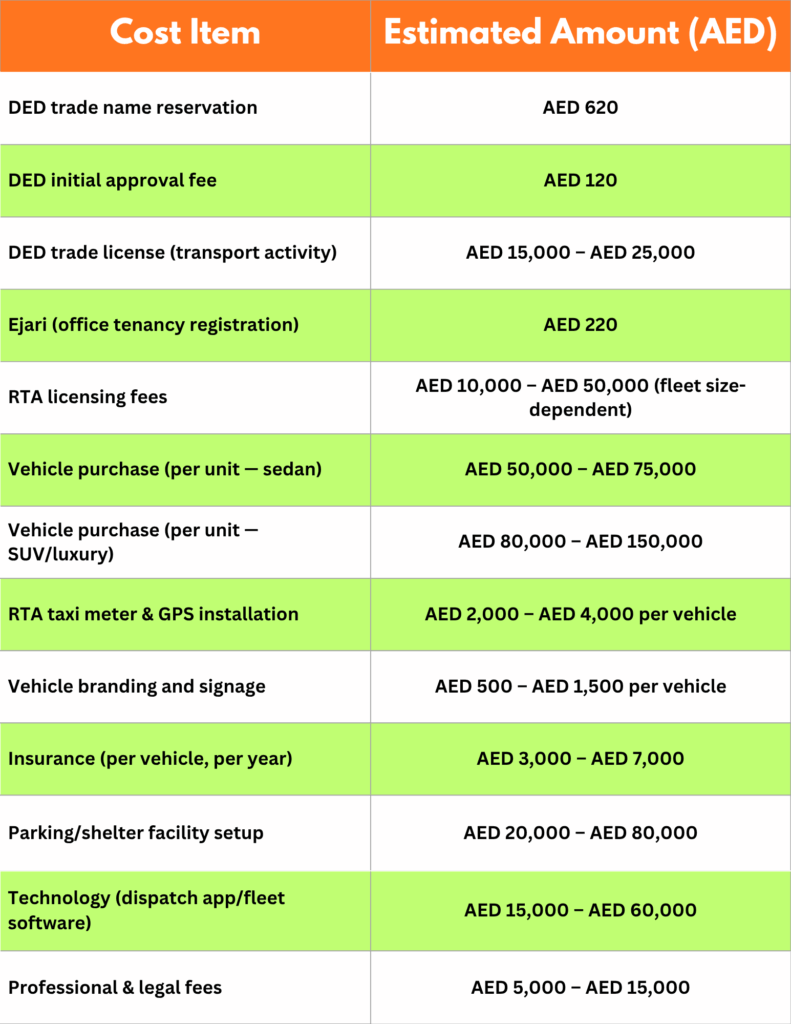
For a taxi business, your DED license will fall under the commercial category with transport as your registered business activity. The process starts with trade name reservation (AED 620), followed by initial approval (AED 120), and then the full license issuance.
Step 3: Secure RTA Taxi Permit
Eligibility Requirements
- Valid DED trade license for transport activities
- Minimum 30 vehicles ready for inspection (for franchise permit)
- Dedicated parking facility and shelter within Dubai
- Fleet meets all RTA vehicle specifications
- Business owner or director has a clean legal and financial record
Application Process
Submit your application to the RTA’s Passenger Transport Licensing section. You can contact the RTA directly at [email protected] for guidance. The RTA will review your application, conduct fleet inspections, and issue your permit upon successful compliance.
Step 4: Vehicle Fleet Acquisition and Registration
RTA-Approved Vehicle Models
The RTA maintains an approved list of vehicles eligible for taxi operations in Dubai. These are typically mid-size to full-size sedans and SUVs from manufacturers including Toyota, Hyundai, and Nissan. Electric and hybrid vehicles are increasingly preferred and receive extended operational life under RTA rules.
Vehicle Requirements
- Maximum 3 years old at time of registration (for petrol/diesel vehicles)
- Operational validity of 5 years (Category 1 & 3) or 7 years for EVs and hybrids
- Must be equipped with RTA-calibrated taximeter
- GPS tracking system (RTA-approved) must be installed
- Approved branding, fare display, and roof sign required
- Air conditioning, adequate passenger space, and safety features are mandatory
Fleet Size Considerations
If you are applying for a full RTA franchise permit, the minimum fleet is 30 vehicles. If you plan to start as an individual operator or under an alternative RTA program, smaller fleets may be permitted. It is worth confirming current requirements directly with the RTA, as programs and thresholds do change.
Step 5: Driver Recruitment and Training
RTA Driver Requirements
• Minimum age: 21 years
• Valid UAE driving license with at least 2 years of experience
• Clean criminal record
• Medical fitness certificate
• Good knowledge of Dubai roads and geography
• Basic English communication skills
• Completion of RTA-approved driver training program
Training Programs
The RTA operates certified training programs that cover defensive driving, customer service standards, knowledge of Dubai routes, and emergency procedures. All drivers must complete this training before they are permitted to operate a licensed taxi. As an operator, it is your responsibility to ensure every driver in your fleet is RTA-certified.
Step 6: Insurance and Safety Compliance
Mandatory Insurance Coverage
- Third-party liability insurance — required by law for all vehicles
- Comprehensive vehicle insurance — covers damage to your fleet
- Driver’s personal accident insurance — protects your drivers
- Passenger liability insurance — covers passengers in case of accidents
Safety Requirements
All vehicles must pass RTA annual safety inspections. Your business must maintain an accident log, an incident reporting system, and emergency contact protocols. Failure to maintain safety compliance can result in permit suspension or cancellation.
No Jargon, No Fluff — Just the Real Cost Breakdown
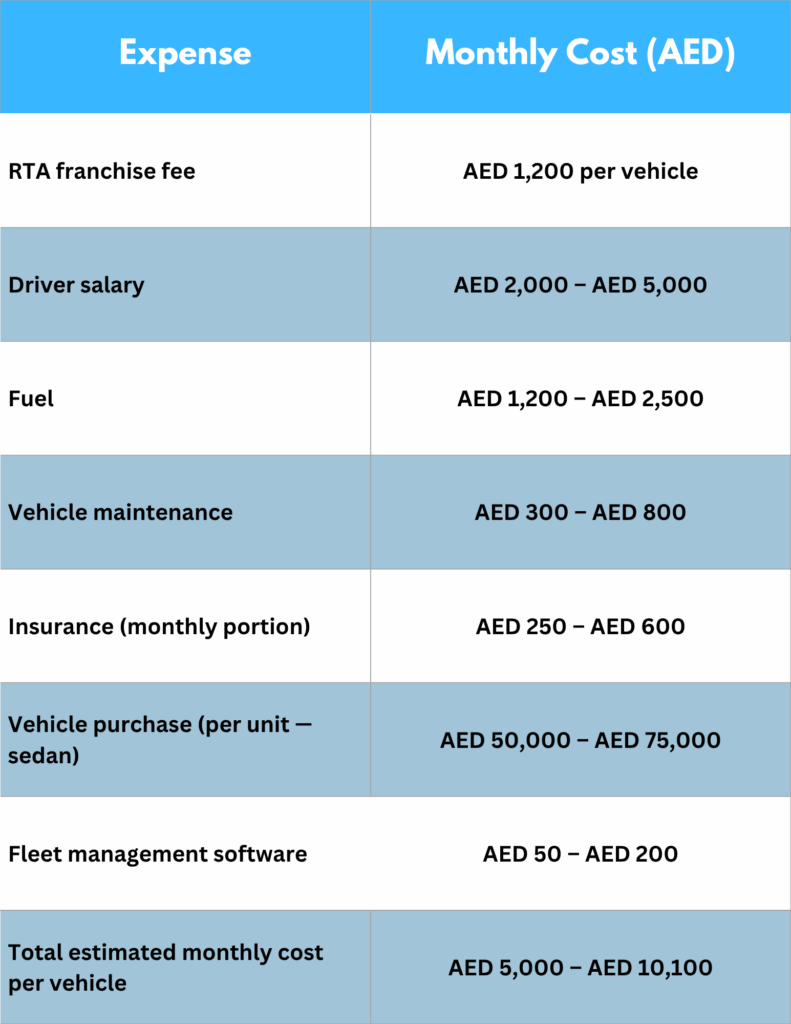
One of the most common questions from anyone starting a taxi business in Dubai is: how much does it actually cost? Here is a clear breakdown.
Initial Setup Costs

Ongoing Operational Costs
Monthly Expenses (per vehicle)
A Clear Look at Revenue and Profit Potential
Revenue Streams
Primary Revenue Sources
- Metered taxi fares — standard trips billed by distance and time
- Airport transfers — fixed-rate or metered premium fares
- Corporate accounts — monthly billing agreements with companies
- Hotel partnerships — exclusive or preferred supplier contracts
- App-based bookings — commissions from platform integrations
- Special events — premium pricing during major Dubai events
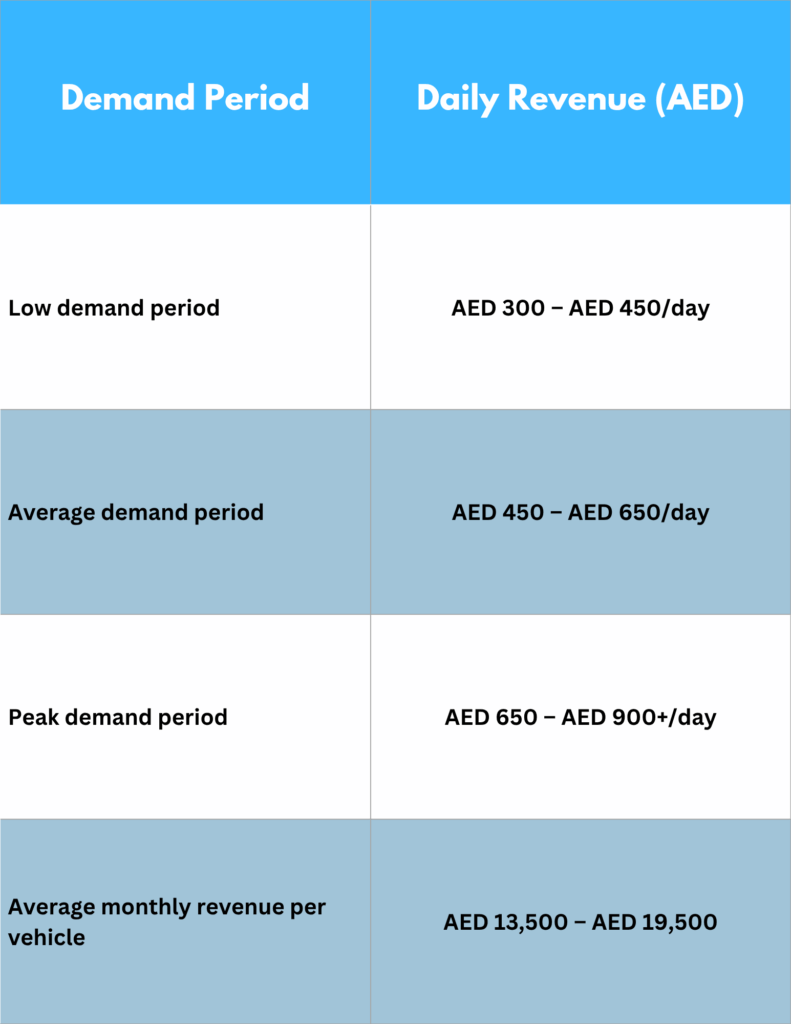
Average Daily Revenue (per vehicle)
Profit Margin Analysis
Monthly Profit Calculation (per vehicle)
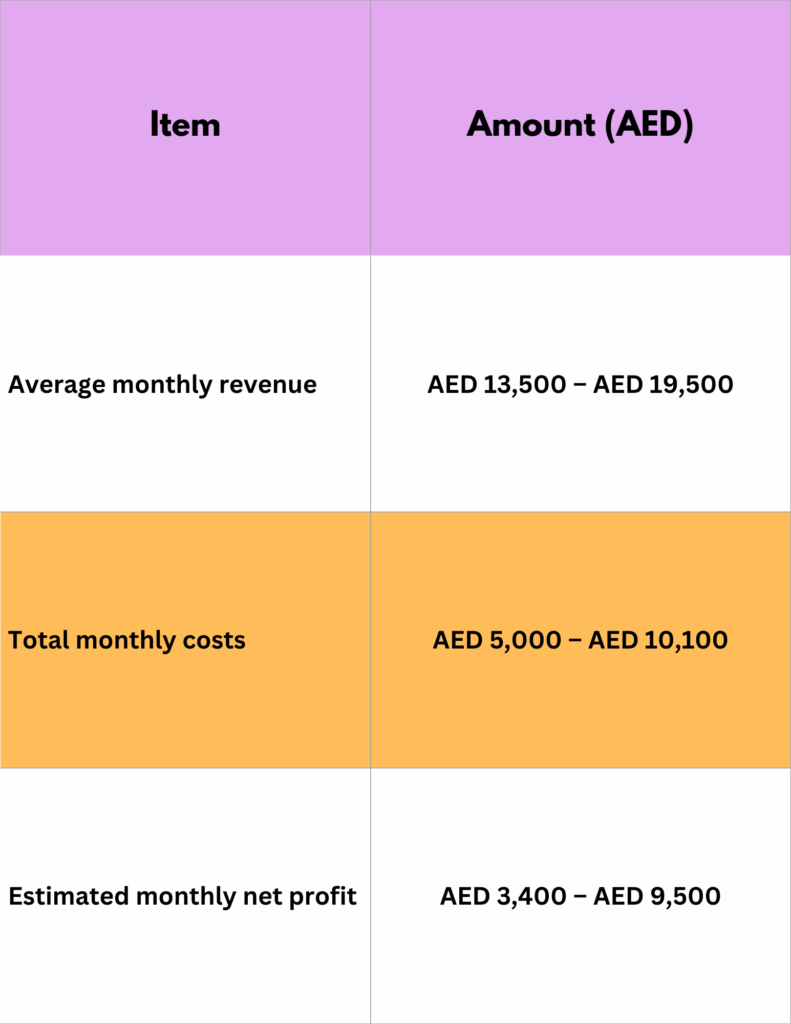
Annual ROI Expectations
For a single vehicle, you can expect to recoup your initial investment within 18 to 36 months, depending on demand, operating costs, and how efficiently the vehicle is managed. For a fleet of 10 to 30 vehicles, the business becomes substantially more profitable due to economies of scale — shared management costs, better insurance rates, and stronger bargaining power with corporate clients.
How is Technology Driving Digital Transformation in the Taxi Industry?
Technology is no longer optional for taxi businesses in Dubai. The RTA mandates certain technology systems, and customers expect digital convenience. The right technology stack can also significantly improve your fleet efficiency and revenue per vehicle.
Essential Technology Systems
Fleet Management Software
Fleet management platforms allow you to track every vehicle in real time, monitor driver performance, manage maintenance schedules, and generate operational reports. Key features to look for include GPS tracking integration, trip history logging, fuel consumption monitoring, and driver behavior analytics. Popular platforms used in Dubai include Samsara, Verizon Connect, and regional solutions built specifically for UAE operators.
Mobile Applications
A dedicated mobile application for passenger bookings gives your business a professional edge and reduces reliance on street hails. Your app should support:
- Real-time GPS tracking for passengers
- Cashless payment — Nol card, credit/debit cards, Apple Pay
- Ride scheduling and booking confirmation
- Driver rating and feedback system
- Corporate booking portal for business accounts
Partnership Opportunities
Rather than building your own app from scratch, many taxi operators in Dubai integrate with existing platforms:
- Careem Partner Program — list your fleet within the Careem ecosystem
- Uber Fleet Integration — operate your vehicles within the Uber network
- RTA eCab App — an official RTA platform for licensed taxis
Partnering with these platforms gives you immediate market access and reduces your technology investment significantly, especially in the early stages of your business.
Mainland vs. Free Zone Setup Options
A question many entrepreneurs ask is whether to set up their taxi business on the mainland or in a free zone. Here is a the clear comparison to help you decide the better:

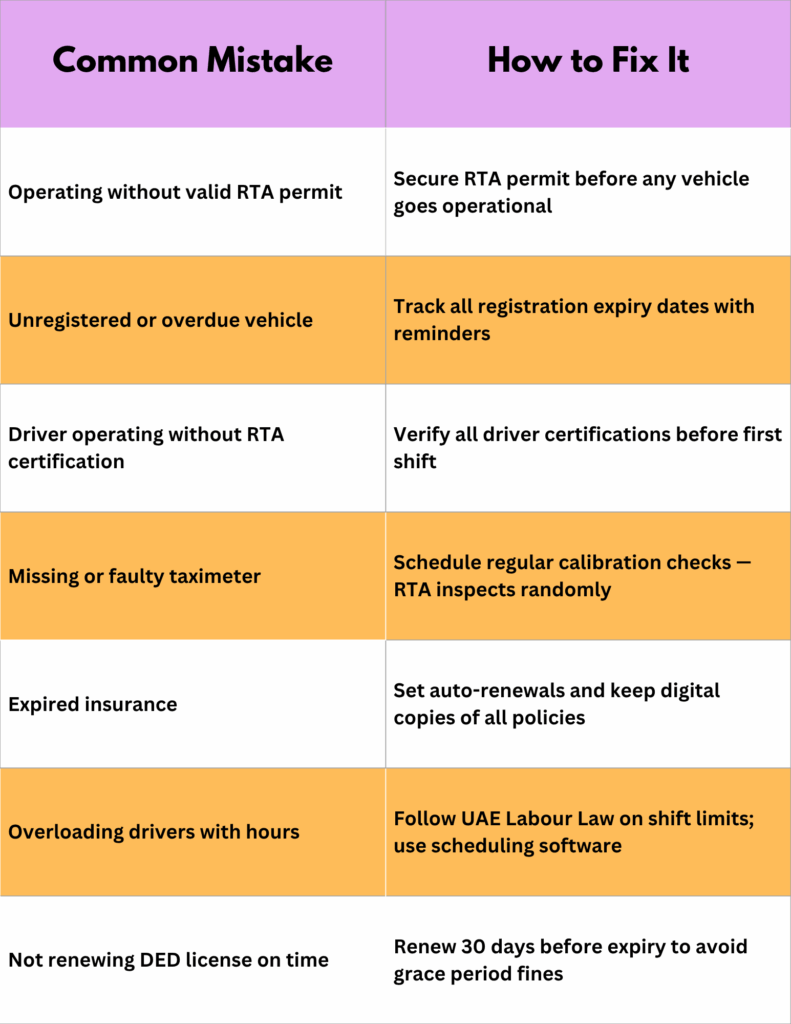
How Can You Avoid Costly Mistakes with Compliance and Penalties?
Non-compliance with RTA and DED requirements can lead to serious consequences — fines, fleet suspension, or license cancellation.
Common Pitfalls (and Fixes)
Can You Use Your Car as a Taxi in Dubai? What’s Allowed?
This is one of the most searched questions on this topic, and the answer is: it depends on how you want to operate.
Using your personal car as a licensed metered taxi without going through the proper RTA licensing process is not permitted in Dubai. The RTA requires all taxis to be registered, inspected, and branded under an approved operator license.
However, there are two situations where your vehicle can enter the transport business:
- If you register your vehicle under an RTA-approved taxi company or franchise operator, your car can be used as a fleet vehicle, provided it meets all RTA vehicle specifications
- If you partner with Careem or Uber as a driver-partner, you can use your personal vehicle for ride-hailing, subject to those platforms’ own vehicle approval processes and RTA ride-hailing regulations
Simply driving passengers in your own car without any RTA registration or platform affiliation is illegal and can result in significant fines. Always operate within the proper legal framework.
What are the Challenges and Risk Management?
No business is without challenges. A taxi operation in Dubai comes with specific risks that you need to plan for. Let’s take an honest look at each one
Market Competition
Challenge: Dubai’s transport market includes DTC (Dubai Taxi Corporation), Careem, Uber, and several other licensed operators. Competition is real and ongoing.
Solution: Differentiate through service quality, reliability, and niche targeting. Corporate accounts, airport specialization, and luxury services are areas where independent operators can compete effectively against large players.
Regulatory Compliance
Challenge: Keeping up with RTA rule changes, annual renewals, vehicle inspections, and driver certification requirements takes time and attention.
Solution: Assign a dedicated compliance manager or use a PRO (Public Relations Officer) service to handle all government-related paperwork. Use digital compliance calendars to track all deadlines across your fleet.
Driver Retention
Challenge: Dubai’s labor market is competitive. Drivers often switch employers for slightly better pay or conditions. High driver turnover increases training costs and disrupts operations.
Solution: Offer competitive salaries, performance bonuses, flexible shift options, and clear career progression. Drivers who feel valued and well-treated stay longer. A stable, experienced driver workforce directly improves customer satisfaction and revenue.
Operational Efficiency
Challenge: Idle vehicles, poor route planning, and maintenance delays all eat into profitability.
Solution: Invest in fleet management software from day one. Real-time tracking, smart dispatch, and predictive maintenance alerts can significantly reduce idle time and keep your fleet operating at optimal efficiency.
Taxi Partnership and Franchise Options in Dubai
RTA Partnership Programs
The RTA offers structured franchise programs for large-scale operators. These programs give you access to the official RTA taxi dispatch network, RTA-branded vehicles, and a defined service area. In return, you operate under RTA quality standards and pay franchise fees per vehicle per month.
Franchise operators benefit from RTA’s marketing and passenger trust. Passengers see an RTA-branded vehicle and immediately trust the service, which can be harder to build with a new independent brand.
Ride-Hailing Platform Integration
Both Careem and Uber have established programs for fleet operators in Dubai. Rather than individual drivers, these programs allow companies to register multiple vehicles and drivers under a single business account. This gives you the technology platform, booking infrastructure, and brand reach of a major platform — without building it yourself.
For new operators with a small fleet, this is often the fastest route to generating revenue while you build your own brand and customer base.
Future Trends and Market Evolution
Sustainability Initiatives
The Dubai government has committed to significantly increasing the share of electric and hybrid vehicles in the city’s taxi fleet by 2030. As an operator, planning your fleet acquisition with EVs and hybrids in mind will future-proof your business, reduce fuel costs, and align with RTA incentives for green operators.
Technology Advancement
Artificial intelligence in dispatch optimization, predictive maintenance systems, and advanced passenger analytics are already entering the Dubai transport market. Operators who adopt these tools early will have a meaningful efficiency advantage over those who resist the shift.
Market Expansion
Dubai continues to grow. New residential communities, expanded airport terminals, and mega-events through 2030 and beyond will continue to increase transport demand. Operators who build strong foundations now will be well-positioned to expand their fleets and service areas as the market grows.
Licensing Renewal and Compliance
Annual Renewal Requirements
- DED trade license renewal — must be completed before the expiry date (typically annual)
- RTA taxi permit renewal — annual, with updated fleet inspection
- Vehicle registration renewal — per vehicle, annual
- Driver’s license and certification renewal — per driver, as per the RTA schedule
- Insurance renewal — per vehicle, coordinate with renewal dates
- Ejari renewal — if the office tenancy contract changes
Compliance Monitoring
The RTA conducts regular inspections — both scheduled and random — of taxi fleets in Dubai. These cover vehicle condition, driver certification status, taximeter accuracy, and GPS system functionality. Maintaining a clean compliance record protects your permit and your reputation.

Business Setup Support and Professional Services
Setting up a taxi business in Dubai involves multiple government interactions, documentation processes, and regulatory steps. For first-time operators, working with a professional business setup service can save significant time and reduce the risk of application errors.
Professional setup consultants in Dubai can assist with:
- DED trade license application and processing
- RTA permit application and fleet registration
- Company formation and Memorandum of Association drafting
- Ejari and office tenancy registration
- Visa processing for investors and employees
- Insurance coordination and compliance documentation
Typical fees for a full-service setup consultant in Dubai range from AED 5,000 to AED 20,000 depending on the scope of services and the complexity of your business structure.
Why Choose Apptechies as Your Taxi App Development Partner in Dubai?
Building the right technology for your taxi business is just as important as getting your licenses in order. Apptechies is a Dubai-based technology company with deep expertise in developing taxi and ride-hailing applications for the UAE market.
Here is why taxi business owners in Dubai choose Apptechies:
- UAE Market Expertise — deep understanding of RTA technical requirements, Nol payment integration, and Dubai-specific user behaviour
- Full-Stack Taxi App Development — passenger app, driver app, and operator admin dashboard built as a complete, integrated system
- Rta-compliant Technology — GPS integration, taximeter connectivity, and digital fare display built to meet RTA standards
- Careem and Uber API integration — connect your fleet to major platforms without building from scratch
- Scalable Architecture — your app grows with your fleet, from 5 vehicles to 500, without a complete rebuild
- Arabic and English Language Support — essential for serving Dubai’s diverse customer base
- Post-launch Support & Maintenance — ongoing technical support to keep your platform running smoothly
- Affordable, Transparent Pricing — clear project quotes with no hidden costs
Whether you are launching a new taxi brand in Dubai or looking to upgrade the technology behind an existing fleet, Apptechies delivers solutions that are built for the realities of the UAE transport market.
Conclusion
Starting a taxi business in Dubai in 2026 is a serious opportunity for the right entrepreneur. The market is large, the demand is consistent, and the regulatory framework — while strict — provides a structured environment where quality operators can thrive.
The key decisions come down to three things: choosing the right legal structure, meeting RTA’s licensing and fleet requirements, and investing in the right technology from day one.
Costs are real and need to be planned for carefully. But so is the revenue potential. A well-run fleet of even five to ten vehicles can generate meaningful and growing monthly returns.
If you are serious about entering Dubai’s taxi market, use this guide as your starting point. Work with experienced professionals for your setup, stay compliant with RTA from day one, and invest in technology that helps your fleet run efficiently.

Frequently Asked Questions
Q. What Is The Minimum Investment Required To Start A Taxi Business In Dubai?
Ans: The minimum investment for a single-vehicle taxi operation in Dubai starts at approximately AED 126,000 to AED 265,000. This covers your DED trade license, RTA permit fees, vehicle purchase, taximeter and GPS installation, insurance, and basic setup costs. For a full 30-vehicle RTA franchise fleet, the investment ranges from AED 2.5 million to AED 4 million or more.
Q. How Many Taxi Companies Are In Dubai?
Ans: Dubai has several RTA-licensed taxi franchise operators operating alongside the government-affiliated Dubai Taxi Corporation (DTC). These include major operators such as Cars Taxi, National Taxi, Metro Taxi, Arabia Taxi, and City Taxi. In addition, Careem and Uber operate ride-hailing services under separate RTA approvals. The exact number of licensed operators changes as new permits are issued, so checking with the RTA for the most current list is advisable.
Q. Can Foreigners Start A Taxi Business In Dubai?
Ans: Yes. Following the 2021 amendments to UAE’s Commercial Companies Law, foreign nationals can own 100% of a mainland LLC in most business categories, including transport services. This means you do not need a UAE national partner or local sponsor to start a taxi business in Dubai as a foreigner. However, you must still meet all DED and RTA requirements just as a UAE national would.
Q. Can I Use My Car As A Taxi?
Ans: Not without proper registration. Using a personal vehicle as a taxi without RTA approval is illegal in Dubai. Your vehicle must be registered under an RTA-approved operator license or through a ride-hailing platform like Careem or Uber. Both platforms have their own vehicle approval processes and require your vehicle to meet specific standards before it can carry passengers for hire.
Q. Do I Need Taxi Solicitors Or Legal Advisors?
Ans: You are not legally required to hire a lawyer to set up a taxi business in Dubai. However, working with a legal advisor or a professional business setup consultant is strongly recommended, especially for first-time operators. They help you avoid documentation errors, choose the right business structure, and navigate the DED and RTA application processes more efficiently.
Q. Is It Profitable To Start With One Taxi?
Ans: Yes, a single taxi can be profitable in Dubai if managed well. A single vehicle can generate AED 13,500 to AED 19,500 per month in revenue and AED 3,400 to AED 9,500 per month in net profit after costs. The initial investment for a single vehicle can typically be recovered within 18 to 36 months. However, profitability improves significantly with scale — more vehicles mean lower per-unit costs and stronger revenue.
Q. How Long Does The Licensing Process Take?
Ans: The full licensing process — from DED trade license to RTA taxi permit and fleet registration, typically takes between 4 and 8 weeks when all documents are in order. Delays usually occur due to incomplete documentation, vehicle inspection failures, or processing backlogs during peak periods. Working with a professional setup consultant can help reduce this timeline significantly.
Q. Can I Operate Both Traditional And App-based Services?
Ans: Yes. Many taxi operators in Dubai run both metered street taxis and app-based bookings simultaneously. This dual-channel approach maximizes vehicle utilization and revenue. You can integrate your fleet with Careem or Uber while also operating under the standard RTA metered fare system. Your RTA permit will specify the modes of operation allowed, so ensure your application reflects both service types from the start.
Author Name: Ajay Chaudhary
Author Bio: AJ Chaudhary, CEO of Apptechies. He is a full-stack developer with 10+ years of experience developing web and mobile applications. He has successfully delivered projects for different industries and helped companies turn concepts into scalable solutions. Passionate about technology, he simplifies complicated tech topics for entrepreneurs and startups by sharing insights.