Hire LangChain Developers
Work with engineers who use LangChain to chain LLM calls, tools, and memory into multi-step AI agents and pipelines that hold up in production — not just a single-prompt demo.
LangChain is an orchestration framework for building applications that chain multiple LLM calls, external tools, and memory together into a coherent workflow — rather than a single prompt-in, response-out interaction. A LangChain developer designs these chains and agents: deciding when the AI should call a tool, retrieve a document, ask a clarifying question, or hand off to a human. At Apptechies, we use LangChain where it earns its complexity, and skip it where a simpler direct API call would serve you better — the framework is a means to an end, not the goal.
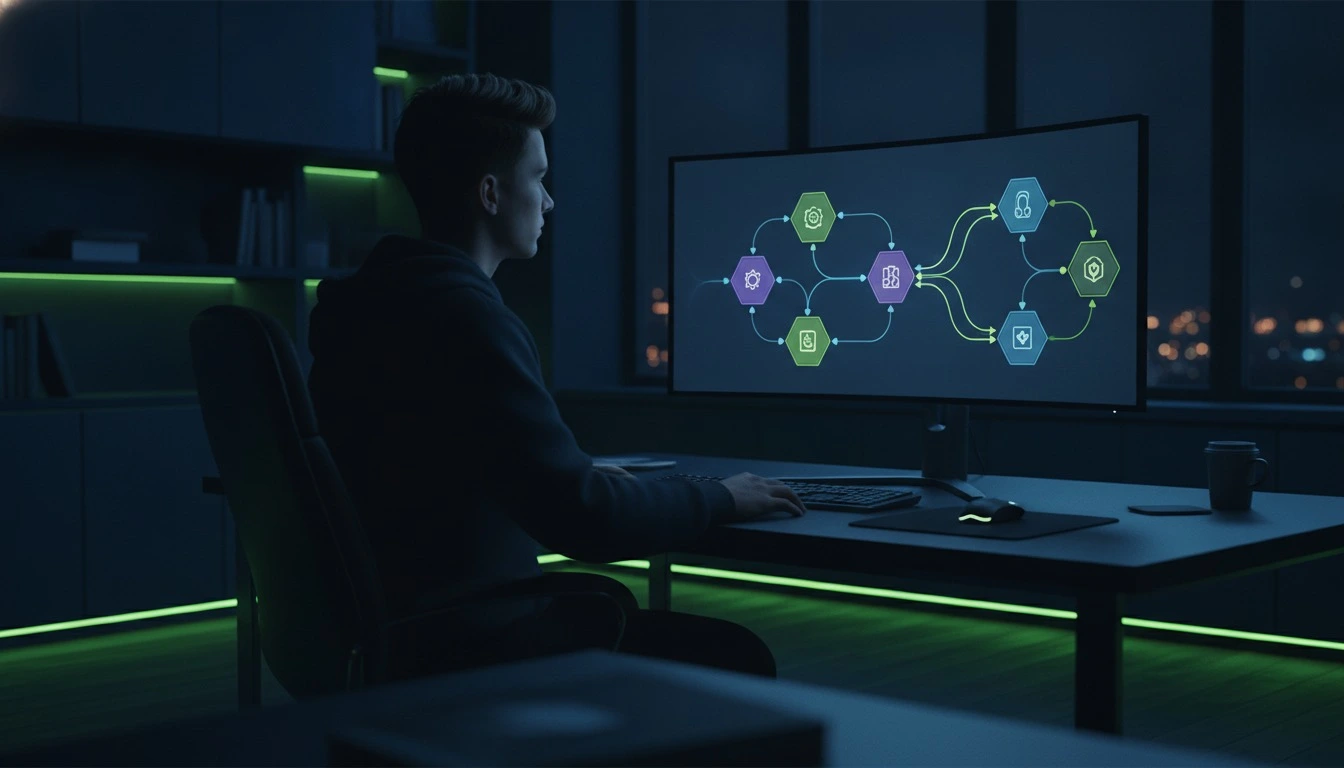
Linear prompt chains fail on non-trivial workflows. We build resilient, cyclic agent graphs that plan, execute, critique, and self-correct.
Designing stateful graphs where specialized sub-agents critique, refine, and validate output across cyclical loops rather than rigid linear chains.
Configuring interrupt nodes that pause execution and require human sign-off before committing high-stakes API calls or financial actions.
Building Pydantic-validated tool definitions with strict runtime error recovery, retry backoffs, and auth scoping.
Storing state across conversation threads using PostgreSQL and Redis checkpointers for seamless session resumption.
From single chains to fully agentic, multi-tool workflows.
Multi-step LLM pipelines that pass context between steps — summarize, extract, validate, then act.
Agents that decide which tool or API to call based on the task, with guardrails to prevent runaway or unsafe actions.
Short-term and long-term memory so conversations and workflows retain context across multiple turns or sessions.
Wiring LangChain to your vector database and document store for retrieval-grounded responses within a larger workflow.
Tracing every step of a chain (via LangSmith or custom logging) so failures are diagnosable, not mysterious.
Building the tools and function-calling integrations your agents need to actually take action, not just talk about it.
Never treat agent execution as a black box. We implement full trace logging to inspect token spend, latency, and tool invocations.
Deep visibility into every intermediate chain run, prompt payload, token count, and latency profile across complex agent graphs.
Running regression suites across updated prompt templates and foundation models to measure drift before deployment.
Hard limits on sub-agent recursion depth and token consumption to eliminate infinite loops and runaway API expenditures.
The orchestration frameworks, vector databases, and runtime environments our engineers use.
Senior developers recognize that simple single-prompt tasks should use native API calls. LangChain is chosen for multi-agent coordination, tools, and stateful memory.
They utilize LangGraph checkpointers (Postgres/Redis) to maintain thread continuity and enable resumption of long-running agent workflows.
Top engineers implement maximum step limits, circuit breakers, and schema validation on tool outputs to guarantee safe execution.
The questions we hear most from teams hiring a langchain developer. Don't see yours? Ask us directly on the right.
LangChain is a framework for chaining LLM calls, tools, and memory into multi-step workflows and agents. You need a specialist when your AI feature does more than answer a single question — for example, retrieving data, calling an API, and then generating a response, all in one flow.
No — for a simple, single-prompt use case, a direct API call is often simpler and more reliable. We recommend LangChain (or LangGraph for more complex agent logic) specifically when multi-step orchestration, tool-calling, or persistent memory genuinely simplify your build.
Yes, through tool/function calling — we build custom tools that let an agent take defined, safe actions in your systems, with guardrails so it can’t take unintended or destructive actions.
We build with tracing from the start, typically using LangSmith or custom step-by-step logging, so you can see exactly which step in the chain produced the unexpected result rather than treating the whole pipeline as a black box.
Both — for more complex orchestration needs, we use LangGraph to coordinate multiple specialized agents that hand off tasks to each other, with a supervising layer to keep the overall workflow on track.
Typically a shortlist within 3-5 business days and full onboarding within one to two weeks, depending on your systems and any procurement steps.
Yes, full IP ownership transfers to you as part of the engagement, backed by an NDA signed before any substantive work begins.
Also Exploring?
Tell us what you're building, and a senior engineer or solutions architect will reply within 24 hours.