AI in Pharma & Biotech: Future Use Cases & Trends 2026
In healthcare, Artificial Intelligence has progressed from experimentation to implementation. AI in pharma and biotech is now a strategic focus. It has become a key element of research, development, manufacturing, and decision-making. By 2026, pharma and biotechnology companies will depend on AI. Because it controls growing R&D expenses, boosts creativity, and reduces the risks associated with drug development.
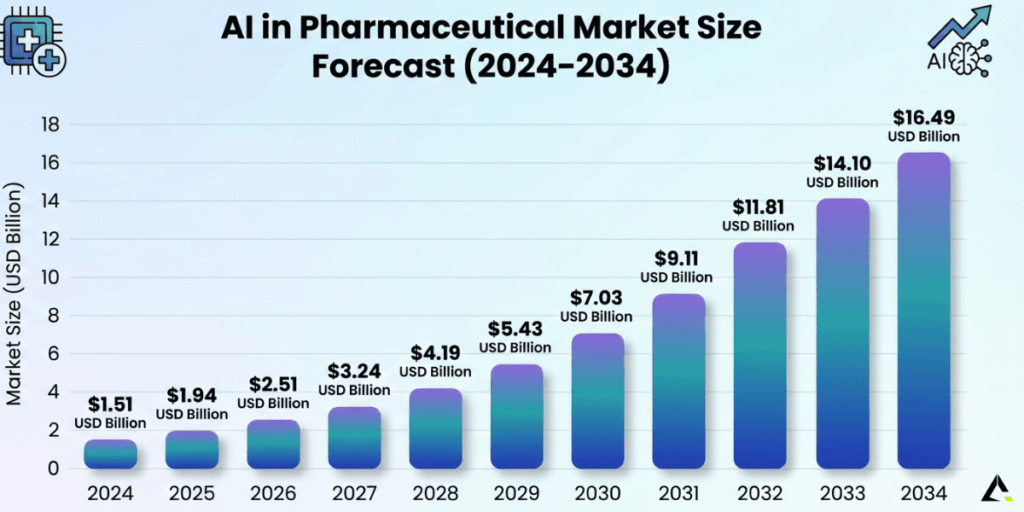
According to Bcc Research, the global AI in the pharmaceutical industry was projected to increase from $3.8 billion in 2025 to reach $15.2 billion by the end of 2030. The demand for precision medicine, the pressure to speed up development, and the growing complexity of data. This is where a dedicated AI development company helps pharma and biotech firms create scalable, compliant solutions tailored to regulated environments.
The requirement of AI in pharma is real. An article published by NIH (National Institutes of Health) states that developing a new drug typically takes 10–15 years. Each drug development process costs $2.6 billion or more and this includes the costs associated with failure. And due to safety or efficacy issues, about 90% of clinical drug trials fail. AI helps reduce these errors by identifying risks earlier and improving prediction accuracy.
As a result, regulators such as the FDA are also encouraging the use of AI-powered analytics and real-world evidence, further accelerating adoption. In this blog, we’ll define what is AI in pharma and biotech, analyze its advantages and disadvantages and also highlight the key AI trends in 2026.
What Is AI in Pharma and Biotech?
AI in pharma and biotech means using artificial intelligence to analyze data and predict outcomes. It also supports better decisions in drug research, development, manufacturing and healthcare. In simple words, AI helps pharma and biotech teams work faster and smarter.
In the pharmaceutical industry, AI supports drug discovery, clinical trials, quality control and supply chain planning. In biotech, AI helps interpret complex biological data such as genomics and protein structures.
Read Also: Artificial Intelligence in Education
Why Artificial Intelligence is Important?
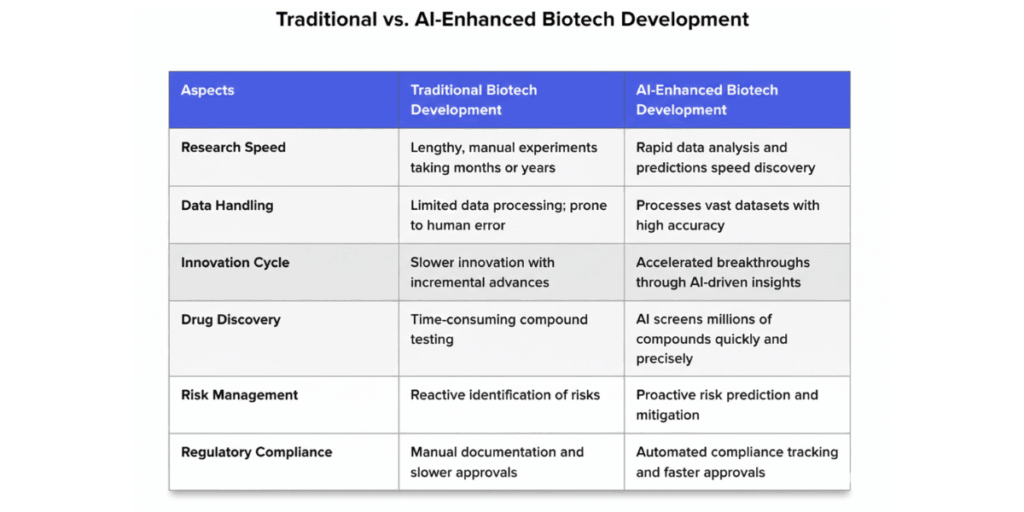
Drug development is slow, expensive and risky. AI reduces this risk by quickly identifying promising drug candidates and flagging errors before they become costly.
Machine learning in pharma improves accuracy, shortens research timelines and enables data-driven decisions. The result is faster innovation, improved efficiency and safer outcomes for patients.
AI in healthcare improves treatment personalization, patient safety and decision-making.
AI is also used in other industries, such as AI in education, the automotive industry, and other industries. In pharma, it strengthens research, development and patient care without replacing human expertise. It improves human expertise and strengthens pharma innovation at all levels.
How Artificial Intelligence Is Changing the Pharma Industry
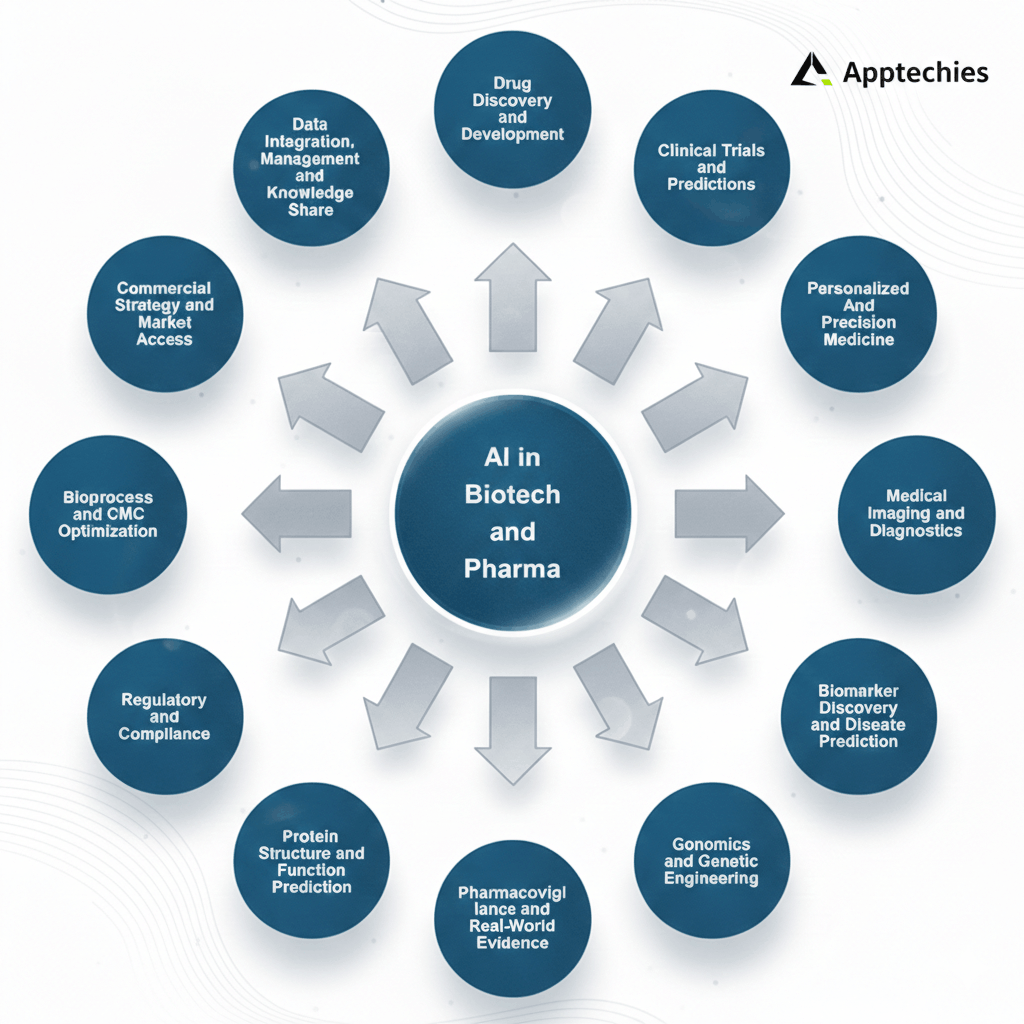
Artificial intelligence is changing how the pharma industry works at every stage. It improves the speed, accuracy and decision-making throughout the drug lifecycle. This evolution isn’t about adding technology everywhere. It’s about using AI only where human decision-making reaches its limits.
AI in Drug Discovery and Molecular Research
AI examines massive chemical and biological datasets to quickly identify potential drug candidates. This speeds up discovery and decreases trial-and-error research.
AI for Clinical Trial Planning and Optimization
AI assists in selecting suitable patients, predicting test results and monitoring data in real time. This improves test efficiency and reduces delays.
AI in Manufacturing and Quality Control
Through predictive analytics, AI in drug manufacturing detects flaws, monitors batch quality and prevents equipment failures. This ensures consistent production standards.
AI for Supply Chain and Demand Forecasting
AI reduces operational risk and shortages. It improves demand planning, inventory management and delivery accuracy.
You Can Also Read: AI in the Automotive Industry
Challenges & Opportunities of Using AI in Pharma & Biotech
Adoption of AI in biotech and pharmaceuticals has many benefits, but also reveals operational and structural flaws that businesses need to carefully fix.
Challenges
Data Quality and Availability
AI systems rely on large amounts of clean, structured data. In pharma and biotechnology, data is often spread across research laboratories, hospitals, clinical trials, and legacy systems. Inconsistent formats and missing data reduce AI accuracy and slow usage.
Regulatory and Compliance Complexity
Pharma is one of the most regulated industries. AI models must meet strict regulatory standards for verification, transparency and auditability. Unclear or evolving AI regulations make it difficult for companies to deploy AI with confidence.
Lack of Explanation and Trust
Many AI models act as black boxes. When results cannot be clearly explained, it becomes difficult for researchers, doctors and regulators to trust AI-driven decisions, especially in patient-critical use cases.
Integration with Existing Systems
Most pharmaceutical organizations rely on legacy infrastructure. Integrating AI into existing R&D, clinical and manufacturing workflows requires time, technical expertise and significant investment.
Talent and Skills Gaps
There is a limited group of professionals who understand both life sciences and AI. This skills gap slows down implementation and increases dependency on external partners.
Opportunities
Faster and Smarter Drug Discovery
AI helps identify potential drug candidates by analyzing large biological and chemical datasets. This reduces trial-and-error research and shortens development timelines.
More Efficient Clinical Trials
AI improves patient recruitment, trial design and real-time monitoring. Better tests lead to lower costs, fewer delays and higher success rates.
Better Use of Existing Research Data
The pharmaceutical companies already have large amounts of historical data. AI turns this underutilized data into meaningful insights, helping teams make better decisions without repeating studies.
Improved Manufacturing and Operations
Supply chain optimization, quality assurance, and predictive maintenance are made possible by AI. This results in fewer production errors, less downtime and better inventory planning.
Personalized and Precision Medicine
By analyzing genetic, clinical and lifestyle data, AI supports more personalized treatment approaches, improving patient outcomes and long-term care strategies.
You Can Also Read: Top Trending App Ideas for Startups in 2026
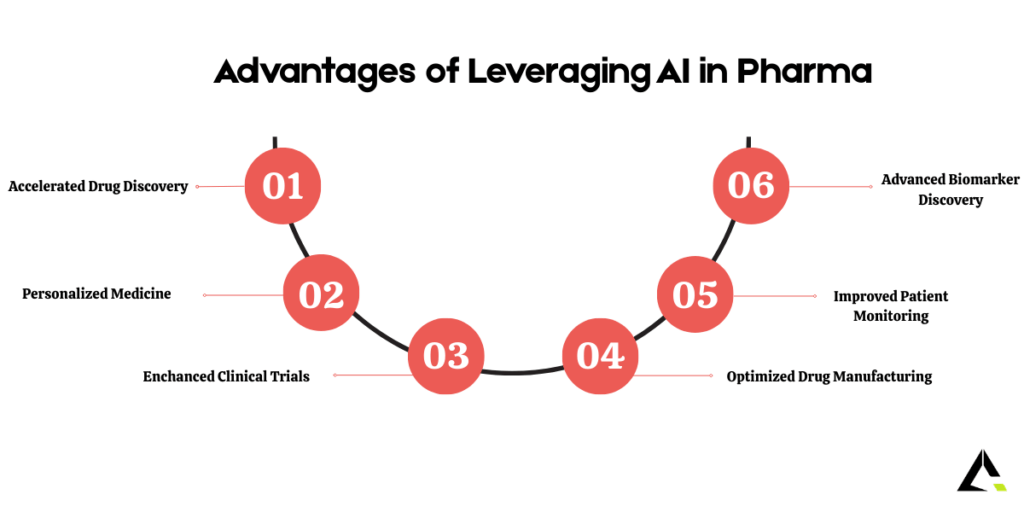
What are the Benefits of Using AI in Pharma & Biotech
The benefits of using artificial intelligence in pharma and biotechnology lie in various factors. It supports smarter decisions by turning complex data into actionable insights. By integrating AI into core workflows while maintaining regulatory and quality standards.
Faster Research and Development Cycles
AI speeds up research by rapidly assessing clinical, chemical and biological data. Machine learning in pharma models finds promising drug targets early. It improves overall development timelines and reduces time spent on failed compounds.
Reduced Operational and Testing Costs
AI reduces unnecessary experiments and optimizes resource use. AI in drug manufacturing, testing and predictive analytics reduces expensive rework. It also lowers the equipment downtime and increases cost effectiveness without sacrificing quality.
Improved Accuracy and Data-Driven Decisions
AI improves accuracy by spotting trends that human analysis frequently overlooks. This supports AI use cases in pharma by promoting better choices in trial design, safety assessment and dose selection.
Better Patient Outcomes and Safety
AI enhances therapy planning and trial monitoring with patient data. Artificial Intelligence in biotech, this results in safer trials, more successful treatments and fewer side effects.
Scalable and Sustainable Pharma Innovation
AI allows businesses to expand innovation in research, manufacturing and supply chains. It streamlines the operations without adding complexity. This supports long-term pharma innovation while meeting compliance and quality requirements.
Real World Examples of AI in Biotech and Pharma
Real-world examples of AI in pharma and biotechnology show how AI is actively used in healthcare. These cases show measurable improvements in speed, accuracy, cost-efficiency and patient outcomes.
AI Use Cases From Global Pharma Companies
Example: Pfizer collaborated with IBM Watson to analyze molecular interactions in cancer treatments. AI processed massive data sets so that potential drug candidates could be identified quickly.
Impact: Researchers are highlighting the role of AI in the pharmaceutical industry. It reduces early-stage errors, accelerates development timelines and improves overall efficiency.
AI Adoption by Biotech Startups
Example: Startups like Insitro and Recursion Pharmaceuticals incorporate AI from day one. They use predictive modeling and virtual screening in early research.
Impact: Small teams accelerate drug discovery and compete with larger organizations. It drives sustainable pharma innovation at scale.
How AI Improves Decision-Making in Real Scenarios
Example: Roche uses artificial intelligence to match patients with trials using real-world data. Predictive algorithms help select candidates and plan test designs.
Impact: This leads to faster enrolment, greater sample diversity and better quality data. This supports safer and more effective drug trials.
Improvement of Production and Quality Control
Example: Novartis implemented AI-powered predictive maintenance and monitoring in production lines. AI tools identify risks and ensure consistent batch quality.
Impact: Less downtime, fewer defective batches and compliance with regulatory standards. It demonstrates the benefits of AI in pharmaceutical manufacturing.
Advances in Personalized Medicine
Example: Ginkgo Bioworks uses artificial intelligence in biotechnology to analyze genetic and clinical patient data, enabling tailored treatments.
Impact: Patients receive more accurate treatments, improved medical efficiency and safer outcomes, demonstrating the potential of AI in personalized healthcare.
You Can Also Read: What is the Role of AI in Mobile App Development
How AI Trends are Shaping the Pharma & Biotech in 2026
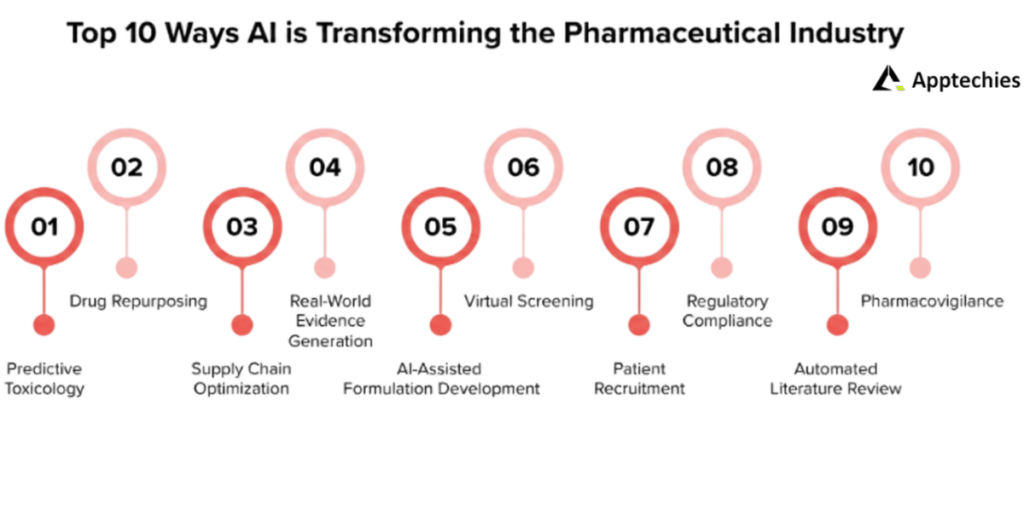
The systematic use of AI in drug discovery, manufacturing, clinical research and operational planning is one of the trends. These trends are influencing the pharma and biotech industry. It shows how AI is emerging as a key asset. It improves productivity, lowers risk and supports data-driven innovation throughout the pharmaceutical lifecycle.
AI-Driven Drug Design
AI models now analyze chemical structures, biological pathways and historical drug data. These data help to design optimal molecules before laboratory testing starts. Researchers use digital simulations to evaluate thousands of molecules instead of physically examining them. This reduces early attrition and improves candidate quality. This strengthens the role of machine learning in the pharmaceutical discovery workflow.
Generative AI for Molecular Simulation
Generative AI systems create new molecular structures based on desired biological properties. AI suggests workable chemical compositions, while scientists target. This speeds up iteration cycles and allows teams to investigate chemical sites. This is rarely reached by traditional methods.
Better Target Identification
AI processes genomic, proteomic and clinical datasets to identify disease-driving mechanisms more accurately. AI helps researchers focus on uncovering hidden connections in complex biological systems. This increases the initial research accuracy of AI in pharmaceutical industry.
Monitoring of Clinical Trials in Real Time
Traditional clinical studies analyze data over time. AI systems now continuously evaluate patient data during trials. This enables quicker detection of safety signals, protocol violations or efficacy patterns. This lowers risk and boosts regulatory trust.
Predictive Patient Admission
AI analyzes electronic health records and demographic data. This helps them to identify patients who meet eligibility criteria more accurately. This reduces recruitment timelines and improves trial diversity. This addresses one of the most persistent obstacles in drug development.
AI in Pharmaceutical Production Automation
Predictive analytics is used in pharma manufacturing to track production lines. It also identifies equipment wear and predicts maintenance requirements. This prevents unplanned delays and maintains consistent batch quality. This is essential for regulatory compliance.
AI-Powered Quality Control
Real-time product inspection is done via computer vision systems and anomaly detection techniques. AI identifies microscopic defects and process deviations earlier than manual inspection methods. This reduces waste and improves manufacturing precision.
Expand Personalized Medicine
In biotech, AI combines genetic, clinical and lifestyle data to support customized medicine design. By lowering side effects and increasing the treatment response rates. This makes therapies more patient-centred.
AI-integrated Supply Chain Optimization
AI improves distribution planning, anticipates shortages and forecasts demand trends. This lowers inventory risk and increases supply chain resilience, particularly during global disruptions.
The Rise of AI-first Biotech Companies
New biotech startups are integrating AI directly into their research and operational infrastructure. They create automation systems, predictive models, and data pipelines from day one, rather than adding AI later. Across the pharmaceutical ecosystem, this model reshapes competition and encourages innovation.
How to Choose the Right AI Development Partner
The most important decision for long-term innovation is choosing the right company. This directly impacts long-term scalability, compliance readiness and innovation speed. Among AI development companies, Apptechies is a reliable choice for businesses looking to apply AI in healthcare.
Deep Industry Experience and Domain Knowledge
AI in pharma and biotech is quite different from other industries. It involves clinical trials, research validation and AI in pharma production systems. Choose a partner who can explain how AI works with actual pharma procedures and who is familiar with these workflows.
Strong Data Security and Compliance Framework
Healthcare and biotech data require strong protection. Your AI partner should create systems that support audit trails, controlled access, model validation and regulatory transparency. Transparency and security should be built into the architecture from the beginning.
Scalable AI Architecture and Integration Capability
AI in drug production and machine learning in pharma often start small but grow quickly. The system must handle larger datasets and integrate with existing platforms. Verify that the solutions your partner develops are both scalable and compatible with other systems.
Focus on Measurable Business Results
Technical accuracy alone does not create business value. AI should solve actual issues. It should improve efficiency, reduce costs or increase research accuracy. Ask how success will be measured. The focus should be on outcomes, not just model accuracy.
End-to-end Development and Deployment Support
Pharma AI projects require structured execution from planning to deployment and continuous optimization. Fragmented development creates risk and inefficiency. Choose a partner who provides ongoing assistance rather than on-time delivery.
Transparent Communication and Collaborative Approach
AI in biotechnology involves cross-functional teams, including researchers, compliance officers and operations managers. Clear communication ensures alignment at all levels. Make sure the company follows a collaborative development model and maintains transparency throughout project phases.
Final Thoughts
Artificial intelligence is evolving in many areas and pharma and biotech are among them. It is rapidly changing how businesses find new medications, manage clinical studies and optimize production processes. Intelligent technologies help organizations move faster and make more informed decisions.
However, successful AI implementation requires more than advanced algorithms. It requires structured data, regulatory awareness, scalable infrastructure and a clear execution strategy. Without the right foundation, AI initiatives can struggle to deliver measurable results.
Working with an experienced technology partner like Apptechies can help translate innovation into real-world impact. AI in pharma and biotech is no longer just an advantage; it is becoming essential for sustainable growth and competitive leadership.
Frequently Asked Questions
Q. Why is AI important in the Pharmaceutical & Biotechnology Industry?
Ans: AI makes it easier for businesses to manage large amounts of research and clinical data. It supports faster research, better data analysis and more informed decision-making. It improved accuracy and accelerated innovation in research, testing and manufacturing.
Q. What ROI can Enterprises Expect from AI in Biotech Pipelines?
Ans: Return on investment measures with saving time and reducing costly failures. AI helps teams focus on stronger drug candidates, improve trial planning and use resources more effectively. This eventually results in increased productivity and decreased development cost.
Q. How can AI Transform Drug Discovery and Development?
Ans: Artificial Intelligence analyzes vast biological and chemical data to identify promising compounds. It predicts molecular behavior and simulates results before physical testing begins. This reduces the need for repetitive trial-and-error studies. It helps researchers prioritize high-potential candidates earlier in the development process.
Q. What is the Role of AI in Pharma and Biotech in Personalized Medicine?
Ans: AI assists in personalized medicine by studying patient information such as genetics and medical history. This makes it possible to customize treatments for each patient rather than using the same solution. The aim is to achieve better results with fewer side effects.
Q. Are any Major Pharma Companies using AI?
Ans: Yes. Many global pharmaceutical leaders are integrating AI into research, clinical trials and manufacturing. Companies such as Pfizer, Novartis, Roche, Johnson & Johnson, AstraZeneca and Sanofi are using AI. To improve their digital abilities, some companies work with technology firms and biotech startups.
Q. What are the Benefits of AI in Clinical Trials?
Ans: AI helps in risk prediction, more precise data monitoring and identifies suitable participants. This can cut down on delays, increase test accuracy and improve overall success rate.
Q. Does AI Replace Scientists and Researchers?
Ans: No, AI acts as a decision support tool rather than a replacement for human expertise. It is still important to interpret scientific insights, validate findings and ensure ethical and regulatory compliance throughout the research process.
Author Name: Ajay Chaudhary
Author Bio: AJ Chaudhary, CEO of Apptechies. He is a full-stack & AI Mobile app developer with 10+ years of experience developing web & mobile applications. He has successfully delivered projects for different industries and helped companies turn concepts into scalable solutions. Passionate about technology, he simplifies complicated tech topics for entrepreneurs and startups by sharing insights.