How Much Does It Cost to Build an AI App in 2026? Save Money with Smart Planning
AI app development cost in 2026 typically ranges from $12,000 to $500,000+. Depending on your app’s complexity, features, team location, and how much custom AI work is involved.
But that range alone won’t help you plan a budget.
What actually matters is why the cost lands where it does, which factors move it up or down, and where most businesses quietly waste money without realizing it.
In 2026, AI isn’t a buzzword, it’s a business standard. The global AI market is valued at over $320 billion this year, and enterprise AI spending is projected to exceed $490 billion globally by year’s end. Competition is heating up fast. Businesses that invest in AI apps intelligently are pulling ahead. Those who rush in without planning are burning budgets.

This guide gives you a complete, transparent breakdown of AI app development costs — from data infrastructure to developer rates, hidden fees to real-world examples. Whether you’re evaluating an AI development company for the first time or comparing quotes from multiple vendors, by the time you finish reading, you’ll know exactly what you’re paying for and how to spend less of it. By the time you finish reading, you’ll know exactly what you’re paying for and how to spend less of it.
AI App Development Cost: Why It Should Be Your First Priority
Most businesses think about budget after they’ve already fallen in love with their AI idea. That’s the wrong order.
Understanding AI app development cost upfront changes everything. Here’s why it has to be your first move.
Better Budget Planning
When you know what drives cost, you can make smarter feature decisions early. You won’t overbuild. You won’t run out of funding halfway through development.
Clear Development Roadmap
Knowing your budget forces you to prioritize. It helps your team build what matters first — and skip what doesn’t add value yet.
Higher Return on Investment (ROI)
A McKinsey survey found that 64% of organizations using AI have already seen increased revenue or significant cost savings. But that only happens when the investment is planned well, not poured in blindly.
Reduced Risk of AI Project Failure
Between 70–85% of AI projects fail to reach production. The most common reasons? Poor data quality, undefined goals, and scope creep without budget adjustments. Knowing your numbers from day one protects you from all three.
What Are the Types of AI Projects?
Before diving into specific costs, it helps to understand what kind of AI project you’re actually building. The type determines the complexity, and the complexity determines the price.
Here are the main categories businesses invest in today:
Rule-Based AI Systems
These follow predefined logic. Think basic chatbots that answer FAQs. They are the fastest and most economical to construct. Good for low-complexity, predictable tasks.
Machine Learning (ML) Applications
ML models learn from data to make predictions or identify patterns — fraud detection, recommendation engines, churn prediction. These sit in the mid-complexity range.
Natural Language Processing (NLP) Apps
Apps that understand and generate human language. Customer support bots, sentiment analysis tools, and AI writing assistants fall here.
Computer Vision Systems
These process images and video product recognition, facial verification, and medical imaging diagnostics. They require large labeled datasets and GPU-heavy infrastructure.
Generative AI Applications
Content generation, code assistants, design tools. These use large language models (LLMs) like GPT or Claude and are increasingly common. They come with ongoing inference costs at scale.
Agentic AI Systems
The newest and most complex tier. These AI agents make autonomous decisions, manage workflows, and integrate with multiple systems. Development budgets can range from $300,000 to over $1,000,000 for advanced builds.
AI App Development Costs Revealed
Let’s break down every major cost category. These are the building blocks of your total AI app development budget.
Data Collection and Management
Any AI system is built on data. Even the finest model fails in the absence of high-quality data.
Data costs vary widely:
- Internal data: Often free if already structured and clean
- External datasets: Can cost thousands to license (financial data, medical records, satellite imagery)
- Manual data labeling: Labor-intensive and can exceed $30,000 for complex tasks like annotating medical images
- Privacy and compliance prep: Anonymization, encryption, and governance add cost — especially in healthcare and finance
Data preparation typically accounts for 25–40% of total project budgets and is the most commonly underestimated cost category.
Computational and Infrastructure Costs
Hardware
Custom GPU hardware is needed for training large models. While cloud has reduced the need for owned hardware, high-performance computing is still a major line item for complex builds.
Cloud Services
Cloud platforms like AWS, Google Cloud, and Azure host your AI workloads. A conversational AI handling one million monthly requests can cost $5,000–$15,000 per month in cloud infrastructure alone.
Servers and Networking
Production AI apps need robust server architecture. Latency, uptime, and bandwidth all cost money — and they scale with your user base.
Security
AI apps handling sensitive data require encryption, access controls, multi-factor authentication, and real-time monitoring. These aren’t optional add-ons. They’re essential, and they add meaningfully to your build cost.
Electricity
For on-premise training infrastructure, electricity and cooling costs are real. Custom AI model training is energy-intensive — Meta’s Llama 2 alone required over 3 million GPU hours.
Licensing and Software
Pre-built AI models and APIs come with usage fees. OpenAI, Google Vision AI, and other platforms charge per token or per API call. For example, running a small app that handles 1,000 customer queries per day could cost $200–$300/month in model usage alone.
Open-source tools like PyTorch and TensorFlow reduce licensing costs but still require skilled engineers to implement.
Training
Training a custom AI model is expensive. Costs depend on:
- Volume and complexity of training data
- Model architecture (small vs. large)
- Hardware used (GPU/TPU type and training time)
Custom model training and tuning can run from $15,000 to $100,000+, depending on your accuracy requirements and data volume.
Testing and Validation
AI apps don’t just need QA testing — they need model validation. This includes:
- Accuracy benchmarking
- Bias and fairness testing
- Edge case evaluation
- Performance testing under load
Testing adds 10–15% to your overall development cost and should never be skipped.
How Much Does It Cost to Maintain AI?
Deployment isn’t the finish line. AI maintenance is a permanent line item.
Most organizations spend 15–25% of their initial development cost annually on maintenance, retraining, and optimization. Models degrade over time as real-world data patterns shift, a process called model drift. Without regular retraining, your app loses accuracy quietly.
Budget maintenance from day one or pay significantly more to fix it later.
AI Application Development Costs
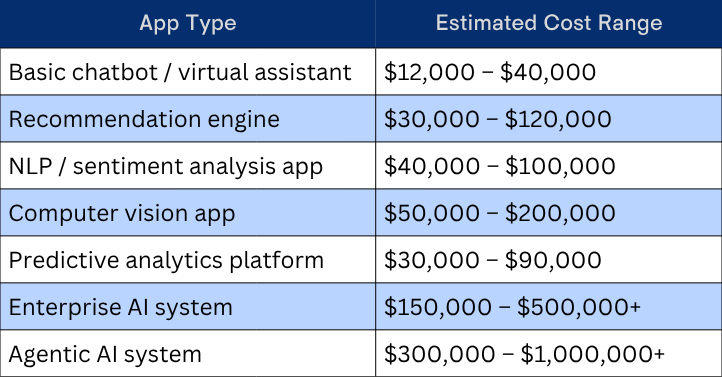
The core software development work, architecture, coding, UI/UX design, and API integration varies by team and complexity:
Implementation and Change Management
Rolling out an AI app inside an organization takes more than tech. It requires training employees, updating workflows, and managing the transition. These soft costs are real and often ignored in initial budgets.
Production and Scaling
Once live, your infrastructure costs grow with usage. Inference — the cost of running your AI in production — now accounts for roughly two-thirds of all AI compute costs in 2026. A well-optimized prompting strategy can reduce inference costs by 25–35%.
Artificial Intelligence Developers
Developer rates are one of the biggest variables in your budget.
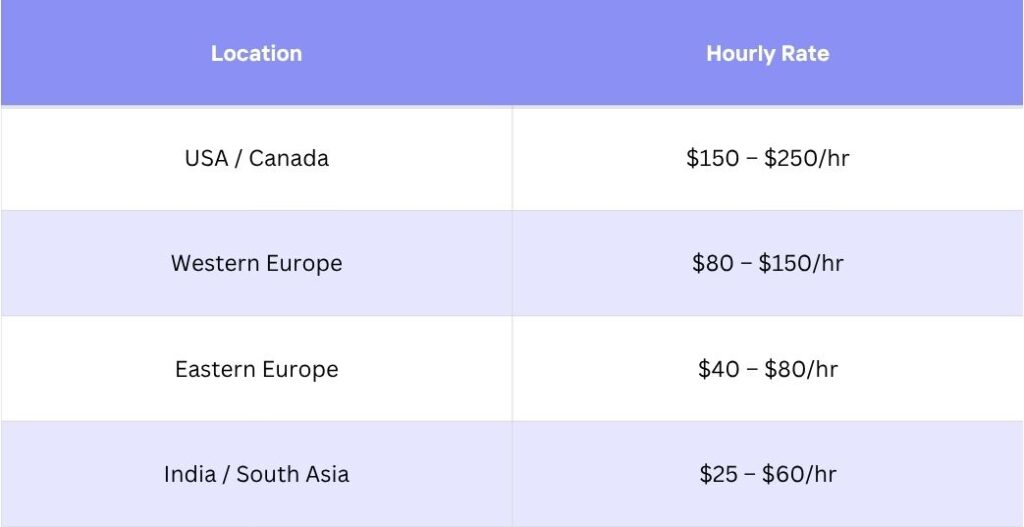
Workers with machine learning skills command a 40% wage premium over comparable software engineering roles. Specialized roles — AI/ML engineers, data scientists, MLOps engineers, often carry six-figure annual salaries in the US market.
Why 2026 Is the Best Time to Invest in AI Apps & Intelligent Markets
If you’ve been on the fence, the window for early-mover advantage is still open — but it’s closing.
Here’s why 2026 is the right moment:
- AI tools are cheaper than ever. The LLM price war among OpenAI, Google, Anthropic, and others has driven API costs dramatically lower. Smaller, specialized models are now highly capable and far more affordable to run.
- Infrastructure is more accessible. Managed cloud AI services have reduced the need for expensive on-premise hardware.
- The competitive gap is widening. With 88% of companies already using AI in at least one business function, businesses that wait are falling further behind.
- Generative and predictive AI technologies are projected to contribute $2.6 trillion to $4.4 trillion in annual global economic value across industries.
- Government and regulatory frameworks are maturing, making compliance planning more predictable in most markets.
The cost of catching up increases with the length of time you wait.
Which Factors Have the Biggest Impact on AI App Development Cost?
Now that you understand the cost components, let’s look at which factors move the needle most.
Scope and Complexity of the App
More features = higher cost. An AI chatbot that handles basic FAQs is fundamentally different from one that performs sentiment analysis, pulls from a CRM, and speaks multiple languages. Feature creep is the fastest way to blow a budget.
Start with an MVP (Minimum Viable Product). Build only what’s essential to validate your idea first.
Development Team and Expertise
Building with a US-based agency costs 3–5x more than partnering with an equally skilled Eastern European or South Asian team. That said, time zone friction, communication overhead, and domain expertise should all factor into your decision — not just the hourly rate.
Data Requirements
If you need custom datasets, external data licenses, or large-scale manual annotation, your data costs will dominate the budget. Projects with clean, existing internal data cost significantly less.
Technology and Tools
Building from scratch with a custom model is far more expensive than fine-tuning a pre-trained model via API. Using open-source libraries (PyTorch, Keras, scikit-learn) reduces licensing costs. The technology stack you choose has a direct impact on your total spend.
Integration with Existing Systems
Connecting your AI app to legacy systems, CRMs, ERPs, or external databases takes engineering effort. The more integrations required, the more the project costs. Regulated industries face additional overhead for compliance with GDPR, HIPAA, PCI-DSS, and similar frameworks.
Monitoring & Analytics
Production AI apps need dashboards to track model performance, accuracy drift, usage patterns, and cost consumption. Building or integrating monitoring infrastructure is a real line item that grows in importance as your app scales.
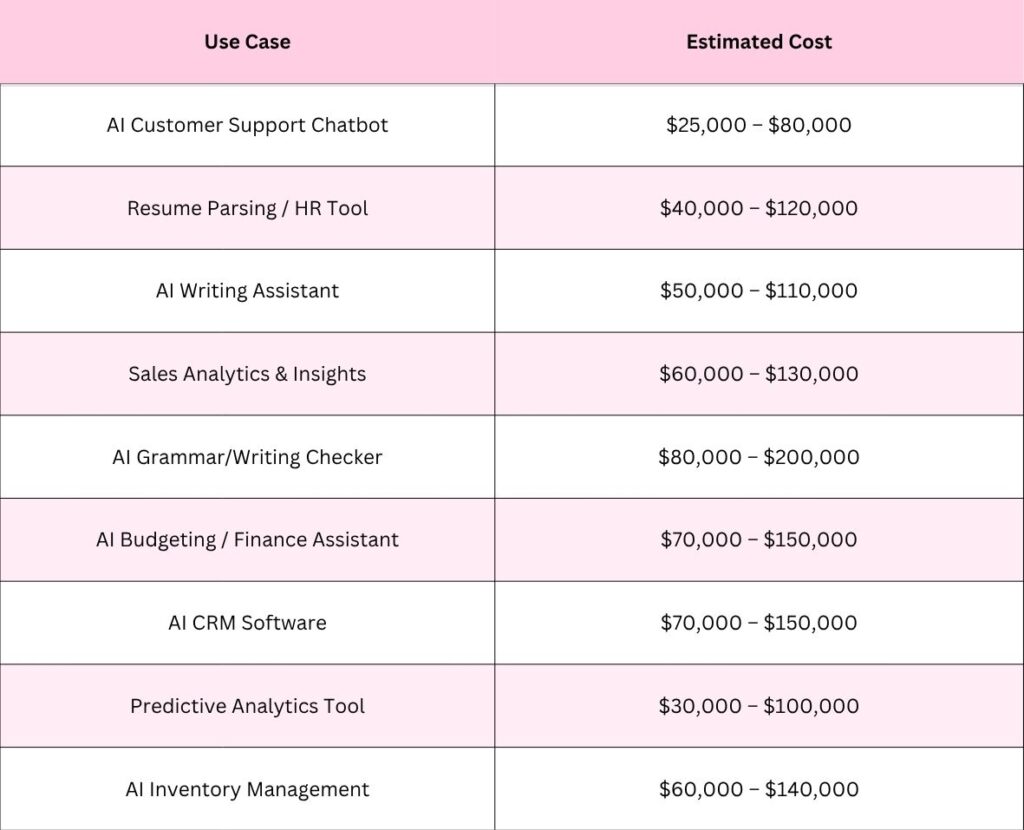
Use-Case Based AI App Development
Costs shift dramatically depending on your specific use case. Here’s a practical reference:
Which Industry Pays the Most for AI App Development in 2026?
Industry context changes everything. Compliance, data sensitivity, and technical complexity vary massively by sector.
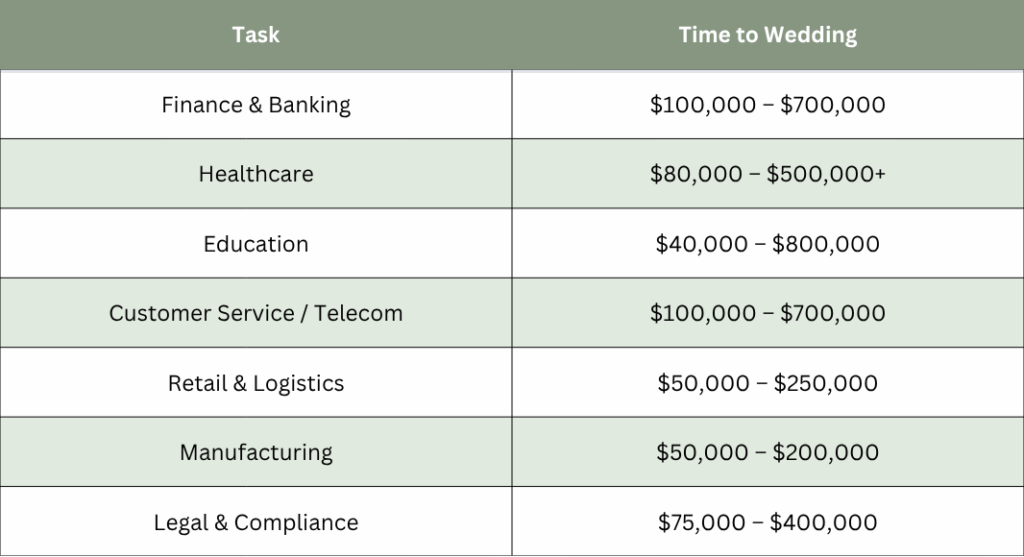
Finance and healthcare consistently sit at the high end. Fraud detection and risk-scoring models require high accuracy and regulatory compliance under PCI-DSS and MiFID II. Healthcare apps must meet HIPAA standards and often require human-in-the-loop validation infrastructure — which can add 20–30% to base development costs.
What Are the Hidden Factors That Affect AI App Development Cost?
These are the costs that most project plans ignore. They’re also the ones that blow budgets.
Data Privacy and Security
Apps handling sensitive user data in healthcare, finance, or personal services require advanced security — encryption, audit trails, access controls, and breach response infrastructure. Compliance audits alone can add significant overhead to your build. Regulatory retrofitting after development is even more expensive.
Licensing Fees for AI Models and APIs
Third-party AI model fees are usage-based. A sudden spike in user activity can double your monthly bill. Businesses in 2026 are increasingly implementing AI FinOps — actively monitoring API calls, optimizing GPU usage, and setting spending limits to prevent runaway costs.
Scalability and Infrastructure
Building for 100 users and building for 100,000 users are different problems. Infrastructure costs don’t scale linearly. Plan for growth from the start. Retrofitting scalability is expensive and disruptive.
Continuous Iteration and Model Improvement
AI apps are never truly “done.” User behavior changes. Data patterns shift. New features get requested. Budget for ongoing iteration — not just post-launch maintenance.
AI Model Training and Computational Resources
If your model requires retraining as new data comes in, ongoing compute costs are part of your operational budget forever. Production-grade AI systems need retraining schedules, data pipelines, and monitoring workflows built in from the beginning.
Development Costs of Top AI Business Applications
Real-world benchmarks help set expectations. Here’s what building AI-powered equivalents of known platforms actually costs:
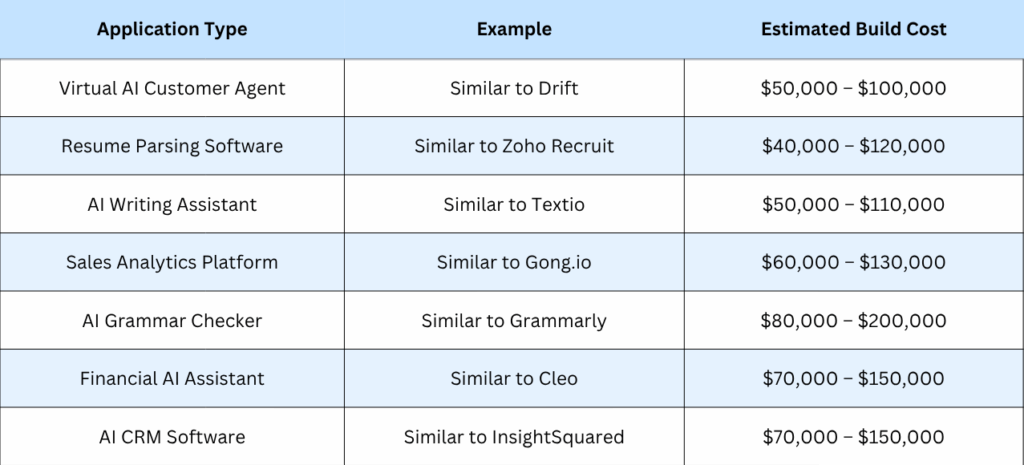
These are benchmarks — not quotes. Your specific requirements, data, and team will move the final number.
How to Optimize AI App Development Cost
You don’t have to spend more to build better. Smart planning reduces cost without reducing quality.
Using Pre-built AI Models and APIs
This is the single most effective cost-reduction strategy for most projects. Instead of training a model from scratch, plug into existing APIs, OpenAI, Google Cloud AI, Anthropic Claude, AWS AI services.
You pay per token or per request. This keeps upfront costs low and lets you validate product-market fit before investing in custom infrastructure.
Agile Development Methodology
Agile enables you to develop in brief, targeted sprints. You test and validate before adding new features. This prevents overbuilding and keeps scope and cost under control.
Start with an MVP. Launch fast. Learn from real users. Then build what actually drives value.
Cloud Services and Infrastructure
Managed cloud AI services (AWS SageMaker, Google Vertex AI, Azure ML) remove the need for expensive on-premise infrastructure. They also offer built-in scaling, so you only pay for what you use.
Audit cloud usage regularly. Unmonitored cloud bills grow fast, especially with inference-heavy applications.
Why Choose Apptechies for Your AI App Development?
At Apptechies, we’ve built AI-powered apps across industries — from lean startup MVPs to enterprise-grade platforms. We understand that every dollar in your AI budget has to work.
Here’s what sets us apart:
- Transparent cost planning from day one — no surprise invoices
- Full-stack AI expertise — ML engineers, data scientists, and DevOps specialists under one roof
- MVP-first approach — we validate before we scale, protecting your budget at every stage
- Cross-industry experience — healthcare, fintech, retail, logistics, and more
- Ongoing support and optimization — because building the app is just the beginning
Whether you’re exploring your first AI feature or ready to build a production-grade intelligent platform, we help you make the right decisions for your specific goals and budget.
Final Thoughts
The AI app development cost in 2026 isn’t a fixed number. It’s a result of your choices — what you build, how you build it, who builds it, and how well you plan before writing a single line of code.
The good news: smart planning dramatically reduces waste. Start with a clear use case. Validate with an MVP. Use pre-built APIs where possible. Build your data strategy before your model. And always budget for maintenance, not just launch.
Businesses that spend the most are not the ones that will benefit from AI in 2026. They’re the ones spending strategically.
If you’re ready to get a realistic estimate for your AI project, start with your use case and your data — those two factors will tell you more about your budget than anything else.
Frequently Asked Questions
Q1: How Much Does It Cost To Build A Basic Ai App In 2026?
Ans: A basic AI app — such as a simple chatbot or FAQ assistant using pre-built APIs — typically costs between $12,000 and $40,000. Costs rise with custom AI model development, complex integrations, and advanced features like NLP or computer vision.
Q2: What Is The Biggest Hidden Cost In AI App Development?
Ans: Data preparation is the most commonly underestimated cost. It accounts for 25–40% of total project budgets. Ongoing model maintenance (15–25% of initial cost annually) and compliance in regulated industries are the next biggest surprises.
Q3: How Long Does It Take To Build An AI App?
Ans: A simple MVP can be built in 4–8 weeks. Mid-complexity apps typically take 3–6 months. Enterprise-scale systems with custom model training and deep integrations can take 9–18 months or more.
Q4: Is It Cheaper To Hire An In-house Team Or Outsource AI Development?
Ans: Outsourcing — especially to Eastern Europe or South Asia — can reduce development costs by 40–60% compared to US-based in-house teams. However, in-house teams offer more control and faster iteration. The right choice depends on your project complexity, timeline, and long-term roadmap.
Q5: Do AI Apps Require Ongoing Costs After Launch?
Ans: Yes, and this is critical to budget for. AI apps require cloud infrastructure, model retraining, performance monitoring, security updates, and iterative improvements. Plan for 15–25% of your initial development cost annually as your ongoing operational budget.