
You have picked an agency and a contract lands in your inbox. It decides who pays when estimates turn out wrong, when you can walk away, and whether the code you paid for is actually yours.
This guide is for US founders and product owners about to hire an app agency. It covers pricing models, payment milestones, what US copyright law says about who owns custom code, a clause checklist and red flags. If you are still deciding whether to outsource at all, start with our build vs buy vs outsource decision guide, and if you still need to collect proposals, our guide to writing a software development RFP covers that step.
Not legal advice
This article is general information about US contracts and copyright, written for buyers. It is not legal advice. Laws differ by state and situation, so have a lawyer licensed in your state review your contract before you sign it.
What an App Development Contract Actually Contains
An app development contract is usually two or three documents, not one:
- Master services agreement (MSA): the legal terms that apply to all work, such as IP, confidentiality, warranties, liability, termination and governing law. It rarely changes between projects.
- Statement of work (SOW): the project itself, meaning deliverables, milestones, acceptance criteria, the named team, the price structure and the change process. A new phase usually means a new SOW.
- Schedules and attachments: the product spec or backlog, your RFP, the agency's proposal, rate cards and any data processing terms.
The most common gap is a vague SOW. A line like "build an iOS and Android app with user login and payments" can be read two ways by two honest people. Attach the scope that was actually discussed (screens, user roles, integrations, platforms and OS versions) so the sales conversation becomes enforceable.
Fixed Price vs Time and Materials vs Dedicated Team
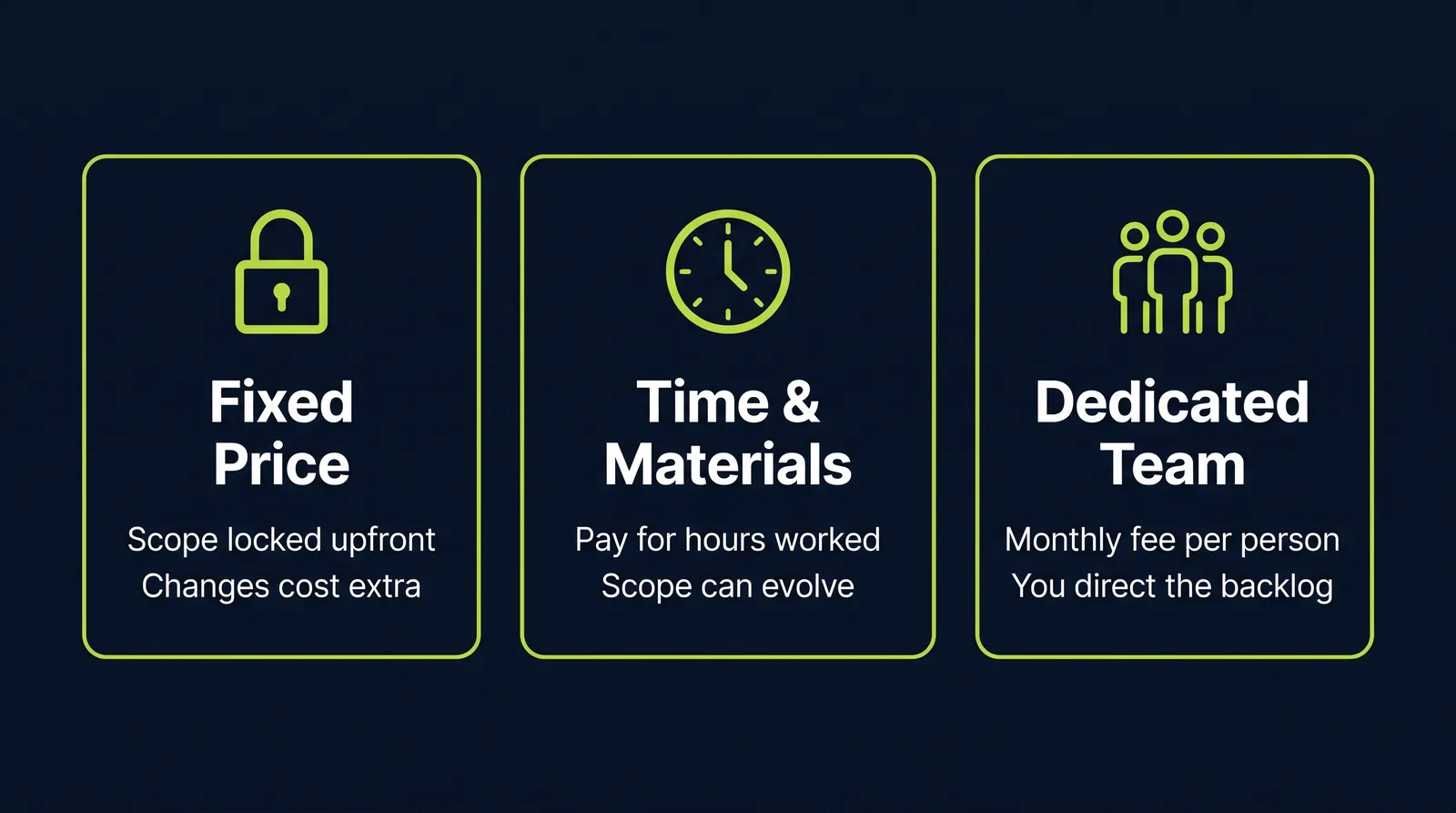
The pricing model decides who carries the risk of the estimate being wrong. US federal procurement rules give clean definitions that are useful outside government too. A firm-fixed-price contract under FAR 16.202-1 is "not subject to any adjustment" based on the contractor's actual costs and puts "maximum risk and full responsibility for all costs" on the contractor. A time-and-materials contract under FAR 16.601 pays for hours at agreed rates, is meant for work where nobody can estimate the extent or duration with reasonable confidence, and must include a ceiling price that the contractor exceeds at its own risk.
App development pricing models compared
| Factor | Fixed price | Time and materials | Dedicated team | Milestone hybrid |
|---|---|---|---|---|
| How you pay | Agreed total, split by milestone | Hours worked at agreed rates, usually billed every two to four weeks | Monthly fee per team member | Fixed fee for discovery, then capped time and materials or fixed sprints |
| Who carries estimate risk | Mostly the agency, which prices that risk in | Mostly you, limited by the cap | You | Shared |
| Scope flexibility | Low; every change needs a change order | High | High; you set priorities | Medium; scope is reset after discovery |
| Best fit | Small, fully specified builds | Evolving products with an engaged product owner | Ongoing development over many months | Most new apps going from idea to first release |
| Contract must include | Detailed spec, acceptance criteria, change process | Rate card, ceiling price, timesheets, demo cadence | Named roles, replacement terms, notice period | Discovery deliverables, re-estimate rule, cap per phase |
Fixed price
A fixed price works when the scope is small and genuinely settled: a well-specified MVP with designs already approved, or a contained feature for an existing app. Because the agency carries the risk, it adds a buffer you pay even if nothing goes wrong, and anything not written in the spec becomes a paid change order.
Time and materials
Time and materials suits products whose requirements will change once real users see them. Its flexibility only works with controls. Ask for a monthly or per-phase cap, timesheets by person and task, a working build at least every two weeks, and the right to stop at the end of any sprint. Our overview of software development methodologies explains why agile delivery and open-ended scope pair naturally, and why the Agile Manifesto values "customer collaboration over contract negotiation" without saying the contract does not matter.
Dedicated team
With a dedicated development team you pay a monthly fee for named people who work only on your product, and you or your product manager set the priorities. It is closer to staffing than to a project contract, so the key clauses are about people: who is on the team, how fast a departing engineer is replaced, notice periods, and who owns what they produce. It fits a live product with a steady backlog. If you only need one or two extra engineers, it can be simpler to hire mobile app developers on a monthly basis.
Milestone hybrid
For a new app, the most honest structure is usually a hybrid. You pay a fixed fee for a short discovery phase that produces user flows, wireframes, an architecture outline and a backlog with estimates. Then the build is priced against that output, either as fixed-price milestones or capped time and materials. A paid mobile app consulting and discovery engagement also gives you an exit point: the discovery outputs should be yours, so you can take them to another agency if the build quote does not work for you.
How to Choose the Right Pricing Model for Your App
Choose by how much you know today, not by which model sounds safest. Three questions settle most cases:
- Could you hand an agency approved designs and a written spec today? If yes, fixed price is realistic. If no, fund discovery first.
- Will someone on your side review builds and make product decisions every week? Time and materials and dedicated teams depend on it.
- Is this a single release or a product you will keep building? A single release fits a project contract. Ongoing work fits a dedicated team after launch.
Apptechies' published ranges for mobile apps are $40,000 to $80,000 for an MVP over 3 to 4 months, $80,000 to $200,000 for a full-featured iOS and Android app over 4 to 6 months, and $200,000 to $400,000 for complex or enterprise apps over 6 to 9 months. Those are typical ranges from past projects, not a quote; a fixed estimate follows a free scoping call. For how features, platforms and integrations move those numbers, see our mobile app development cost guide and our breakdown of how much it costs to build an app.
For time-and-materials and dedicated team work, Apptechies' published developer rates are $20 to $35 per hour for junior developers, $35 to $55 for mid-level, $55 to $80 for senior, and $80 to $100 for leads, architects and AI/ML specialists. As an illustration only, a small dedicated team of one senior developer, two mid-level developers and one junior developer working about 160 hours a month each would cost roughly $23,200 to $36,000 per month at those rates. That is arithmetic on a rate card, not a quote.
Who Owns the Code: IP Ownership Under US Law
Under US law, paying for custom code does not automatically make you its owner. Copyright vests initially in the author of the work under 17 U.S.C. section 201(a), and when an agency's engineers write your app, the author is the agency, not you.
Work made for hire is narrower than it sounds
Many contracts say the app is a "work made for hire." The definition in 17 U.S.C. section 101 covers two situations only: work prepared by an employee within the scope of employment, and specially commissioned work that falls into one of nine listed categories (such as a contribution to a collective work, part of an audiovisual work, a translation or a compilation), and only "if the parties expressly agree in a written instrument signed by them." An agency is not your employee. In Community for Creative Non-Violence v. Reid, the Supreme Court held that whether someone is an employee depends on the general common law of agency, and that a commissioned independent contractor's work is a work for hire only if it fits the commissioned-work categories.
A stand-alone app does not clearly fit any of those categories, so the work-for-hire label alone is a weak foundation. That is why well-drafted contracts pair it with an assignment.
Get a written assignment
Under 17 U.S.C. section 204(a), a transfer of copyright ownership is not valid unless it is in writing and signed by the owner of the rights or its authorized agent. In practice your contract should contain a present assignment ("hereby assigns") of all rights in the code, designs, documentation and other deliverables created for you. Three details matter:
- Timing: IP should pass to you as each milestone is paid, not only on "full and final payment." Otherwise a dispute over the last invoice leaves you without rights to everything built so far.
- Chain of title: the agency can only assign what it owns. Ask it to confirm that every employee and subcontractor on your app has assigned their rights to the agency, and that subcontractors need your approval.
- Background IP: agencies reuse their own libraries and tools, which often saves you money. The contract should list that material and give you a perpetual, royalty-free license to use it in your app.
Copyright protects code, not your idea or business method. If you think part of your app is patentable, that is a separate process; our article on patenting an app idea covers the basics.
Open source and third-party components
Every app uses open-source libraries, and their licenses travel with them. Copyleft licenses can cause trouble. The GNU project's own GPL FAQ says "you cannot incorporate GPL-covered software in a proprietary system." Ask for a list of third-party components and their licenses at each release, plus a warranty that nothing in the delivered code restricts your commercial use.
Accounts, Credentials and Handover
Owning the code is not the same as being able to run your app. Get the accounts right before the first line of code:
- App store accounts: enroll your own company in the Apple Developer Program and Google Play Console, then invite the agency as users. Our guide to App Store and Google Play requirements covers what each store expects from you.
- Code repository: the Git repository should sit in your organization's account, with the agency given access, so you can see every commit as it happens.
- Cloud, domain and third-party services: hosting, the domain, email delivery, analytics, payment providers and push notification keys should all be billed to and owned by you.
- Keys and secrets: signing keys, API keys and production passwords should be stored in a vault you control, and rotated when the engagement ends.
Moving an app later is possible but slow. Apple's app transfer process needs the sending Account Holder to start the transfer and the receiving Account Holder to accept it, with extra steps for subscriptions and other features. Google's process to transfer apps to a different developer account requires both accounts to be active and linked services such as Firebase to be updated by hand. Publishing from your own account from the start avoids all of that.
Write handover into the contract too: documented source code, build and deployment instructions and a knowledge-transfer session, delivered at the end or on early termination.
Payment Schedules and Milestones
A good payment schedule pays for accepted work and never runs far ahead of it. Large deposits shift risk onto you; payments without an acceptance step turn invoices into arguments.
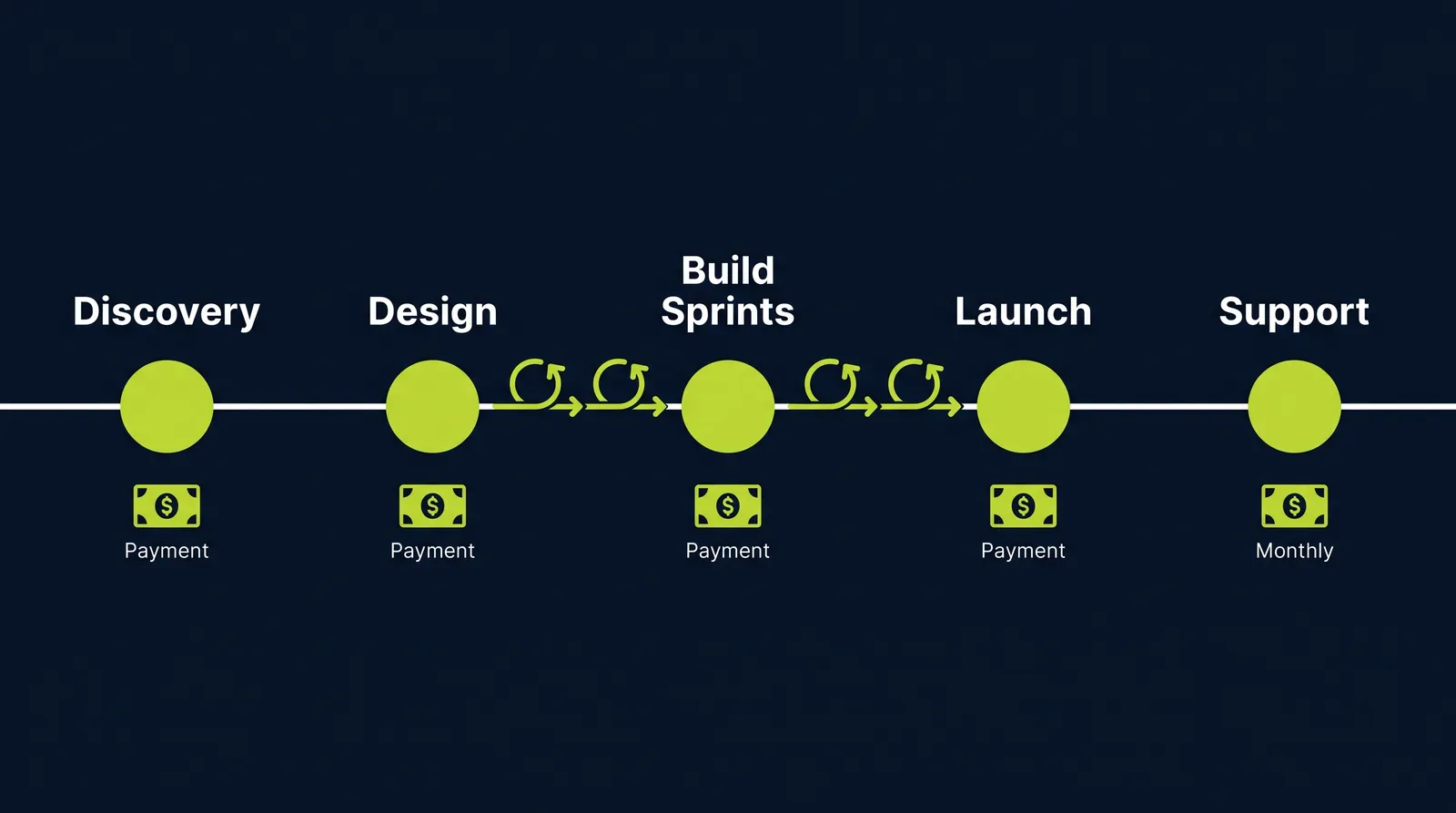
Each milestone in the SOW should name the deliverable, the acceptance criteria and the review window. "Design complete" is not a deliverable. "Clickable prototype of the 24 screens listed in Schedule A, approved in writing by the product owner" is. Give yourself a defined review period, such as five to ten business days, and say what happens if you neither accept nor reject in that time.
Here is an illustrative milestone hybrid for a $120,000 full-featured app, a figure inside the published $80,000 to $200,000 range for that tier. The split shows the structure only; it is not an Apptechies quote or an industry standard.
- Discovery and design, 15 percent ($18,000): user flows, clickable prototype, architecture outline and estimated backlog accepted.
- Build block 1, 20 percent ($24,000): accounts, onboarding and the core flow working on test devices.
- Build block 2, 20 percent ($24,000): payments, integrations and the admin panel working end to end.
- Build block 3, 20 percent ($24,000): a feature-complete build that passes the agreed test plan.
- Launch, 15 percent ($18,000): apps approved in both stores under your accounts and the handover package delivered.
- End of warranty, 10 percent ($12,000): no open critical defects when the warranty period ends.
Holding back the last 10 percent until the warranty period ends keeps both sides focused on fixing launch defects. Testing is part of acceptance, so ask how the agency's quality assurance process works and which devices it tests on. For a sense of how these phases run in practice, our delivery process describes the stages we use, and our article on the mobile app development process explains each phase in more detail.
App Development Contract Clause Checklist
Use this table as a review list when the draft arrives. It does not replace legal review, but it helps you ask the right questions first.
Clauses to check before you sign
| Clause | What good looks like | Question to ask |
|---|---|---|
| Scope and deliverables | Spec, designs or backlog attached as a schedule; exclusions listed | What is explicitly not included? |
| Pricing and invoicing | Model stated, rate card attached, cap for time and materials, payment terms in days | What is the most I can be billed for this phase? |
| Acceptance | Written criteria per milestone, review window, defect severity levels | What happens if I find a defect during review? |
| Change requests | Written request, estimate of cost and time impact, approval before work starts | Who can approve a change on my side? |
| IP assignment | Present assignment of all deliverables, passing on payment of each milestone | Do all your staff and subcontractors assign their rights to you? |
| Accounts and credentials | All accounts in the client's name; secrets in a client-controlled vault | Whose name is on the developer accounts? |
| Warranty and support | Defect-fix period after launch at no charge; separate support terms after that | What counts as a defect versus a new feature? |
| Security and data | Access controls, data handling and breach notification duties | Who can access production user data? |
| Termination | Exit for convenience with notice; pay only for work done; full handover | What do I receive if we stop after sprint two? |
| Liability and disputes | Reasonable caps, governing law and venue you can live with, escalation before litigation | Which state's law governs, and where would a dispute be heard? |
Security terms deserve a closer look if your app handles payments, health or other sensitive data. Ask the agency to describe its controls in writing; our security practices page shows the kind of detail you should expect from any partner. If the agency is offshore, read our take on offshore software development for the time-zone, governing-law and communication terms worth adding.
Red Flags in an App Development Contract
Some terms tell you something about the agency. Treat these as reasons to slow down, and walk away if the agency refuses to discuss them.
Contract red flags and what to ask for instead
| Red flag | Why it matters | Ask for instead |
|---|---|---|
| IP passes only on "full and final payment" | One disputed invoice leaves you owning nothing | Assignment as each milestone is paid |
| Agency keeps the app store or cloud accounts | You cannot ship, fix or move the app without them | Accounts in your company name, agency invited as users |
| No acceptance criteria | Every milestone becomes a debate | Written criteria and a review window per milestone |
| Uncapped time and materials | Budget can drift without any trigger to stop | A ceiling per phase and a right to pause |
| Large upfront payment for a fixed price build | You fund work long before you can check it | Payments tied to accepted deliverables |
| Code delivered only at the end | You cannot check quality or recover if the agency fails | Repository access in your account from day one |
A competent agency will have reasonable answers to all of these without much pushback. Our guide on how to choose a software development company lists the questions to ask during selection, and our Android app development company checklist adds platform-specific points such as signing keys.
From Signed Contract to Kickoff
A good contract is a plan both sides follow. Before kickoff:
- Create the accounts in your company's name and invite the agency: repository, app stores, cloud and analytics.
- Agree who approves milestones and change requests on your side, and put that name in the SOW.
- Schedule the demo cadence and the first milestone review in the calendar now.
- Plan for after launch: support terms, a maintenance budget and who will own the roadmap.
If you want to compare how a project contract and an ongoing team would work for your app, our software development outsourcing services cover project-based engagements, and our page on mobile app development for US companies explains how we structure US engagements, from discovery through launch and support.